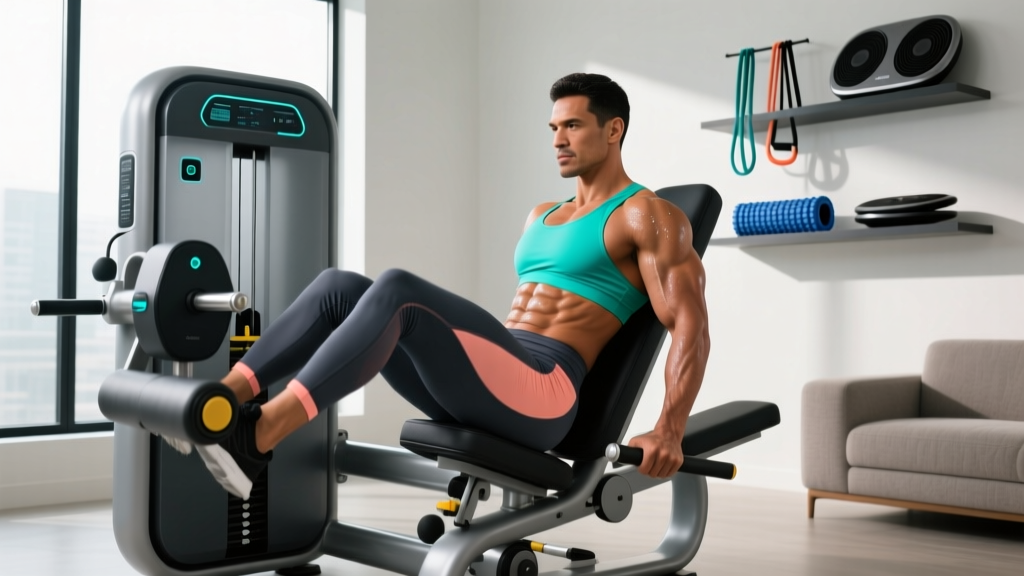
Hip Thrust Pads vs DIY Leg Press Machine: Budget Breakdown
Compare the cost and value of dedicated hip thrust machines, barbell pads, and building a DIY leg press machine for optimal glute training.

The True Cost of Dedicated Hip Thrust Machines
Glute hypertrophy has dominated fitness programming over the last decade, and the barbell hip thrust remains the undisputed king of posterior chain development. However, as home gym builders and commercial facility owners look to optimize their leg training equipment in 2026, a major budgetary dilemma emerges: Is a dedicated hip thrust machine worth the massive financial investment, or are you better off utilizing barbell pads, or even attempting to build a DIY leg press machine to mimic the resistance profile?
To make an informed decision, we must break down the exact market pricing, the biomechanical realities, and the hidden costs of each approach.
Commercial vs. Home Gym Machine Pricing
The market for dedicated hip thrust machines has matured significantly. Entry-level plate-loaded models from brands like Titan Fitness or Valor Fitness typically range from $800 to $1,400. These units feature basic pivot points and standard vinyl padding. While functional, they often suffer from belt slip and limited range-of-motion adjustments.
On the premium end, the industry standards are the Nautilus Glute Drive (often retailing between $3,800 and $4,500) and the Prime Fitness Hip Thrust (hovering around $4,200). These machines utilize gas-strut assistance, patented cam systems to maintain constant tension on the gluteus maximus through the entire concentric phase, and heavy-duty contoured padding. For a commercial gym, this is a justifiable ROI. For a home gym, it is a massive capital expenditure that forces us to look at alternatives.
Barbell Pad Options: A Tiered Budget Analysis
If a $4,000 machine is out of the question, the traditional barbell hip thrust is the default. However, the barbell will aggressively compress the anterior superior iliac spine (ASIS) and surrounding soft tissue without proper padding. Here is how the current pad market breaks down in terms of budget and value.
| Pad Category | Material & Design | Avg. Cost (2026) | Durability | Comfort Rating |
|---|---|---|---|---|
| Standard Cylindrical | Low-density EVA foam, nylon cover | $12 - $18 | Low (Flattens after 3 months) | 3/10 |
| Reinforced Core | High-density PU foam, velcro closure | $25 - $35 | Medium | 6/10 |
| Contoured Ergonomic | Multi-density foam, PU leather, pelvic cutout | $55 - $85 | High | 9/10 |
| Specialized Belt Pad | Neoprene/Leather hybrid, wraps around lifting belt | $90 - $130 | Very High | 10/10 |
Value Winner: The contoured ergonomic pad (such as the Rogue Fitness Hip Thrust Pad or similar third-party equivalents) offers the best intersection of price and performance. At roughly $65, it eliminates the bruising associated with heavy loads (400+ lbs) without requiring a dedicated machine.
The DIY Leg Press Machine: Budget Hack or Safety Hazard?
Many home gym owners, deterred by the high price tag of commercial glute drivers and seeking a more stable alternative to the barbell, turn to the internet searching for a diy leg press machine blueprint. The idea is to build an angled, linear-bearing sled that can be used for both leg presses and modified hip thrusts. But does the math actually work out?
⚠️ CRITICAL SAFETY WARNING: Building a DIY leg press machine introduces severe shear-force liabilities. According to the U.S. Consumer Product Safety Commission (CPSC), homemade weight-bearing fitness equipment accounts for a disproportionate number of catastrophic crush injuries in home environments due to uncalculated load-bearing limits on wooden or lightly welded joints.Material Cost vs. Hidden Liabilities
Let us break down the actual cost of building a safe, functional DIY leg press machine using 80/20 aluminum framing, linear shafts, and steel weight horns:
- 80/20 Aluminum Extrusion (Base & Tower): $250 - $400
- Linear Bearings & Hardened Steel Shafts: $120 - $180
- Steel Footplate & Welding/Hardware: $150 - $250
- Upholstery & High-Density Foam: $80 - $120
Total Estimated Build Cost: $600 to $950.
While this is cheaper than a $4,000 Nautilus Glute Drive, it is significantly more expensive than a $65 barbell pad and a standard flat bench. Furthermore, a DIY leg press machine requires precise engineering to ensure the sled does not bind on the linear rails when loaded asymmetrically. If a user pushes harder with their right leg during a heavy set, the resulting torsional stress can snap standard linear bearings, sending the sled crashing down.
Biomechanical ROI: Hip Thrust vs. Angled Press
When evaluating leg training equipment, we must look at the biomechanical return on investment. The primary reason lifters seek out a DIY leg press machine for glute work is the belief that an angled press mimics the hip thrust. Biomechanically, this is flawed.
According to research published in the Journal of Strength and Conditioning Research, the hip thrust maximizes gluteus maximus activation at the shortened muscle length (full hip extension) because the resistance vector is perpendicular to the torso. In contrast, a leg press—even a DIY angled sled—applies resistance axially through the femur. While the leg press heavily recruits the quadriceps and glutes in the lengthened position (deep flexion), it fails to provide the peak contraction stimulus at lockout that the hip thrust provides.
Therefore, spending $800 and 40 hours of labor to build a DIY leg press machine will yield a movement pattern that is biomechanically inferior for targeted glute isolation compared to a simple barbell hip thrust performed with a high-quality contoured pad. For a comprehensive leg day, a standard commercial 45-degree leg press (which can be found used for $800-$1,200) is a vastly superior and safer investment than a homemade contraption.
Proper Setup for the Barbell Hip Thrust
If you opt for the barbell and pad route, proper setup is non-negotiable to protect your lumbar spine. The Exercise Prescription database (EXRX) notes that the bench height should ideally be 14 to 16 inches. A standard 18-inch gym bench forces excessive lumbar extension at the top of the movement. If your bench is too high, use a set of rubber bumper plates under the bench legs to lower it, or place a thick mat under your feet to alter the starting geometry.
Final Value Verdict: Where Should Your Money Go?
When conducting a strict budget breakdown for lower-body equipment, the hierarchy of value becomes exceptionally clear:
- The Absolute Best ROI ($65 - $150): Purchase a premium contoured barbell hip thrust pad and a specialized lifting belt. Use your existing flat bench and barbell. This provides 95% of the glute-building stimulus of a $4,000 machine for less than 5% of the cost.
- The Mid-Tier Investment ($800 - $1,500): Buy a dedicated, plate-loaded hip thrust attachment (like the Titan Fitness Glute Drive Attachment) that pins into your existing power rack, or purchase a used commercial 45-degree leg press to complement your barbell thrusts.
- The Money Pit (Avoid): Building a DIY leg press machine. The material costs approach $1,000, the engineering risks are severe, and the biomechanical output does not replicate the hip thrust vector. It is a trap that wastes both capital and garage space.
Ultimately, smart budget allocation in the home gym means prioritizing free-weight versatility and high-quality contact points (like pads and grips) over attempting to engineer complex, single-use cable or sled machines from scratch. Stick to the barbell, invest in premium foam, and direct the rest of your budget toward progressive overload.
More gear to consider
All reviews
Calf Raises: Standing vs Seated Form & Leg Press Machine Images

Hack Squat vs Leg Press: Installation & Leg Press Machine Placement
Titan Leg Press Machine vs. Bells of Steel: 2026 Home Gym Showdown
How to Unlock Leg Press Machine Limits: Space-Saving Squat Racks

Horizontal Leg Press Machine Calf Raises vs Standing & Seated