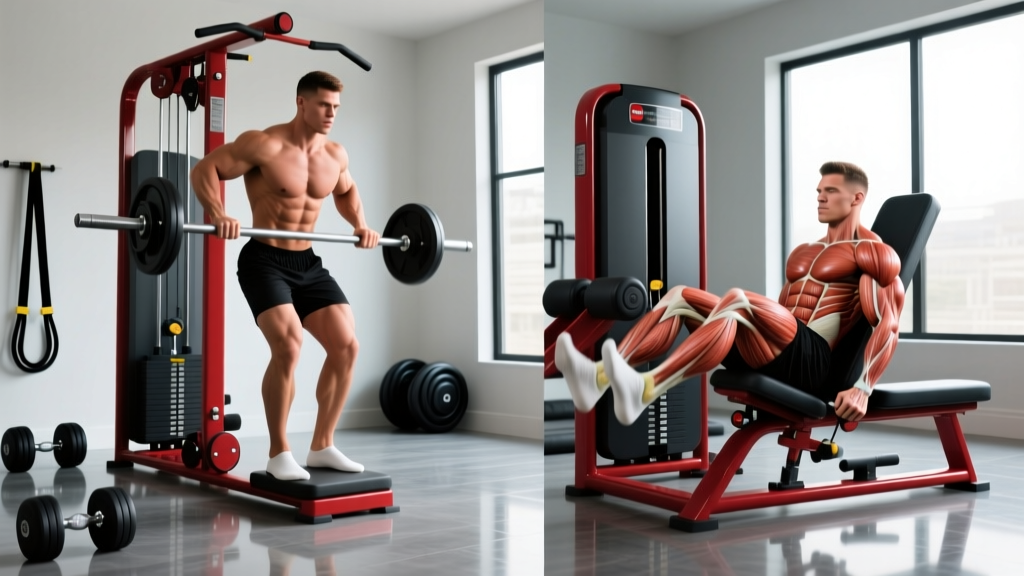
Calf Raises Standing vs Seated: Horizontal Leg Press Machines
Fix common calf training mistakes. We troubleshoot standing vs seated calf raises and the risks of using horizontal leg press machines for calves.

The Kinesiology of the Triceps Surae: Standing vs. Seated
When building a comprehensive lower-body training program, understanding the biomechanical distinction between standing and seated calf raises is non-negotiable. The calf complex, primarily composed of the triceps surae (the gastrocnemius and the soleus), responds to knee joint angles in highly specific ways. According to the kinesiology databases at ExRx.net, the gastrocnemius crosses both the knee and the ankle joint. This means it is most heavily recruited when the leg is completely straight (standing). Conversely, the soleus only crosses the ankle joint; it becomes the primary mover when the knee is flexed to 90 degrees (seated).
Troubleshooting calf hypertrophy and strength plateaus almost always begins with evaluating whether the lifter is utilizing the correct knee angle for their specific weak point. However, a massive trend in commercial and home gyms involves attempting to bypass dedicated calf machines entirely by improvising on multi-purpose equipment. This brings us to one of the most debated and potentially dangerous substitutions in modern fitness: using horizontal leg press machines for calf extensions.
The Danger Zone: Using Horizontal Leg Press Machines for Calves
In 2026, many high-end commercial facilities are optimizing floor space by removing single-joint isolation machines. Consequently, lifters frequently turn to horizontal leg press machines to perform their calf work. While a leg press calf raise is technically a 'seated' variation (because your hips and knees are bent, albeit not at a strict 90-degree angle like a dedicated seated calf machine), the horizontal vector introduces severe mechanical and safety flaws that must be troubleshooted immediately.
⚠️ CRITICAL SAFETY WARNING: Never perform calf raises on horizontal leg press machines without the safety stop pins engaged exactly one inch below your maximum dorsiflexion depth. A slipped footplate under 400+ lbs of horizontal sled pressure can cause catastrophic ankle inversion, severe Achilles tearing, and crushed metatarsals.Mistake 1: The Sled Slip and Leverage Failure
The most common failure mode on a horizontal leg press is foot slippage. Dedicated standing calf machines utilize a textured, knurled steel block with a raised lip to lock the ball of the foot in place. Horizontal leg press footplates are typically smooth diamond-tread aluminum or rubber-coated steel designed for flat-footed pressing. When you elevate your heels and press with only your toes, the rotational torque combined with the horizontal weight vector frequently causes the foot to slip upward, sending the heavy sled crashing down the rails.
Mistake 2: Rail Friction and the Bottom Stretch
Vertical linear bearing machines (like a Smith machine or dedicated standing calf block) move strictly against gravity. Horizontal leg press machines, however, rely on sled rails or bushings. When you perform a calf raise on a horizontal sled, the extreme plantarflexion at the top of the movement shifts the center of gravity, causing the sled wheels or bushings to bind against the guide rails. This 'sticking point' creates artificial friction, robbing you of the deep, loaded dorsiflexion stretch required to trigger mechanotransduction and muscle growth.
Mistake 3: Lumbar and Hip Flexor Compression
To get a full range of motion on a horizontal leg press, lifters often slide their glutes forward to the edge of the seat pad. This posterior pelvic tilt, combined with heavy horizontal resistance, places immense shearing force on the lumbar spine and compresses the hip flexors, turning an isolation movement into a painful lower-back endurance test.
Dedicated Units: Standing vs. Seated Calf Raise Machines
If you are outfitting a home gym or auditing commercial equipment, dedicated machines remain the gold standard for troubleshooting calf development issues. Here is how the dedicated units compare in the current market.
Standing Calf Machines (Gastrocnemius Focus)
Standing units require the user to bear weight directly through the axial skeleton (shoulders/spine). The Hammer Strength Plate-Loaded Standing Calf (retailing around $1,450) utilizes a linear bearing system that ensures zero friction during the deep stretch phase. The shoulder pads are angled to prevent the lifter from slipping forward. Because the gastrocnemius is composed primarily of fast-twitch Type II muscle fibers, standing machines are designed for heavy, low-rep loading (5-8 reps) with long rest periods.
Seated Calf Machines (Soleus Focus)
Seated units lock the knee at a 90-degree angle, entirely removing the gastrocnemius from the movement and isolating the soleus. The Body-Solid Pro Dual Seated Calf Raise (SCL-400) (approximately $1,850) features a stack-loaded cam system that matches the natural strength curve of the ankle joint. The soleus is highly oxidative and fatigue-resistant, meaning seated machines should be utilized for higher rep ranges (15-25 reps), drop sets, and shorter rest intervals to induce metabolic stress.
Machine Comparison and Troubleshooting Matrix
| Machine Type | Primary Target | Knee Angle | Common Error / Failure Mode | Optimal Rep Range |
|---|---|---|---|---|
| Dedicated Standing | Gastrocnemius | 180° (Straight) | Bouncing at the bottom (using Achilles elasticity) | 5 - 10 |
| Dedicated Seated | Soleus | 90° (Bent) | Thigh pads placed too close to the knee joint | 15 - 25 |
| Horizontal Leg Press | Mixed / Soleus Bias | ~135° (Partially Bent) | Foot slipping off smooth plate; rail binding | Not Recommended |
Execution Errors: Eliminating the Stretch-Shortening Cycle
Regardless of whether you are using a premium standing unit or carefully improvising on a 45-degree incline sled, the most pervasive mistake in calf training is the misuse of the stretch-shortening cycle (SSC). The Achilles tendon is incredibly thick and acts like a massive rubber band. When lifters drop their heels quickly and immediately reverse the motion, the tendon absorbs and releases the kinetic energy, meaning the actual calf muscles do very little work.
To troubleshoot this, you must implement a strict 2-second isometric pause at the bottom of every repetition (maximum dorsiflexion). This dissipates the elastic energy stored in the tendon, forcing the muscle bellies to initiate the concentric phase from a dead stop. The American Academy of Orthopaedic Surgeons (AAOS) notes that controlled, paused eccentric and isometric loading is also a primary rehabilitation protocol for Achilles tendinopathy, making this technique both a hypertrophy catalyst and an injury-prevention tool.
'If your calves are burning but not growing, you are likely training your tendons, not your muscles. Kill the momentum. Pause for two full seconds at the bottom of every single rep until the burning is replaced by deep muscle failure.'
Final Troubleshooting Checklist for Lifters and Gym Owners
- Audit Your Equipment: If your gym only has horizontal leg press machines, purchase a portable wooden calf block with a high-traction grip tape surface to place on the footplate, and always set the safety catches.
- Check the Thigh Pad (Seated): On seated machines, the pad must rest on the lower quadriceps, just above the knee. If it rests directly on the patella (kneecap), it will cause severe joint pain and inhibit force transfer.
- Footwear Matters: Never do heavy standing calf raises in soft, compressible running shoes. The foam sole absorbs the force and creates an unstable base. Train barefoot, in socks, or in flat-soled lifting shoes to ensure direct force transfer into the metatarsals.
- Frequency and Volume: The calves are accustomed to carrying your body weight all day. To force adaptation, they require high frequency. Train them 3 to 4 times per week, alternating between heavy standing days (gastrocnemius) and high-rep seated days (soleus).
By respecting the kinesiology of the lower leg and avoiding the mechanical traps of improvised equipment, you can finally break through stubborn calf plateaus and build lower-body armor that is both aesthetically impressive and functionally bulletproof.
More gear to consider
All reviews
Pendulum Leg Press Machine & Cable Leg Attachments Care

Calf Raises: Standing vs Seated Form & Leg Press Machine Images

Small Leg Press Machine for Home: 2026 Head-to-Head Test

Atlantis Leg Press Machine vs Hip Thrusts: Budget & Pad Analysis

Hack Squat vs Leg Press: Installation & Leg Press Machine Placement
