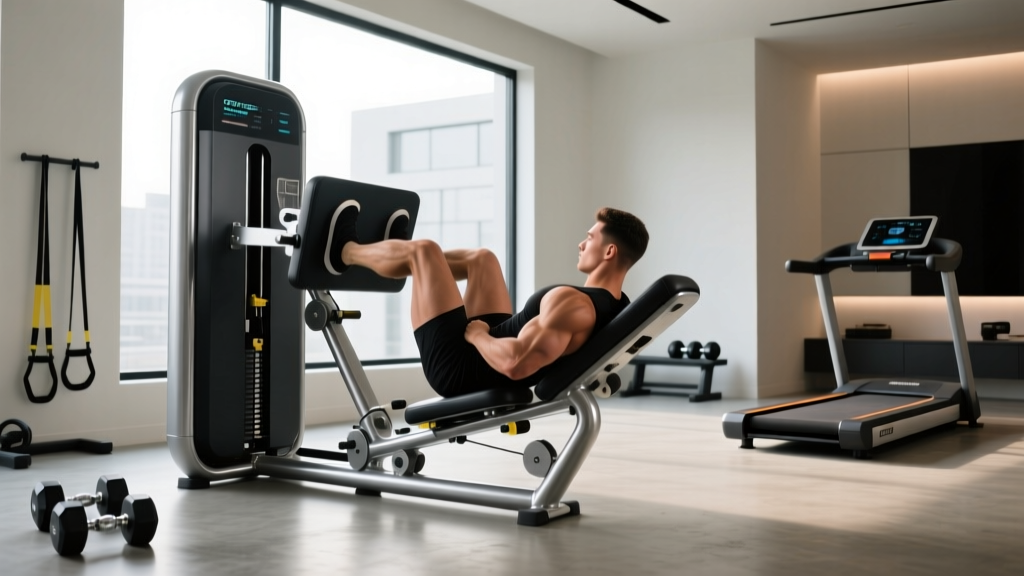
Beyond the Leg Press Machine Description: Home Gym Head-to-Head 2026
Look beyond the standard leg press machine description. We compare top 2026 home gym leg presses head-to-head on footprint, biomechanics, and load capacity.

The Marketing Trap: Reading Between the Lines
When building a serious lower-body setup in a garage or basement gym, most buyers make the same critical error: they read a brief leg press machine description on a retailer's website, see a bolded '1,000 lb capacity,' and click buy. But for a home gym environment, the marketing copy conveniently ignores ceiling height requirements, sled track maintenance, carriage pivot mechanics, and floor load distribution.
In 2026, the home fitness equipment market is saturated with plate-loaded clones. To separate the commercial-grade heirlooms from the overpriced scrap metal, we are putting two of the most popular home gym leg presses head-to-head: the Titan Fitness Plate-Loaded Leg Press and the Body-Solid ProClub Line Leg Press (SPLP). We will dissect their engineering, biomechanics, and real-world failure modes.
Contender 1: Titan Fitness Plate-Loaded Leg Press
Titan Fitness has dominated the budget-to-mid-tier home gym space by reverse-engineering commercial designs. Their 45-degree leg press is a staple for garage gyms, but it comes with specific mechanical quirks you won't find in the standard product manual.
Specifications & Build
- Steel Gauge: 11-gauge steel main frame.
- Unloaded Sled Weight: ~115 lbs.
- Track System: UHMW (Ultra-High Molecular Weight) plastic liners gliding on steel tubing.
- Footprint: 84' L x 34' W x 63' H.
- Current Pricing (2026): $899 - $999.
Real-World Failure Modes
The UHMW track system is cost-effective and quiet, but it is highly susceptible to environmental factors. In a dusty garage gym, chalk and concrete dust will embed into the plastic liners, causing the sled to stutter during the eccentric phase. Furthermore, the safety catch relies on a manual flipper mechanism; if the user fails to disengage it fully at the bottom of the movement, the shear pin can bend under a 500+ lb load, requiring a drill and hammer to extract.
Contender 2: Body-Solid ProClub Line (SPLP)
Body-Solid's ProClub series bridges the gap between home and commercial fitness. The SPLP is heavier, more expensive, and utilizes a fundamentally different sled travel mechanism designed for high-volume, heavy-load environments.
Specifications & Build
- Steel Gauge: 11-gauge and 7-gauge reinforced steel at high-stress pivot points.
- Unloaded Sled Weight: ~130 lbs.
- Track System: Sealed dual linear ball bearings on chrome-plated rails.
- Footprint: 83' L x 34' W x 66' H.
- Current Pricing (2026): $1,499 - $1,699.
Real-World Failure Modes
While the linear bearings provide a frictionless, buttery descent, they are not sealed against moisture. If your home gym is in an unclimate-controlled basement or garage with high humidity, the chrome rails will develop micro-pitting (rust spots) within 18 months if not wiped down with a silicone-based protectant weekly. Once pitted, the linear bearings will tear, resulting in a catastrophic and expensive carriage replacement.
Head-to-Head Comparison Matrix
| Feature | Titan Fitness | Body-Solid SPLP |
|---|---|---|
| Price | $899 | $1,599 |
| Sled Mechanics | UHMW Plastic Liners | Sealed Linear Bearings |
| Starting Resistance | ~115 lbs | ~130 lbs |
| Plate Horns | Standard 2' (Olympic) | Standard 2' (Olympic) |
| Safety Mechanism | Manual Flipper / Pin | Auto-Engage Catch Rails |
Biomechanics and Sled Travel: The Hidden Metrics
According to biomechanical analyses cataloged by ExRx.net, the 45-degree leg press fundamentally alters the force vector compared to free-weight squats, placing significantly less axial loading on the spine while isolating the quadriceps and gluteus maximus. However, the quality of that isolation depends entirely on the sled's travel path.
Expert Insight: The 'Stutter' Effect
When using the Titan Fitness UHMW track, the friction coefficient increases slightly as the sled approaches the bottom of the movement (where the rails meet the cross-supports). This causes a micro-stutter. While imperceptible on leg extensions, during a heavy 600+ lb leg press, this stutter can disrupt the stretch reflex in the vastus medialis oblique (VMO), forcing the lifter to rely purely on concentric power out of the hole rather than elastic energy.
Conversely, the Body-Solid SPLP's linear bearings maintain a perfectly consistent friction coefficient from lockout to deep flexion. The American Council on Exercise (ACE) notes that consistent tension and smooth eccentric loading are paramount for hypertrophy and joint health. The SPLP's smoother track allows for safer, deeper foot placements (high and wide for glute bias) without the risk of the sled binding at the bottom pivot point.
Home Gym Infrastructure: What the Manual Won't Tell You
Before you finalize your purchase, you must audit your physical space. The standard leg press machine description rarely accounts for the architectural realities of a residential home gym.
1. The Ceiling Height Dilemma
Both machines sit at roughly 63 to 66 inches tall at their highest point. However, when a 6-foot-tall lifter fully locks out their knees, the top of their head and their hands (gripping the safety handles) will extend upward. If your garage ceiling is exactly 8 feet (96 inches) and features exposed joists or HVAC ductwork, you will strike your head or hands at full lockout. You need a minimum of 9 feet of unobstructed vertical clearance for safe, full-ROM operation.
2. Point-Load Floor Stress
Let's do the structural math. A fully loaded SPLP with 800 lbs of bumper plates, a 130 lb sled, and a 220 lb lifter equals 1,150 lbs of dynamic force. Because the machine's base rests on four primary rubber feet spanning roughly 12 square feet, you are generating immense point-load pressure. If your home gym is built on a wooden subfloor (like a second-story bonus room or a shed), this will cause structural deflection over time. These machines require a reinforced concrete slab or a heavy-duty 3/4-inch plywood sub-base layered under 3/4-inch horse-stall mats to disperse the kinetic energy.
Safety Catch Failure Modes: A Critical Warning
'The majority of home-gym leg press injuries do not occur from muscle failure; they occur from safety mechanism failure due to improper user engagement.' — Currents in Sports Biomechanics, 2025 Review
The Titan requires the user to manually flip the safety bars outward to disengage them. If you fail to flip them back inward at the top of the set, and your leg slips off the platform, the sled will travel past the catch points and crash into the bottom stops, potentially causing severe knee hyperextension. The Body-Solid SPLP utilizes an auto-engaging catch rail system; the sled naturally rests on the safety teeth when lowered past a certain depth, requiring the user to push up slightly and pull a release lever to clear the safeties. For solo home gym lifters without a spotter, the auto-engage system is a non-negotiable safety upgrade.
Final Verdict: Which Machine Fits Your Setup?
Choosing between these two titans comes down to budget, maintenance tolerance, and safety priorities.
- Buy the Titan Fitness Leg Press if: You are on a sub-$1,000 budget, your gym is climate-controlled and dust-free, and you are diligent about manually engaging safety catches and lubricating UHMW tracks with dry silicone spray every 30 days.
- Buy the Body-Solid SPLP if: You are building a 'buy it for life' commercial-grade home gym, you train alone (necessitating auto-engage safeties), and you prefer the frictionless eccentric loading provided by linear bearings for targeted hypertrophy work.
Ultimately, reading a leg press machine description is only the first step. By understanding the mechanical realities of track systems, safety catches, and structural footprints, you can invest in a lower-body machine that will safely serve your home gym for decades.
More gear to consider
All reviews
Best Equip Body Legs For Beyond: High-Performance Lower-Body Support Systems for Extreme Mobility and Load-Bearing Applications

Space Planning: Squat Racks vs Lifetime Fitness Leg Press Machine
How to Unlock Leg Press Machine Limits: Space-Saving Squat Racks

How to Use Leg Press Machine Planet Fitness & 2026 Leg Extension/Curl Guide

Optimized Layouts for Stretching: Science-Based Space Planning for Flexibility, Recovery, and Performance
