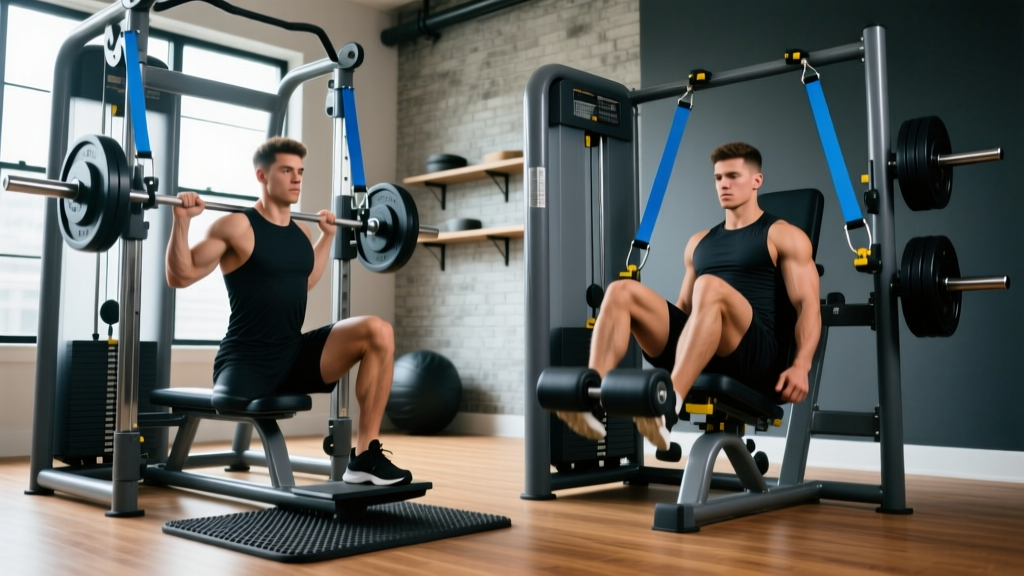
Hack Squat vs Leg Press Setup & Leg Press Machine Exercises
Compare hack squat and leg press setups, from installation footprints to biomechanics, and master essential leg press machine exercises for your 2026 gym.

The Biomechanical Divide: Hack Squat vs. Leg Press
When outfitting a commercial facility or high-end home gym in 2026, the debate between the hack squat and the 45-degree leg press remains a cornerstone of lower-body equipment planning. While both machines isolate the lower extremities and remove the stabilizing demands of a free-weight barbell back squat, their biomechanical profiles and installation requirements are vastly different. Understanding these differences is critical before you unbox the hardware and begin anchoring these multi-hundred-pound behemoths to your floor.
The hack squat enforces a fixed, inclined spinal path, typically set at a 10-degree angle from vertical. This allows for deep knee flexion while the torso remains supported, heavily targeting the quadriceps with minimal lower-back fatigue. Conversely, the 45-degree leg press places the user in a reclined, open-hip position. While it entirely removes axial spinal loading, it introduces the risk of posterior pelvic tilt (lumbar flexion) at the bottom of the range of motion if hamstring flexibility is inadequate.
Expert Insight: According to the National Strength and Conditioning Association (NSCA), closed-chain machine movements like the hack squat produce higher vastus lateralis activation compared to the leg press, largely due to the fixed torso angle forcing the knees to track further over the toes.
Complete Installation Walkthrough: Space, Flooring, and Assembly
Proper installation is not just about aesthetics; it dictates the lifespan of the linear bearings and the safety of your lifters. Below is the complete setup walkthrough for both machines, using current industry-standard models as our baseline.
Phase 1: Subfloor Preparation and Footprint Mapping
Before assembling the frame, you must verify your flooring and spatial clearance. Both machines require a high-durometer surface to prevent shifting under heavy eccentric loads.
- Hack Squat Footprint: A standard commercial unit (e.g., the Prime Fitness Linear Bearing Hack Squat, retailing around $4,500 in 2026) measures approximately 86 inches long by 42 inches wide. Crucial: You must account for the user's overhead clearance. The carriage extends upward during the lockout, requiring a minimum ceiling height of 96 inches.
- Leg Press Footprint: A premium 45-degree sled (e.g., Body-Solid Pro Club Line, approx. $2,900) spans 84 inches long by 34 inches wide. However, the operational footprint is larger; you need an additional 36 inches of clearance behind the machine for loading Olympic plates onto the sled horns.
- Flooring Requirement: Do not install these machines directly on bare concrete or thin foam tiles. Use 3/4-inch (19mm) vulcanized rubber mats. This thickness absorbs the kinetic shock of dropped sleds and prevents the machine frame from cracking the concrete slab over time.
Phase 2: Frame Assembly and Hardware Torquing
The most common failure mode in heavy leg equipment is hardware loosening due to repetitive vibrational stress. Follow these exact assembly protocols:
- Base Alignment: Assemble the base frame on the rubber matting but do not fully tighten the structural bolts. Leave them at 80% tightness. This allows the frame to settle into its natural geometry before locking it down.
- Upright Installation: For the hack squat, mount the angled uprights and insert the linear bearing carriage. Before tightening the carriage bolts, manually slide the empty carriage up and down the track. If you feel binding or friction, the uprights are misaligned. Adjust the base until the carriage glides freely, then torque all structural bolts to 65 ft-lbs using a calibrated torque wrench.
- Sled Track Calibration: On the 45-degree leg press, the guide rods must be perfectly parallel. Use a digital level on the sled carriage. If the bubble is off-center, the guide rods are twisted, which will destroy the bronze bushings within 500 reps. Adjust the rear support feet until the carriage sits perfectly level on the incline.
- Anchoring: While many modern leg presses are heavy enough to remain stationary via gravity, the hack squat must be anchored. Use 3/8-inch x 3-inch zinc-plated lag screws driven directly into the concrete subfloor (through the rubber matting) at the four primary base flanges.
Safety Calibration and Failure Mode Prevention
Once the physical installation is complete, you must calibrate the safety mechanisms. A catastrophic failure on a hack squat or leg press can result in severe crush injuries.
Warning: The 'False Catch' PhenomenonMany lifters rely on the safety catch pins to bail out of a failed rep. However, if the sled is loaded asymmetrically (e.g., four plates on the left, three on the right), the carriage can twist on the guide rods during a bail-out, jamming the safety pins against the catch brackets and preventing them from engaging. Always load plates symmetrically and verify that the safety pawls engage smoothly on both sides of the track.
Maintenance Protocol: In 2026, most commercial facilities have moved away from wet lithium greases for guide rods, as they attract dust and chalk, creating an abrasive paste that scores the steel. Instead, apply a PTFE (Teflon) dry lubricant to the hack squat linear bearings and leg press guide rods every 30 days. Wipe the rods with a microfiber cloth before application to remove chalk buildup.
Integrating the Best Leg Press Machine Exercises
Once your equipment is safely installed and calibrated, it is time to program your training. Mastering various leg press machine exercises requires manipulating foot placement to alter the biomechanical lever arms and shift the muscular emphasis. According to electromyography (EMG) data referenced by ExRx.net, shifting the foot position on the sled platform drastically changes the activation ratios between the quadriceps, hamstrings, and gluteus maximus.
Foot Placement Matrix for Targeted Hypertrophy
| Foot Placement | Primary Muscles Targeted | Biomechanical Mechanism | Execution Cue |
|---|---|---|---|
| Standard (Middle) | Overall Quadriceps, Glutes | Balanced hip and knee flexion. | Feet shoulder-width apart, toes pointed slightly out (15 degrees). |
| Low & Narrow | Vastus Lateralis (Quad Sweep), Rectus Femoris | Increases knee flexion angle while reducing hip flexion, isolating the quads. | Feet 6 inches apart, placed on the lowest third of the platform. Do not let heels lift. |
| High & Wide (Sumo) | Gluteus Maximus, Adductors, Hamstrings | Increases hip flexion and external rotation, recruiting the posterior chain. | Feet 1.5x shoulder-width, placed on the top edge, toes pointed out 45 degrees. |
| Single-Leg | Unilateral Quad/Glute, Core Stabilizers | Eliminates bilateral deficits and corrects left-to-right strength asymmetries. | Place one foot dead-center on the platform. Keep the non-working leg extended safely to the side. |
Execution Nuances for 2026 Training Protocols
When executing these leg press machine exercises, the eccentric phase (lowering the sled) is where the most muscle damage and subsequent hypertrophy occur. Implement a 3-second eccentric tempo for all variations. Pause for exactly one second at the bottom position—just above the point where your lower back begins to round off the backpad—before driving explosively through the mid-foot.
For the hack squat, the setup is slightly different. Because the shoulders are locked under the pads, the lifter must actively pull themselves down into the hole using their hip flexors and hamstrings, rather than just yielding to gravity. This active pulling mechanism maintains tension on the quads throughout the entire range of motion and prevents the carriage from 'dropping' and bouncing off the safety stops.
Expert Verdict: Which Should Anchor Your Leg Day?
The decision between installing a hack squat or a leg press—or finding the budget and floor space for both—comes down to your facility's primary demographic and training goals.
- Choose the Hack Squat if: Your focus is pure bodybuilding, quad hypertrophy, and athletic carryover to the barbell back squat. The fixed torso angle allows lifters to safely push to absolute muscular failure without the limiting factor of lower-back fatigue or balance.
- Choose the Leg Press if: You are catering to a general population gym, physical therapy clients, or athletes with a history of spinal compression injuries. The 45-degree leg press offers unparalleled versatility through foot-placement variations and completely unloads the spine, making it the ultimate accessory movement for high-volume leg days.
Ultimately, a meticulously executed installation—ensuring perfect track alignment, proper subfloor matting, and rigorous safety calibration—will dictate the performance of the machine far more than the brand name on the shroud. Treat your setup process with the same precision you apply to your training programming, and your equipment will deliver flawless, heavy-duty performance for decades.
More gear to consider
All reviews
Cable Leg Care & Leg Press Machine Weight Without Plates kg Compared
Hip Thrust Gear vs Leg Press: What Muscles Does a Leg Press Machine Work?

Difference Leg Press Machines Make for Glute Training: 2026 Guide

Horizontal vs 45-Degree Leg Press Machine: Which is Best?

Small Leg Press Machine for Home: 2026 Head-to-Head Test
