
How Much Weight Do You Need for a Tiny Home Gym?
Discover exactly how much weight you need for a tiny home gym. Compare adjustable vs. fixed weights, floor load limits, and space-saving gear for 2026.

The Spatial Paradox: Heavy Lifting in a Tiny Home Gym
Building a tiny home gym presents a unique engineering and physiological challenge: you want to lift heavy, but your physical footprint is severely restricted. Whether you are converting a 60-square-foot corner of a studio apartment or outfitting a compact 100-square-foot shed, the traditional approach of buying a full rack of fixed dumbbells and standard 45-pound bumper plates simply does not work. A standard 5-to-50-pound rubber hex dumbbell set requires over 6 linear feet of wall space and weighs nearly 550 pounds. In a tiny home gym, every square inch and every pound of dead load matters.
This in-depth buying guide cuts through the fluff to answer the most critical question for small-space lifters: How much weight do you actually need? We will break down strength baselines, compare space-saving weight systems, and provide structural safety calculations to ensure your tiny home gym is both effective and structurally sound in 2026.
Calculating Your Baseline: How Much Weight Do You Actually Need?
Before purchasing any equipment, you must map your current strength levels to your available space. According to the strength standards aggregated by ExRx, lifters generally fall into three categories based on their one-rep max (1RM) relative to body weight. However, in a tiny home gym, you are likely relying on dumbbells, kettlebells, or compact plate-loaded machines rather than a full Olympic barbell setup.
The 1.5x Bodyweight Rule for Compact Spaces: For 90% of intermediate lifters, capping your maximum adjustable dumbbell weight at 75% to 100% of your body weight per hand is sufficient for hypertrophy and unilateral strength work. If you weigh 180 lbs, a pair of 80 lb or 90 lb adjustable dumbbells will serve you for years before you outgrow them.Weight Requirements by Experience Level
| Lifter Level | Target Dumbbell Weight (Per Hand) | Target Kettlebell Weight | Space-Saving Gear Recommendation |
|---|---|---|---|
| Beginner (0-12 months) | 5 - 35 lbs | 12 - 24 kg | Entry-level adjustable dumbbells (e.g., Bowflex 552) |
| Intermediate (1-3 years) | 40 - 70 lbs | 24 - 32 kg | Premium adjustables (e.g., Nuobell 80) or competition bells |
| Advanced (3+ years) | 80 - 120+ lbs | 32 - 48+ kg | Ironmaster Quick-Lock with add-on kits or loadable handles |
Fixed vs. Adjustable: The Tiny Home Gym Weight Matrix
When outfitting a tiny home gym, the debate between fixed and adjustable weights is settled almost entirely by spatial geometry. Fixed weights offer superior durability and instant weight changes, but their spatial footprint is a dealbreaker for small rooms. Adjustable weights consolidate up to 15 sets of dumbbells into a single 2-square-foot footprint.
| Metric | Fixed Hex Dumbbells (5-50 lbs) | Adjustable Dumbbells (5-80 lbs) | Loadable Dumbbell Handles |
|---|---|---|---|
| Floor Space Required | ~12 sq ft (with 3-tier rack) | ~2.5 sq ft (trays included) | ~4 sq ft (requires plate storage) |
| Total Equipment Weight | ~550 lbs | ~160 lbs | ~200 lbs (including plates) |
| Cost Per Pound (2026 Avg) | $1.80 - $2.50 / lb | $3.50 - $5.00 / lb | $2.00 - $3.00 / lb |
| Drop Durability | Excellent | Poor to Moderate | Excellent (if using steel plates) |
Top Space-Saving Weight Systems for 2026
Not all adjustable weights are created equal. The internal mechanisms dictate the physical length of the dumbbell, which directly impacts your range of motion in a cramped space. If a dumbbell is too long, it will collide with your torso during movements like dumbbell bench presses or goblet squats.
1. Nuobell 80 lb Adjustable Dumbbells
The Nuobell system uses a telescoping steel handle and a dial mechanism. At 15.7 inches in length at the 80 lb setting, they closely mimic the profile of a standard fixed dumbbell.
- Max Weight: 80 lbs per hand (expandable to 100 lbs with extension kits).
- Footprint: 17" x 8.5" per tray.
- Price: ~$449 per pair.
- Edge Case Warning: The plastic trays are brittle. Never drop Nuobells; always place them gently into the cradle to avoid cracking the internal alignment gears.
2. PowerBlock Elite USA
PowerBlocks utilize a cage-like, blocky design. While visually unorthodox, they are the most compact adjustable dumbbells on the market.
- Max Weight: 50 lbs base (expandable to 70 or 90 lbs).
- Footprint: 12" x 6.5" (significantly shorter than Nuobell).
- Price: ~$319 per pair (base model).
- Edge Case Warning: The enclosed cage restricts wrist movement and makes certain exercises, like renegade rows or traditional goblet holds, highly awkward.
3. The Adjustable Kettlebell Solution
For functional fitness and ballistic movements, kettlebells are essential. Buying a full set of competition bells is a spatial nightmare. The Rogue Adjustable Kettlebell solves this by using a pin-lock system with machined steel plates.
- Weight Range: 12 kg to 40 kg (26.5 to 88 lbs) in a single bell.
- Footprint: 8.5" x 12" base.
- Price: ~$395.
- Information Gain: Unlike cheap plastic-filled adjustable kettlebells found on big-box retail sites, the Rogue system maintains the exact center of gravity and horn thickness of a competition bell, ensuring your grip mechanics do not degrade as the weight increases.
Structural Integrity: Floor Load Limits and Safety
A critical, often overlooked aspect of tiny home gym planning is structural load capacity. According to the International Residential Code (IRC) and structural guidelines referenced by the APA The Engineered Wood Association, standard residential floors are designed for a "live load" of 40 PSF (pounds per square foot).
If you weigh 200 lbs and hold two 80 lb dumbbells, your total static weight is 360 lbs. If you stand on a 2-foot by 2-foot mat (4 square feet), your static point load is 90 PSF—more than double the standard code. When you add dynamic force (e.g., dropping a dumbbell during a heavy set of Romanian Deadlifts), the impact force can easily exceed 300 PSF, risking subfloor puncture or joist deflection.
⚠️ Structural Warning for Apartment & Second-Floor Lifters:Never drop weights on an upper-level floor. To mitigate point loads, you must distribute the weight. Lay down a sheet of 3/4" tongue-and-groove plywood over your existing floor, then top it with 3/4" vulcanized rubber horse stall mats. This sandwich spreads dynamic impact forces across multiple floor joists (typically spaced 16" on center), keeping the localized PSF well within safe limits.
Step-by-Step Weight Acquisition Strategy
Do not buy your end-goal weight on day one. Tiny home gyms require a phased acquisition strategy to manage both your budget and your spatial learning curve.
- Phase 1: The Foundation (Months 1-6): Purchase a high-quality adjustable dumbbell set that caps at 50 lbs per hand and a single 24 kg kettlebell. Focus on form, time-under-tension, and unilateral movements. Cost: ~$450.
- Phase 2: The Overload (Months 6-18): Once you can comfortably press the 50 lb dumbbells for 3 sets of 12, upgrade to an 80 lb or 90 lb system. Alternatively, if using loadable handles, purchase an additional 40 lbs of fractional steel plates. Cost: ~$250.
- Phase 3: The Specialist (Year 2+): Introduce specialized compact tools. Add a set of gymnastic rings (which hang from a single ceiling mount or doorway pull-up bar) and resistance bands. Bands provide accommodating resistance, simulating heavier loads without adding physical mass to your tiny home gym. Cost: ~$80.
Frequently Asked Questions
Can I use standard Olympic plates in a tiny home gym?
Standard 45 lb bumper plates are 17.5 inches in diameter and 3-4 inches thick. A pair of 45s, 25s, 10s, and 5s will consume a massive amount of floor space. If you must use a barbell, opt for "comp" style plates (which are thinner) or invest in a compact, wall-mounted plate tree that utilizes vertical dead space rather than horizontal floor space.
Are resistance bands a viable replacement for heavy weights?
For pure hypertrophy, bands can supplement weights by increasing tension at peak contraction. However, they lack the eccentric overload and absolute load tracking required for maximal strength development. Use bands to augment your adjustable dumbbells, not replace them entirely.
How do I store adjustable dumbbell trays in a tiny room?
Many tiny home gym owners utilize custom-built, low-profile rolling carts or under-bed storage solutions for their dumbbell trays. If building a cart, ensure it is rated for at least 200 lbs and features locking casters to prevent the heavy cart from rolling during dynamic floor exercises.
More gear to consider
All reviews
Rental Apartment Functional Training Home Gym: No-Damage Setup
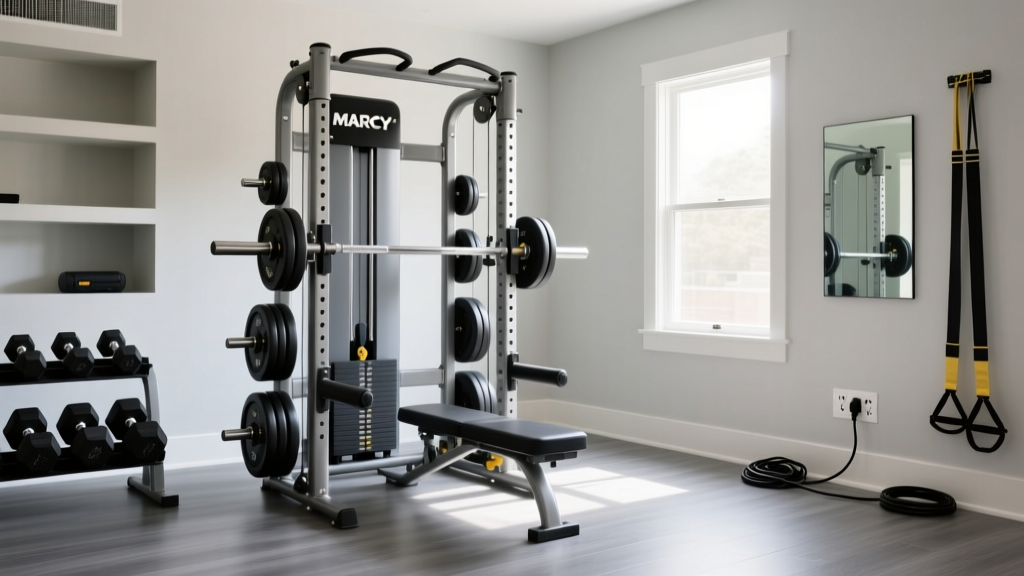
Marcy Home Gym Weight Chart & Electrical Safety Setup

How Much Weight Is a Leg Press Machine? Layout & Floor Guide

No-Damage Strength Training Home Gym: 2026 Rental Trends

Black Home Gym Ideas: Head-to-Head Remodeling Guide
