
Outdoor Setup Walkthrough: Weather & Workout Routine for Home Gym
Master your outdoor setup with our weatherproofing walkthrough. Learn to protect gear and adapt your workout routine for home gym environments year-round.

Building an outdoor home gym is the ultimate dream for many lifters: unlimited fresh air, natural vitamin D synthesis, and a deep connection to your training environment. However, exposing thousands of dollars of steel, rubber, and electronics to the elements requires meticulous planning. When you transition from a climate-controlled garage to an open-air pavilion, your workout routine for home gym programming must evolve alongside your environment, and your equipment installation must be bulletproof against moisture, UV radiation, and thermal expansion.
In this complete setup and installation walkthrough, we will cover the structural, material, and physiological considerations necessary to build a weather-resistant outdoor training facility in 2026.
The Foundation: Pouring a Weather-Resistant Slab
Do not build an outdoor gym on bare earth, gravel, or an existing wooden deck. Wood warps and rots, while gravel shifts under heavy dynamic loads like barbell drops. You need a reinforced concrete pad.
Concrete Specifications for Heavy Dropping
- Thickness: Minimum 4 inches (6 inches if you plan to drop 500+ lb deadlifts frequently).
- PSI Rating: 3,500 PSI minimum. Standard 2,500 PSI residential mixes will spider-crack under the point-load of a dropped barbell.
- Reinforcement: #4 rebar grid placed at 16 inches on-center (OC), elevated 2 inches off the subgrade using plastic chairs.
- Drainage Slope: The slab must be pitched at exactly 1/8 inch per foot away from your primary rack footprint to prevent pooling and hydrostatic pressure buildup.
Material Science: Choosing Outdoor-Rated Equipment
Standard powder-coated steel will begin to show micro-rust within 60 days in a high-humidity outdoor environment. You must specify the correct metallurgical treatments. According to the American Galvanizers Association, hot-dip galvanizing provides a metallurgical bond that offers decades of corrosion resistance, far outperforming standard paint or zinc plating.
| Finish Type | Outdoor Lifespan | Cost Premium | Best Use Case |
|---|---|---|---|
| Standard Powder Coat | 6-12 Months | Base Price | Indoor only |
| Zinc Plating | 1-3 Years | +10% | Covered patios |
| Hot-Dip Galvanized | 15-25 Years | +25-40% | Fully exposed racks |
| Marine-Grade Stainless | Lifetime | +100-150% | Coastal/Salt-air zones |
2026 Market Reality: If you are buying a power rack, look for the REP Fitness PR-5000 V2 with the optional Stainless Steel upgrade (adds roughly $800-$1,000 to the base price) or Titan Fitness Galvanized Infinity Racks (starting around $550). Never buy standard black powder-coated racks for outdoor use unless you plan to completely strip and repaint them with marine-grade epoxy annually.
Overhead Shielding and Wind Load Engineering
Direct UV radiation destroys rubber and plastics, while rain ruins barbell knurling. You need a roof, but you must respect wind shear.
An improperly anchored pergola acting as a sail in a 60 MPH microburst can rip concrete footings out of the ground and turn your gym into a projectile hazard.
Installation Specs: Use a polycarbonate multi-wall roof system (16mm thickness minimum) angled at a 3:12 pitch to shed snow and rain. Anchor your uprights using Simpson Strong-Tie wedge anchors (1/2 inch diameter, 5.5 inch embedment) directly into the concrete slab, or better yet, cast the upright base plates directly into the wet concrete during the pour for maximum lateral stability.
Flooring and Bumper Plate UV Degradation
Standard horse stall mats (crumb rubber) will off-gas violently in the summer heat and become brittle in freezing temperatures. Furthermore, UV rays break down the sulfur bonds in vulcanized rubber.
- The Flooring Fix: Use interlocking UV-stable rubber pavers (like those from Rubber Floor Inc., costing roughly $3.50 to $4.50 per square foot). They allow water drainage underneath, preventing mold and mildew buildup on your concrete slab.
- The Bumper Plate Reality: Hi-Temp (crumb rubber) bumper plates will flake and degrade within one summer if left in direct sunlight. You must invest in virgin rubber plates (e.g., Rogue Echo Bumpers or Fringe Sport Black Series) and store them in a shaded, ventilated cabinet when not in use.
Adapting Your Workout Routine for Home Gym Seasons
Designing an outdoor space is only half the battle; executing your workout routine for home gym sessions safely in extreme weather is the other. The National Weather Service emphasizes that heat index and wind chill drastically alter human physiological output and safety thresholds.
Summer Heat Protocols (Heat Index > 95°F)
When the heat index crosses 95°F, your central nervous system (CNS) fatigues rapidly, and grip strength plummets due to excessive sweating. Adapt your routine by shifting to high-volume, lower-intensity hypertrophy work rather than 1-rep max strength testing. Move heavy squats and deadlifts to 5:30 AM starts. Utilize liquid chalk mixed with isopropyl alcohol, as standard block chalk will turn into a slippery paste in high humidity.
Winter Cold Protocols (Ambient Temp < 40°F)
Cold steel acts as a heat sink, rapidly draining core temperature from your hands and causing severe grip failure. Furthermore, the Centers for Disease Control and Prevention notes that cold-weather exercise requires extended warm-ups to prevent muscle strains in stiffened connective tissues.
- Warm-up Adjustment: Double your general physical preparedness (GPP) warm-up time. Spend 10 minutes on an assault bike or doing dynamic mobility before touching the barbell.
- Grip Modification: Switch to lifting straps for heavy pulling movements when temperatures drop below 35°F, as bare knurling on a cold barbell can cause micro-tears in the skin of your palms.
The 12-Month Maintenance Protocol
Even galvanized and stainless steel requires maintenance to prevent surface oxidation and keep moving parts (like pulleys and hinges) functioning smoothly. Follow this exact maintenance schedule:
- Weekly: Wipe down all barbell shafts with a nylon brush and apply a micro-thin layer of 3-IN-ONE oil. Wipe off the excess to prevent dust adhesion.
- Monthly: Inspect all structural bolts. Thermal expansion and contraction will loosen hardware over time. Retorque all rack bolts to 60 ft-lbs using a calibrated torque wrench.
- Bi-Annually (Spring/Fall): Spray all non-stainless steel hardware, hinge pins, and safety strap carabiners with Fluid Film NAS or Boeshield T-9. These lanolin and paraffin-based creepers displace moisture and halt existing surface rust without damaging rubber or plastics.
- Annually: Pressure wash the concrete slab (using a 15-degree tip, keeping 12 inches from the surface to avoid etching) and reapply your penetrating siloxane concrete sealer.
By treating your outdoor gym not just as a collection of weights, but as a permanent architectural installation, you ensure that your training space remains safe, functional, and inspiring for decades to come.
More gear to consider
All reviews
How Much Weight You Need: Space-Optimized Home Gym TV Layouts

The Gold Home Gym Trend: 2026 Garage Flooring & Ventilation Guide
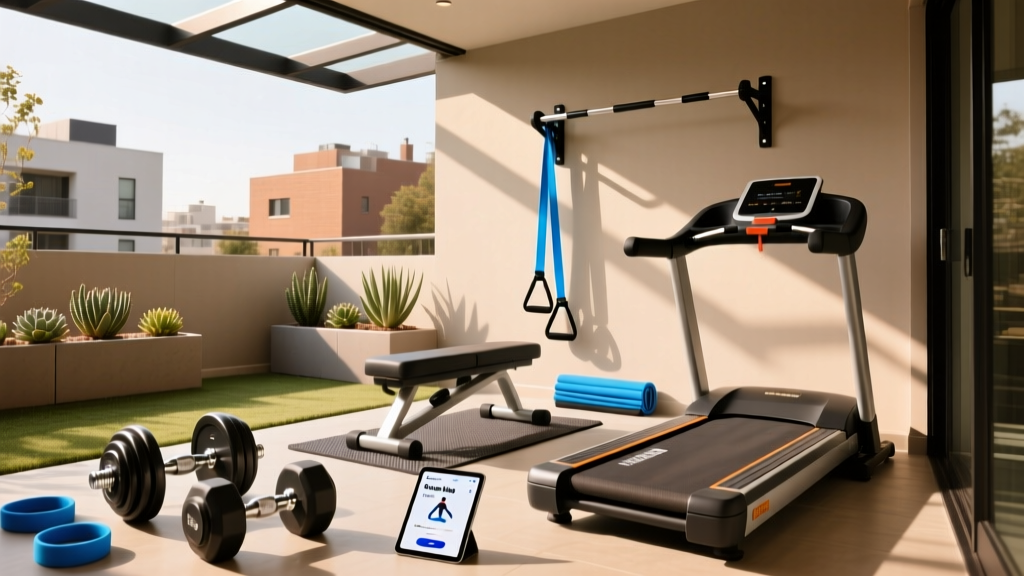
Outdoor Gym Weather Care & Home Gym Club Training App Tracking

Weatherproofing Your Outdoor Home Gym Layout for Longevity

How to Switch Home Gyms Planet Fitness Memberships for a Couples Setup
