
Your First Home Gym Total: Essential Starter Kit Buying Guide
Calculate your exact home gym total with our beginner starter kit guide. Compare costs, essential gear, and hidden fees to build the perfect budget setup.

Defining Your Home Gym Total: The Beginner’s Blueprint
Building a home gym from scratch is one of the most effective investments you can make for your long-term health, but sticker shock often derails beginners before they even lift their first weight. When planning your setup, the most critical metric to understand is your home gym total. This isn't just the price of a dumbbell set; it encompasses the cost of essential equipment, protective flooring, spatial requirements, and often-overlooked accessories. According to physical activity guidelines from the Centers for Disease Control and Prevention (CDC), adults need at least 150 minutes of moderate-intensity activity and two days of muscle-strengthening activities per week. A well-planned starter kit ensures you can hit these metrics without needing a commercial gym membership.
The 60/20/20 Budgeting Framework
Before buying a single piece of gear, allocate your budget using the 60/20/20 rule to keep your home gym total balanced:
- 60% Core Resistance Equipment: Dumbbells, kettlebells, or adjustable cable systems.
- 20% Infrastructure: High-density rubber flooring, a stable weight bench, and storage.
- 20% Ergonomics & Accessories: Ventilation, mirrors, resistance bands, and cleaning supplies.
Tier 1: The Bodyweight & Band Foundation (Total: $120 - $200)
If your budget is tight or you are renting an apartment with strict noise and space limitations, a Tier 1 setup focuses on variable resistance and calisthenics. This setup requires a minimum of 35 square feet of clear floor space.
| Equipment | Recommended Model | Est. Cost | Primary Use |
|---|---|---|---|
| Tube Resistance Bands | WHATAFIT Set (with door anchor) | $35 | Isolation & hypertrophy |
| Loop Bands | Rogue Fitness Monster Bands | $45 | Assisted pull-ups, warm-ups |
| Doorway Pull-Up Bar | Perfect Fitness Multi-Gym Doorway | $30 | Lat & bicep development |
| Exercise Mat | BalanceFrom GoYard All-Purpose | $25 | Floor work, core, yoga |
Expert Insight: The failure point in cheap resistance bands is the metal carabiner clip. Always inspect the weld on the carabiner before heavy lateral raises or chest presses. Upgrade to bands with reinforced molded clips or continuous loop designs as you progress.
Tier 2: The Free Weight Progressive Setup (Total: $450 - $750)
To achieve true progressive overload—a core principle endorsed by the National Strength and Conditioning Association (NSCA) for building muscle and bone density—you need external, easily incrementable loads. The Tier 2 setup is the sweet spot for 80% of beginners, requiring roughly 50 to 70 square feet.
The Core Shopping List
- Adjustable Dumbbells (5-50 lbs per hand): $300 - $450
- Flat/Incline Utility Bench: $130 - $180
- Rubber Flooring (Two 4x6 ft mats): $110 - $130
Comparison Matrix: Adjustable Dumbbells for Beginners
Adjustable dumbbells are the single largest line item in your home gym total, but they replace up to 15 pairs of fixed dumbbells, saving massive amounts of space and money.
| Brand & Model | Weight Range | Adjustment Mechanism | Price (Pair) | Best For |
|---|---|---|---|---|
| Yes4All Adjustable | 5-25 lbs (expandable) | Spin-lock collar | $115 | Strict budgets; durability |
| Nuobell 80lb | 5-80 lbs | Twist handle | $649 | Mimics real dumbbell feel |
| Bowflex SelectTech 552 | 5-52.5 lbs | Dial system | $429 | Quick transitions; supersets |
"When evaluating adjustable dumbbells, never drop them from shoulder height. The internal plastic casing and dial mechanisms of even premium models like the Bowflex 552 will shatter upon impact with hard surfaces. Always return them to their cradle gently."
Tier 3: The Complete Beginner Sanctuary (Total: $900 - $1,400)
If you have a dedicated spare room, garage corner, or basement space (minimum 80-100 sq ft), Tier 3 introduces barbell training. This setup bridges the gap between a beginner kit and a lifelong lifting sanctuary.
Essential Barbell Additions
Adding a barbell exponentially increases your home gym total, but it is non-negotiable for lower-body development (squats, deadlifts) and heavy pressing.
- Power Rack / Squat Stand: Rogue Fitness SML-1 Monster Lite Squat Stand ($495). Why? It features Westside hole spacing (1-inch spacing in the bench/press zone) for precise safety bar placement, a critical safety feature when lifting alone.
- Olympic Barbell: REP Fitness AB-4100 (20kg, $249). Why? It offers 190k PSI tensile strength and dual knurl marks, accommodating both powerlifting and Olympic lifting grips.
- Bumper Plates (160 lb set): Fringe Sport Black Bumpers ($289). Why? Virgin rubber with a stainless steel insert prevents the 'dead bounce' and cracking associated with cheap recycled rubber plates.
Hidden Costs That Inflate Your Home Gym Total
Beginners frequently blow their budgets by forgetting the infrastructure required to support heavy iron. Factor these into your initial calculations to avoid mid-build financial stalls.
Flooring (Crucial)
Do not use cheap foam puzzle mats for free weights; they compress and cause instability during heavy squats. Buy 3/4-inch thick vulcanized rubber horse stall mats (typically $55 each at farm supply stores). They offer a 70-75 Shore A durometer rating, perfect for absorbing dropped dumbbells.
Climate & Air Quality
Garages and basements trap humidity, which will rust unprotected iron knurling within months. Budget $50 for a dehumidifier (like the Vremi 22-pint model) and $30 for a 3-in-1 gun oil/silicone spray to wipe down your barbell sleeves monthly.
Frequently Asked Questions
Can I build a functional home gym for under $300?
Yes. By focusing on Tier 1 equipment (resistance bands, a quality pull-up bar, and a plyo box) combined with bodyweight progressions like Bulgarian split squats and gymnastic ring rows, you can achieve exceptional hypertrophy and cardiovascular results without touching a cast-iron dumbbell.
Should I buy used equipment to lower my home gym total?
Buying used is highly recommended for fixed-weight iron (dumbbells, kettlebells, and plates) because solid iron rarely degrades. However, never buy used adjustable dumbbells or cable machines. The internal mechanisms degrade unpredictably, and a failing locking mechanism during an overhead press poses a severe safety hazard. The American Council on Exercise (ACE) consistently advises inspecting all moving parts and safety latches on home gym equipment before every use.
How much space do I really need for a Tier 2 setup?
You need a minimum footprint of 6 feet wide by 8 feet long (48 sq ft). This allows for a standard 4-foot bench, enough clearance to lie down with 50lb dumbbells extended (roughly 5.5 feet wingspan), and safe walking clearance to your equipment rack.
Final Thoughts on Your Investment
Calculating your home gym total is about balancing immediate budget constraints with long-term fitness goals. Beginners should start with the Tier 2 Free Weight Foundation, as it provides the highest return on investment for muscle building and fat loss. By prioritizing high-density rubber flooring and a versatile adjustable dumbbell set, you create a scalable environment that will serve you well into your intermediate and advanced training years.
More gear to consider
All reviews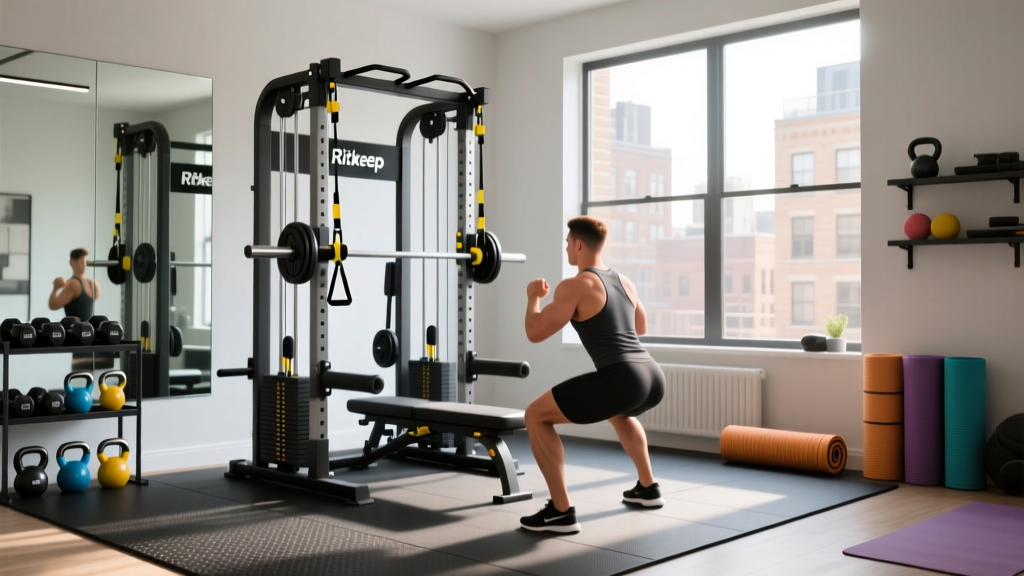
The Ultimate Ritkeep Home Gym Setup and Floor Plan Guide
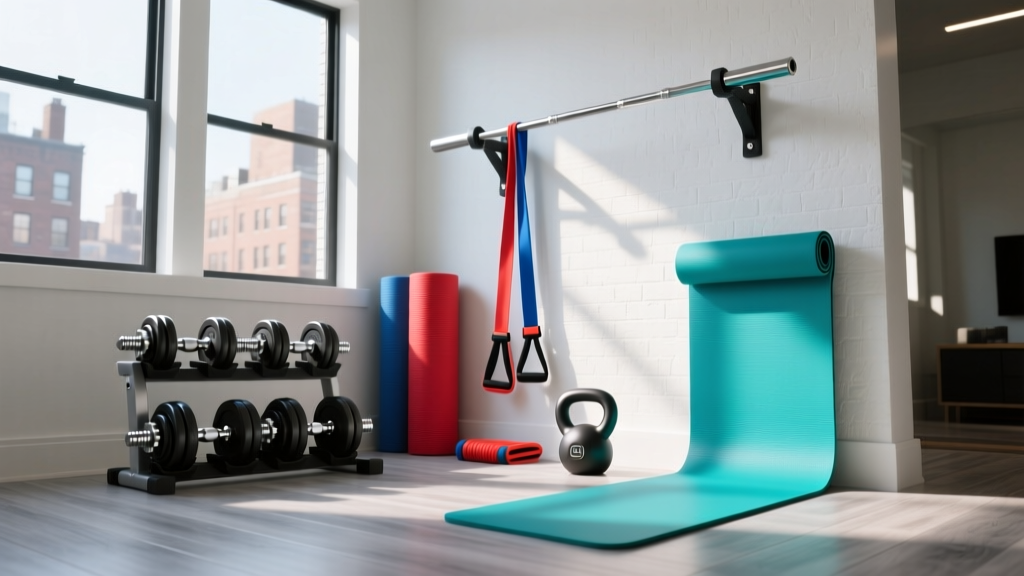
Joe Rogan Home Gym Vibe: Beginner Starter Kit & Layout

Compact Home Gym Equipment for Strength Training: Starter Kit

Bells of Steel All-In-One Home Gym: Outdoor Setup & Weather Guide

Foldable Home Gym Cost: Compact Setup Pricing Guide
