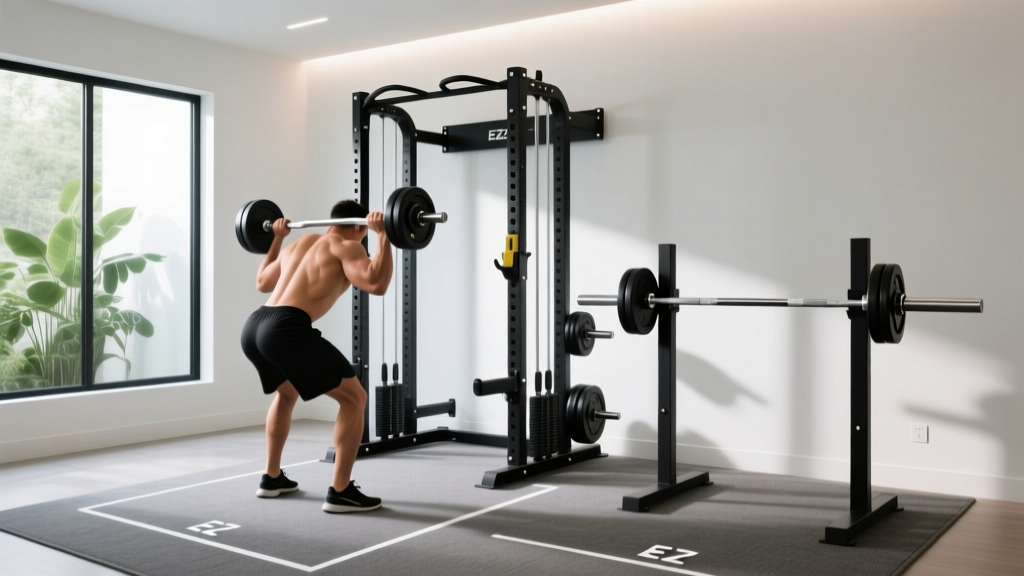
Space-Saving Gym Layouts: Bent-Over Dumbbell Rows, EZ vs Straight Bar
Optimize your compact home gym layout. We compare EZ curl bar vs straight bar footprints and integrate space-saving bent-over dumbbell rows.

The Spatial Dilemma: Barbell Footprints vs. Dumbbell Versatility
As urban living spaces shrink and home gym footprints become increasingly constrained, the metric for evaluating fitness equipment has shifted. In 2026, it is no longer just about weight capacity or knurling aggressiveness; it is about spatial geometry. When designing a compact training zone, every inch of lateral clearance and posterior swing radius matters. This is especially true when comparing foundational pulling movements and the equipment required to execute them.
The most common spatial conflict in a micro-gym arises when lifters attempt to perform heavy horizontal pulls. A standard barbell requires massive lateral clearance, forcing many to abandon barbell rows entirely. This guide breaks down the exact dimensional differences between an EZ curl bar and a straight Olympic barbell, and demonstrates how integrating bent-over dumbbell rows into your layout solves the clearance crisis while maintaining elite back development.
EZ Curl Bar vs Straight Bar: Dimensions, Storage, and Clearance
To optimize your floor plan, you must first understand the physical envelope of your equipment. The choice between an EZ curl bar and a straight barbell is often framed around wrist ergonomics, but from a layout perspective, it is purely a game of inches.
The Straight Olympic Barbell
A standard 7-foot Olympic barbell (such as the Rogue Fitness Ohio Bar, priced around $295) measures exactly 86.75 inches in total length. The shaft is 52 inches, leaving 16.4 inches per sleeve. To load a standard 45-pound bumper plate (17.75 inches in diameter) on the floor, you must tilt the bar. This tilting action requires a minimum of 9 feet of lateral wall-to-wall clearance to maneuver safely without gouging your drywall or hitting adjacent power rack uprights.
The EZ Curl Bar
Conversely, a standard Super Curl Bar (like the CAP Barbell Super Curl, typically under $50) measures roughly 47 inches in total length, with sleeves averaging just 6 inches. Because the sleeves are short and the bar is light (usually 15-18 lbs), you can load and unload plates while the bar is resting flat on the floor or in a low J-cup. The required lateral clearance drops dramatically to just 5.5 feet.
Layout Pro-Tip: If your gym is housed in a narrow galley-style room or a standard walk-in closet (typically 6 to 8 feet wide), a 7-foot straight barbell is functionally obsolete for floor-based loading. The EZ curl bar becomes your primary barbell for isolation work, while heavy compound lifts must be reimagined.Dimensional & Clearance Matrix
| Equipment Type | Total Length | Sleeve Length | Min. Lateral Clearance | Primary Spatial Use Case |
|---|---|---|---|---|
| 7ft Olympic Straight Bar | 86.75" | 16.4" | 9.0 ft (108") | Standard 2-car garages, wide basements |
| Standard EZ Curl Bar | 47.0" | 6.0" | 5.5 ft (66") | Spare bedrooms, narrow hallways, apartments |
| Adjustable Dumbbells (Pair) | 16.0" (each) | N/A | 4.0 ft (48") | Ultra-compact corners, 4x4 ft rubber mat zones |
Source: Equipment specifications aggregated from Garage Gym Reviews and manufacturer data.
Integrating Bent-Over Dumbbell Rows in Tight Layouts
While the EZ curl bar is exceptional for bicep curls, skull crushers, and upright rows, its angled grips and limited sleeve length make it suboptimal for heavy, high-volume horizontal back pulling. According to biomechanical analyses outlined by ExRx.net's exercise directory, maximizing latissimus dorsi and rhomboid activation requires a deep stretch and a converging path of motion—something a fixed-width barbell restricts.
This is where bent-over dumbbell rows become the ultimate spatial and biomechanical hack for the compact home gym.
The Footprint Advantage
Performing a barbell bent-over row requires the 9-foot lateral clearance mentioned earlier, plus a 4-foot posterior swing radius to hinge at the hips without backing into a wall or bench. In a 6x8 foot spare bedroom gym, this is physically impossible.
By substituting the barbell with a pair of adjustable dumbbells (such as the Nuobell 80lb set, approx. $399, or Powerblock Elite EXP), the entire exercise footprint shrinks to a 4x4 foot square. You can perform bent-over dumbbell rows facing directly into a corner, maximizing unused dead space in your room's layout.
"The unilateral nature of the single-arm bent-over dumbbell row not only resolves spatial constraints but also allows for a greater range of motion and increased thoracic rotation, leading to superior mid-back hypertrophy compared to the fixed-path barbell row."
— Adapted from BarBend's biomechanical comparisons on pulling mechanics.
Execution in Confined Spaces
- The Staggered Stance: In a narrow layout, avoid the traditional wide, bilateral hip-hinge stance. Instead, use a staggered stance (one foot forward, one foot back). This reduces your posterior swing radius by nearly 12 inches, preventing your glutes from clipping the wall behind you.
- The Bench Brace: If your layout includes a compact adjustable bench, place it against the wall. Brace your non-working hand and knee on the bench to perform supported single-arm bent-over dumbbell rows. This completely eliminates lower back shear forces and requires only a 3-foot lateral footprint.
- Converging Pull Path: Unlike a straight bar that locks your wrists into a fixed pronated or supinated position, dumbbells allow you to pull toward your hip pocket. This converging path aligns perfectly with the lower lat fibers, providing a stimulus that neither the straight bar nor the EZ curl bar can replicate.
Space-to-Value Ratio: What Should You Buy?
When allocating your budget and floor plan, prioritize equipment that offers multi-planar utility within a minimal footprint.
- Buy the EZ Curl Bar if: You have at least 6 feet of lateral clearance and prioritize arm isolation (curls, tricep extensions) and front squats. It stores easily on a 2-tier wall-mounted rack, freeing up floor space.
- Skip the Straight Barbell if: Your training zone is less than 8 feet wide. The spatial friction of loading and unloading plates will reduce your workout density and increase the risk of property damage.
- Invest in Premium Adjustable Dumbbells: For the bent-over dumbbell rows, heavy goblet squats, and unilateral presses. A high-quality dial or block-style adjustable dumbbell set replaces an entire 5-pair dumbbell rack, saving roughly 12 square feet of floor space while providing the exact tools needed for heavy horizontal pulling.
Frequently Asked Questions
Can I use an EZ curl bar for bent-over rows?
While physically possible, it is not recommended. The angled grips of an EZ curl bar force your wrists into partial supination, which places the biceps in a mechanically advantageous position but reduces the isolation and stretch on the lats and rhomboids. Furthermore, the short sleeves limit the amount of plate real estate available for heavy loading. Adjustable dumbbells are vastly superior for this movement pattern.
How much space do I need for a power rack in a small room?
A standard 4x4 foot power rack requires a minimum room dimension of 8x8 feet to allow for safe plate loading on a straight barbell and adequate space to walk out with a barbell for squats. If your room is smaller, opt for a squat stand paired with adjustable dumbbells for your rowing and accessory work.
Are single-arm dumbbell rows better than bilateral barbell rows?
For hypertrophy and space optimization, yes. Single-arm bent-over dumbbell rows allow for a deeper stretch at the bottom of the movement and a higher peak contraction at the top. They also unilateralize the load, helping to correct left-to-right strength imbalances that are often masked when using a straight barbell.
More gear to consider
All reviews
How Heavy Are the Dumbbells You Lift? Form Over Fitness Video Hype
Weighted Sit Ups Dumbbells: Rubber Hex vs Urethane Review

Bumper vs Iron Plate Care: Gym Setup for Seated Dumbbell Presses
EZ Curl Bar vs Straight Bar: Gym Layouts for Dumbbell Deadbugs

Adjustable Dumbbell Review: Dumbbell Core Workout Women Setup Guide
