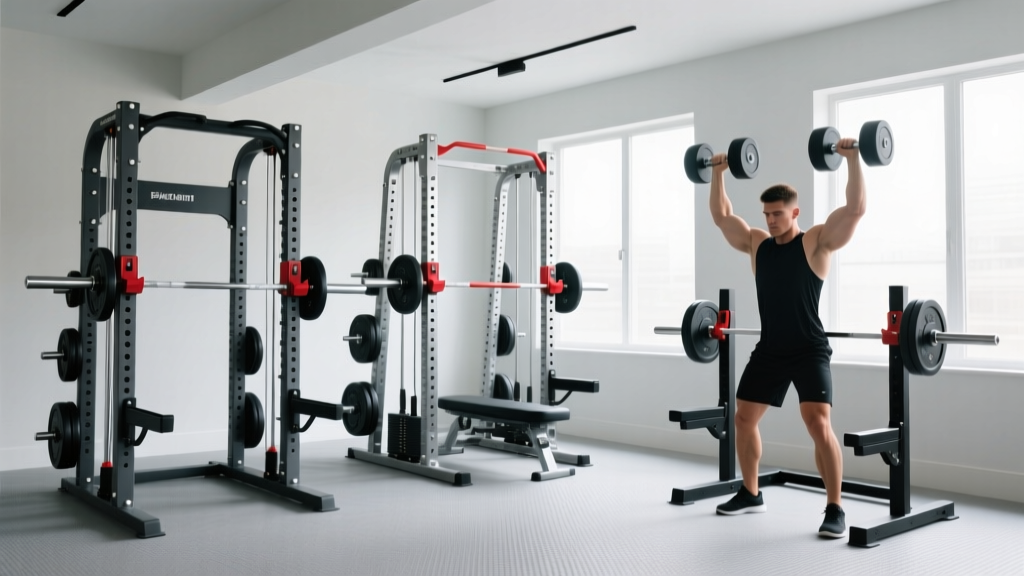
Power Rack vs Squat Rack vs Squat Stand: Troubleshooting Overhead Press Form & Dumbbell Clearances
Compare power racks, squat racks, and squat stands. Learn how ceiling heights and upright spacing impact overhead press form and dumbbell clearances.

The Home Gym Rack Dilemma: More Than Just Squats
When building or upgrading a home gym in 2026, the debate between a power rack, squat rack, and squat stand usually centers on barbell squats, bench presses, and pull-ups. However, a massively overlooked factor is how your rack choice dictates your pressing mechanics. When analyzing overhead press form, dumbbell and barbell variations demand entirely different spatial geometries. A rack that perfectly accommodates a barbell back squat might completely ruin your seated dumbbell shoulder press or force you to alter your standing barbell press trajectory to avoid smashing your wrists into steel crossmembers.
Troubleshooting poor pressing mechanics often leads lifters to blame their mobility or programming, when the true culprit is their equipment footprint. According to biomechanics principles outlined by the ExRx.net kinesiology database, optimal shoulder flexion and scapular upward rotation require unrestricted vertical and lateral pathways. If your rack restricts these pathways, your body will subconsciously alter its motor patterns, leading to flared elbows, lower back over-arching, and stalled progress. This guide breaks down the structural differences between power racks, squat racks, and squat stands, specifically through the lens of overhead pressing and dumbbell training.
Power Rack vs Squat Rack vs Squat Stand: 2026 Comparison Matrix
Before troubleshooting your form, you must understand the structural limitations of each rack type. Pricing and footprints have shifted in 2026, with modular 3x3 inch upright systems dominating the market.
| Feature | Power Rack (Full Cage) | Squat Rack (Half Rack) | Squat Stand (Dual Stands) |
|---|---|---|---|
| Footprint | 48x48 to 53x53 inches | 48x48 to 48x60 inches | 24x24 to 49x49 inches |
| Average Price Range | $650 - $1,400+ | $550 - $1,100 | $350 - $600 |
| Overhead Clearance | Restricted by top crossmembers | Open front, restricted rear | Completely open above |
| Lateral Dumbbell Space | Restricted by side crossmembers | Good lateral space | Unrestricted lateral space |
| Safety for Heavy OHP | Excellent (spotter arms inside) | Good (spotter arms outside) | Poor (tipping hazard) |
| Top 2026 Models | REP PR-4000, Rogue R-3 | Titan T-3 Half Rack, Rogue RM-6 | Rogue SML-2C, Bells of Steel |
Troubleshooting Overhead Press Form: Dumbbell and Barbell Clearances
The Crossmember Interference Problem
The most common failure mode for lifters training in standard 90-inch or 108-inch power racks is crossmember interference. When performing a standing barbell overhead press, a lifter who is 6 feet 2 inches tall (74 inches) will extend their arms to roughly 94 to 96 inches above the floor. If you own a 108-inch rack with a top crossmember situated at 90 inches, you physically cannot lock out the barbell inside the cage. You are forced to press in front of the rack, completely negating the safety of spotter arms and forcing you to lean forward, which compromises your dumbbell overhead press form and barbell mechanics alike.
For seated dumbbell presses, the issue shifts to the side and rear crossmembers. If you place an adjustable bench inside a 49-inch wide power rack, you only have roughly 21 inches of clearance from the center of the bench to the upright. When lifting heavy dumbbells (e.g., 80 to 100 lbs), the wide arc required to kick the weights up and press them outward will result in the dumbbell heads striking the side crossmembers or the safety spotter arms.
Upright Spacing and Elbow Tracking
The National Strength and Conditioning Association (NSCA) emphasizes that the bar path during an overhead press must travel in a straight vertical line close to the center of gravity. Standard power racks feature an internal width of 49 inches. While this is fine for barbells, it creates a psychological and physical barrier for dumbbell work. Lifters subconsciously tuck their elbows too tightly to avoid hitting the uprights, which shifts the load away from the lateral deltoids and places excessive shear stress on the rotator cuff. If your primary focus is hypertrophy and dumbbell variations, a squat stand or a half-rack with no side obstructions is vastly superior for maintaining natural elbow tracking.
Expert Troubleshooting Tip: If you are experiencing wrist pain or a stalled lockout during your overhead press, record your set from a side profile. If you are actively tilting your head back or thrusting your hips forward to clear an imaginary (or real) crossmember, your rack dimensions are dictating your faulty movement pattern, not your shoulder mobility.
Failure Modes: When the Wrong Rack Ruins Your Lift
Let us break down the specific failure modes associated with each rack type when performing overhead and dumbbell movements.
- Power Rack Failure Mode (The Seated Trap): You set your bench to an 80-degree incline for seated dumbbell presses. As you press the final reps, your upper back slides slightly up the bench pad. Your head or knuckles collide with the rear upper crossmember, forcing you to dump the weights dangerously forward.
- Squat Rack Failure Mode (The Front-Heavy Imbalance): Half racks solve the overhead clearance issue by leaving the front open. However, if you are performing heavy standing dumbbell presses and step backward to rack the weights, the extended footprint of the half-rack safety arms can become a tripping hazard, especially in compact garage gyms.
- Squat Stand Failure Mode (The Lateral Tipping Hazard): Squat stands offer the ultimate freedom for overhead pressing. However, picking up heavy dumbbells from the floor while standing directly between or adjacent to unbolted squat stands introduces a severe lateral tipping risk. A 100 lb dumbbell swung slightly off-center can easily topple a 150 lb squat stand if it lacks adequate base gussets or floor bolting.
Step-by-Step Troubleshooting for Your Specific Ceiling Height
Your ceiling height is the ultimate dictator of your rack choice. Standard US residential ceilings are 96 inches (8 feet). Here is how to troubleshoot your setup based on your room dimensions.
- Measure Your Exact Ceiling Height: Do not guess. Account for rubber flooring (typically 3/4 inch thick), which reduces your clearance.
- The 90-Inch Rack Solution: If your ceiling is 96 inches, a 90-inch rack (like the Rogue R-3 or Titan T-3 Short) is mandatory. This leaves 6 inches of clearance. However, you still cannot do standing barbell OHP inside the rack. You must position your bench so your head is just outside the front uprights for dumbbell work.
- The 82-Inch Rack Compromise: For basement gyms with low-hanging ductwork or 8-foot ceilings where you want to do pull-ups without bending your knees, an 82-inch rack is required. The trade-off is that tall lifters (over 6 feet) will have to crouch to get under the bar for squats, and seated dumbbell presses will feel incredibly claustrophobic.
- The Squat Stand Loophole: If you have low ceilings but prioritize overhead pressing and dumbbell work, buy heavy-duty squat stands (like the Rogue SML-2C Monster Lite). They provide zero overhead obstruction, allowing you to press freely without altering your biomechanics.
Optimizing Your Setup for Dumbbell Overhead Press Form
To achieve perfect overhead press form dumbbell variations require a specific setup protocol to ensure safety and optimal muscle recruitment. First, utilize a bench with a high-density pad that prevents sinking; a sinking pad alters your spinal alignment and reduces lateral clearance. Second, if using a power rack, remove the side safety spotter arms during dumbbell presses. While this removes the safety net, it prevents the catastrophic failure mode of your elbow or the dumbbell catching on the arm, which can cause severe shoulder impingement. Instead, rely on controlled eccentrics and leave your ego outside the cage.
For barbell overhead pressing inside a rack, invest in a rack with an adjustable pull-up bar or one that lacks a front top crossmember. According to Rogue Fitness equipment specifications, many modern modular racks allow you to omit the front crossmember entirely, granting you the safety of a full cage with the overhead clearance of a squat stand.
Frequently Asked Questions
Can I do standing overhead presses in a squat stand?
Yes, squat stands are actually the best option for standing overhead presses because there are no overhead crossmembers to restrict your bar path or dumbbell trajectory. However, you must ensure the stands are bolted to a concrete floor or heavily sandbagged to prevent tipping if you fail a rep and drop the weight asymmetrically.
What is the ideal upright spacing for dumbbell work?
For dedicated dumbbell work, you want as much open space as possible. If you must use a rack, look for a wide 53-inch internal spacing (often found in powerlifting-specific racks) or simply use a half-rack where the front is completely open, allowing your elbows to track naturally without the psychological barrier of steel uprights inches from your head.
How do I safely fail a seated dumbbell press in a power rack?
Do not rely on the rack crossmembers to catch heavy dumbbells. The safest method is to guide the dumbbells down to your shoulders, tuck your elbows to your ribs, and aggressively kick your knees up to meet the dumbbells, using your leg momentum to roll backward off the bench safely.
More gear to consider
All reviews
Most Effective Dumbbell Workouts: Bumper vs Iron Plate 2026 Trends

Beyond Dumbbells for Beginners: Olympic Barbell Weight & Knurling Guide
Best Adjustable Dumbbells for Two Arm Seated Dumbbell Extension
Barbell Collar Comparison & Core Training with Dumbbells Setup

Space-Saving Dumbbell Racks for Upper Chest Exercises With Dumbbells
