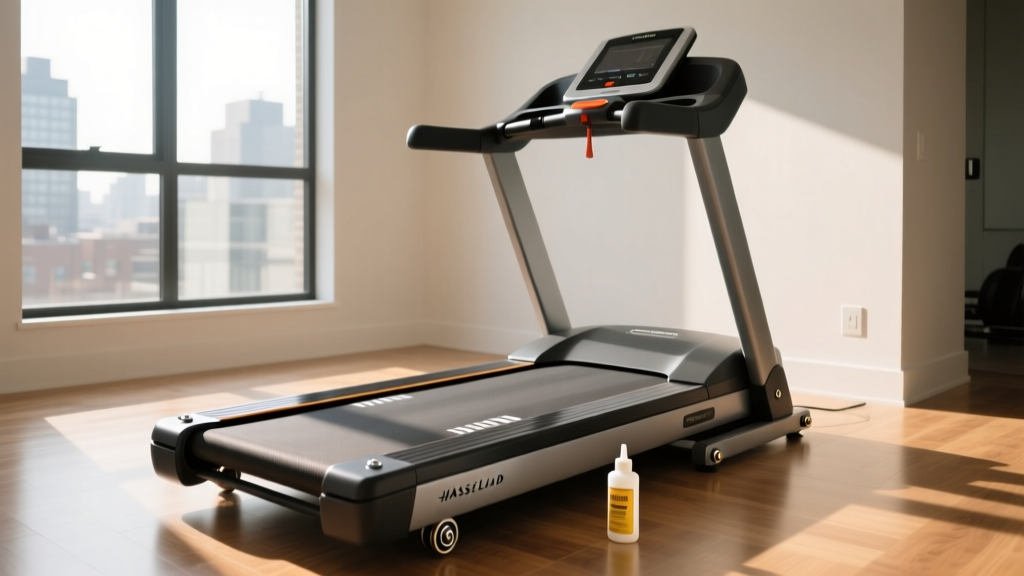
Surviving the Daily One Hour Treadmill Workout: Belt Maintenance Guide
Running a daily one hour treadmill workout? Learn expert belt maintenance, lubrication schedules, and tension adjustments to protect your deck and motor.

The Hidden Cost of High-Volume Training
Committing to a daily one hour treadmill workout is one of the most effective ways to build cardiovascular endurance, manage weight, and improve metabolic health. However, from a mechanical perspective, this level of dedication places immense stress on your machine. If you run or walk at a moderate pace of 4.0 MPH for an hour, you are logging 4 miles per session. Over a five-day training week, that translates to 20 miles a week, or roughly 1,040 miles a year.
Most residential treadmill belts and decks are engineered to withstand between 1,000 and 1,500 miles before requiring major intervention. Without a rigorous maintenance protocol, the sustained friction of high-volume training will rapidly degrade the walking belt, warp the phenolic deck, and ultimately fry the motor controller. In 2026, replacing a lower control board on a premium machine like the NordicTrack Commercial 1750 or Sole F85 can cost between $250 and $400, not including labor. This guide provides the exact maintenance framework required to keep your machine running smoothly under heavy loads.
⚠️ Warning: The Black Dust IndicatorIf you notice fine black dust accumulating near the rear roller or along the sides of the belt, stop your one hour treadmill workout immediately. This dust is a mixture of degraded belt urethane and phenolic resin from the deck. It indicates severe friction and imminent mechanical failure.
Friction, Heat, and the One-Hour Threshold
The primary enemy of any treadmill is friction. When the PVC or urethane belt rubs against the wooden deck coated in phenolic resin, it generates heat. During a standard 20-minute jog, this heat dissipates adequately. However, the sustained friction generated during a one hour treadmill workout causes the deck temperature to rise significantly, accelerating the breakdown of the factory-applied silicone lubricant.
As the lubricant dries out, the coefficient of friction increases. This forces the drive motor to work harder to maintain the set speed under your body weight. According to Treadmill Doctor's comprehensive repair database, a properly lubricated belt drawing 6 to 8 amps under a 175-pound load can quickly spike to 15+ amps when dry. This excessive amp draw triggers thermal overload in the Pulse Width Modulation (PWM) motor controller, leading to catastrophic electronic failure.
Choosing the Right Lubricant
Not all lubricants are created equal. Using the wrong chemical compound can dissolve the belt's backing material and ruin the deck. Below is a breakdown of common lubricant types and their viability for high-mileage runners.
| Lubricant Type | Composition | Verdict for Heavy Use |
|---|---|---|
| 100% Liquid Silicone | Pure polydimethylsiloxane | EXCELLENT. The industry standard. Penetrates deep into the deck weave. |
| Silicone Aerosol Spray | Silicone + propellants | FAIR. Propellants can dry out the belt edges over time. Liquid is preferred. |
| Teflon / PTFE Sprays | Polytetrafluoroethylene | POOR. Can create a gummy residue that attracts dust and debris. |
| Petroleum / WD-40 | Petroleum distillates | DESTRUCTIVE. Will melt the belt backing and delaminate the deck. |
Step-by-Step Belt Lubrication Protocol
For users consistently performing a one hour treadmill workout, the standard manufacturer recommendation of lubricating every 3 months or 130 miles is insufficient. You should inspect and lubricate your belt every 4 to 6 weeks. Follow this exact procedure to ensure even distribution without over-saturating the deck.
- Power Down and Secure: Unplug the treadmill from the wall outlet. Never perform maintenance while the machine is connected to a 120V power source.
- Loosen the Belt Tension: Locate the two rear roller adjustment bolts at the back end of the left and right side rails. Using a 5/16-inch or 1/4-inch Allen wrench (depending on your specific model), turn both bolts counter-clockwise exactly 3 full turns. Keep track of your turns to ensure even realignment later.
- Access the Deck: Gently lift the center of the walking belt away from the deck. You should now have enough clearance to slide your hand underneath.
- Apply the Silicone: Using a bottle of 100% liquid silicone (such as the Horizon Fitness or Sole branded applicator bottles), apply exactly 0.5 ounces in a zig-zag pattern down the center third of the deck. Do not apply lubricant to the outer edges, as this will cause the belt to slip and attract dust.
- Restore Tension: Tighten both rear roller bolts clockwise exactly 3 full turns to return the belt to its original tension.
- Distribute the Lubricant: Plug the machine back in. Start the treadmill at 2.0 MPH and let it run for 3 minutes. Then, increase the speed to 4.0 MPH for another 3 minutes. This centrifugal action spreads the silicone evenly across the phenolic surface.
After restoring tension, perform the 'lift test'. Reach under the center of the belt and pull upward. You should be able to lift the belt exactly 2 to 3 inches off the deck. If it lifts higher than 3 inches, it is too loose and will slip during high-speed intervals. If it lifts less than 2 inches, it is overtightened, which will prematurely destroy the front and rear roller bearings.
Advanced Diagnostics: Measuring Amp Draw
The most authoritative way to gauge the health of your treadmill belt is not by looking at it, but by measuring the electrical current the motor requires to move it. As outlined in the Sole Fitness official maintenance guidelines, monitoring amp draw is the gold standard for preventative care.
To perform this test, you will need a standard digital multimeter with an amp-clamp attachment, or a plug-in power meter (like a Kill-A-Watt). Set the treadmill to 3.0 MPH with no one on it, and note the 'no-load' amp draw (typically 2 to 4 amps). Next, have a user weighing roughly 175 lbs walk at 3.0 MPH.
- Under 10 Amps: Excellent. The belt is well-lubricated and the deck is in pristine condition.
- 10 to 14 Amps: Acceptable, but approaching the threshold. Schedule a lubrication within the next week.
- 15+ Amps: Critical. The friction is dangerously high. Stop using the machine immediately, lubricate the belt, and re-test. If the amp draw remains above 15 amps after lubrication, your phenolic deck is likely worn through to the raw wood and requires replacement.
When to Replace: Belt and Deck Timelines
Even with meticulous maintenance, the materials will eventually fatigue. The continuous impact of a daily one hour treadmill workout will compress the deck's shock-absorption layers and stretch the belt's polyester scrim backing. According to Consumer Reports treadmill care and buying guides, ignoring replacement timelines can lead to collateral damage to the drive motor and electronics.
Signs You Need a Replacement Belt
- Edge Fraying: The white or gray seams on the edges of the belt are unraveling.
- Glazing: The top surface of the belt has become shiny and hardened, losing its traction texture.
- Stretching: You have maxed out the rear roller adjustment bolts, and the belt still slips when you plant your foot during a sprint.
- Estimated Cost (2026): $130 to $250 for OEM replacement parts.
Signs You Need a Replacement Deck
- Visible Grooves: Running your hand under the belt reveals physical depressions or 'ruts' worn into the wood.
- Delamination: The smooth phenolic top layer is peeling away from the MDF wood core.
- Persistent High Amp Draw: As mentioned above, if lubrication fails to drop the amp draw below 15A, the deck is the culprit.
- Estimated Cost (2026): $200 to $450, plus 1-2 hours of labor if not doing it yourself.
'High-volume runners often make the mistake of only replacing the belt while keeping a worn deck. A new belt installed over a grooved, worn deck will be destroyed in less than 90 days. Always replace the belt and deck as a matched set to ensure your warranty remains valid and your machine performs like new.'
Frequently Asked Questions
Can I use a silicone spray from an automotive store?
While automotive silicone sprays do contain silicone, they often include petroleum-based propellants and solvents designed to penetrate rust and clean engine parts. These solvents can break down the adhesives used in treadmill belts. Always purchase 100% pure liquid silicone specifically formulated for fitness equipment.
Does incline training affect belt wear?
Yes. Running at high inclines (10% to 15%) during your one hour treadmill workout shifts your center of gravity backward, placing disproportionate friction and wear on the rear third of the deck. If you frequently train at high inclines, you may need to rotate your deck (if it is a reversible model) or replace it more frequently.
How do I clean the belt before lubricating?
Before applying new silicone, wipe the edges of the belt and the exposed deck with a damp microfiber cloth and a mild dish soap solution to remove accumulated dust and skin oils. Never use harsh chemical degreasers, bleach, or alcohol, as these will dry out the PVC material and cause micro-cracking. Dry the area completely before applying lubricant.
More gear to consider
All reviews
What Is a Walking Pad Treadmill? 2026 Compact Cardio Trends
Beyond the ProForm Treadmill User Manual: 2026 Compact Cardio Trends

Folding Treadmills for Small Spaces: Treadmill Trails App Review
Revo Treadmill Install Guide & Walking Pad Comparison 2026

Dancing Treadmill Workouts: Motor Size & Horsepower Troubleshooting
