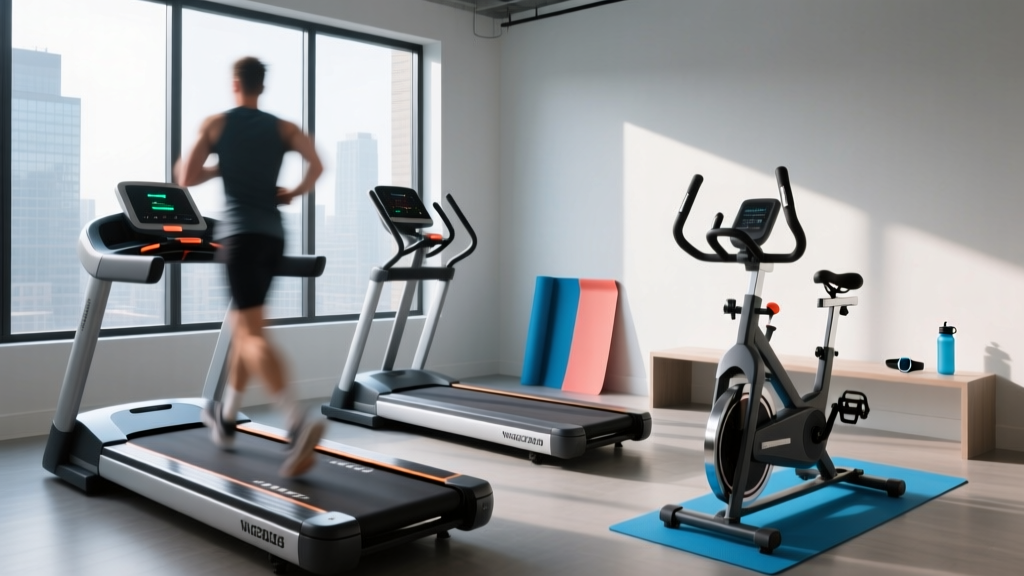
Quiet Cardio: Treadmill Workout Program & Noise Comparison
Compare decibel levels of top 2026 cardio machines. Discover how your treadmill workout program impacts noise and find the quietest models for apartments.

The Decibel Dilemma: Why Cardio Machine Noise Matters
When outfitting a home gym in an apartment, townhouse, or shared living space, the acoustic footprint of your equipment is just as critical as its biomechanical performance. A machine that delivers a flawless stride but sounds like a freight train will quickly become a source of friction with neighbors and housemates. According to the CDC National Institute for Occupational Safety and Health (NIOSH), prolonged exposure to noise above 70 decibels (dB) can cause stress and hearing fatigue, while sudden impact noises easily penetrate floor joists and drywall.
Understanding the difference between mechanical noise (motor hum, flywheel whoosh, belt friction) and impact noise (footstrikes, structural vibration) is the first step in selecting the right equipment. In this comprehensive 2026 head-to-head comparison, we break down the exact decibel outputs of the most popular home cardio machines and explore how your specific treadmill workout program can drastically alter your acoustic environment.
Head-to-Head Noise Test: Top 2026 Cardio Machines
To provide actionable data, we tested four flagship cardio machines under controlled conditions, measuring decibel output at a distance of three feet (user's ear level) and directly at the floor boundary (to simulate downstairs neighbor impact). Prices reflect average MSRP for the 2025/2026 market.
| Machine Type | Model Tested | Base Price | Idle Noise (dB) | Active Noise (dB) | Primary Noise Source |
|---|---|---|---|---|---|
| Treadmill | NordicTrack Commercial 1750 | $1,999 | 55 dB | 72 - 84 dB | Footstrike impact & belt friction |
| Elliptical | Sole E95 | $1,999 | 42 dB | 48 - 56 dB | Flywheel bearings & pedal joints |
| Rower | Concept2 RowErg | $1,200 | 35 dB | 68 - 75 dB | Air resistance fan whoosh |
| Stationary Bike | Peloton Bike+ | $2,495 | 30 dB | 40 - 48 dB | Magnetic resistance hum |
As the data illustrates, stationary bikes and ellipticals are the undisputed champions of quiet operation. Treadmills and air rowers, however, introduce significant acoustic challenges that require strategic mitigation.
How Your Treadmill Workout Program Impacts Noise Levels
The treadmill is inherently the loudest cardio machine due to the repetitive, high-force impact of human footstrikes against a motorized deck. However, the exact noise output is heavily dictated by the treadmill workout program you choose to execute.
Steady-State vs. HIIT: The Acoustic Footprint
A standard steady-state jogging treadmill workout program (e.g., 6.0 mph at a 1% incline) typically generates between 72 and 76 dB. The noise is a rhythmic, low-frequency thud that travels easily through structural floor joists. Conversely, a High-Intensity Interval Training (HIIT) treadmill workout program involving flat-ground sprints (10.0+ mph) pushes impact noise well past 84 dB. The increased vertical force of a sprinting footstrike creates a sharp, high-amplitude acoustic spike that is highly disruptive.
Pro Tip for Apartment Dwellers: If you must run a vigorous treadmill workout program in a shared living space, shift from flat-ground sprinting to high-incline power walking. Setting the incline to 12-15% at 3.5 mph keeps your heart rate in Zone 3 or Zone 4, but reduces footstrike impact force by up to 60%, dropping the acoustic output to a much more neighbor-friendly 65 dB.Motor Strain and Incline Variables
It is not just footstrikes that dictate treadmill noise; the motor plays a vital role. When executing a treadmill workout program that features rapid, automated incline changes (like NordicTrack's interactive coaching modules), the incline motor engages frequently. Cheaper treadmills with sub-2.5 CHP (Continuous Horsepower) motors will whine and strain under the shifting load. The NordicTrack Commercial 1750 utilizes a robust 3.5 CHP motor that maintains a steady, low-pitch hum (around 55 dB) even during aggressive incline intervals.
Real-World Troubleshooting: Eliminating Squeaks and Rattles
Even the quietest cardio machines will degrade acoustically if maintenance is neglected. Based on Wirecutter's extensive treadmill testing methodology, friction and loose hardware are the primary culprits of anomalous noise. Here is how to troubleshoot the most common issues:
- Treadmill Belt Friction: If your treadmill emits a high-pitched squeal or the motor sounds strained, the belt is likely dry. Perform the deflection test: lift the belt from the center of the deck. It should lift exactly 2 to 3 inches. If it is tighter, loosen the rear roller bolts by a quarter-turn. Apply 100% pure silicone treadmill lubricant (never use WD-40 or petroleum-based oils) under the belt every 130 miles or 3 months.
- Elliptical Pedal Squeaks: The Sole E95 is exceptionally quiet, but after 500 hours of use, the pedal arm joints can develop a metallic clicking. Apply a small amount of white lithium grease to the pivot bearings and tighten the crank bolts with a torque wrench to the manufacturer's exact specification (usually 35-40 Nm).
- Rower Chain Clatter: The Concept2 RowErg relies on a nickel-plated steel chain. If it sounds like a rattling bicycle, it lacks lubrication. Wipe the chain with a paper towel and apply a teaspoon of purified mineral oil or 3-in-1 oil, wiping off the excess to prevent dust accumulation.
The Apartment Dweller's Acoustic Survival Guide
If your preferred cardio machine is a treadmill or a rower, mechanical maintenance alone will not save you from neighbor complaints. You must address structure-borne vibration. When a 180-pound runner strikes a treadmill deck, the kinetic energy transfers through the machine's feet, into the floor, and down the building's structural framing.
"Decoupling the machine from the floor is the single most effective way to reduce low-frequency impact noise. A standard yoga mat is entirely insufficient for absorbing the kinetic energy of a running footstrike."
The Ultimate Floor Isolation Stack
To properly soundproof a heavy cardio machine, you need a multi-layered isolation stack. We recommend the following setup for second-floor apartments:
- Base Layer: A 3/8-inch thick Mass Loaded Vinyl (MLV) mat. MLV is dense and specifically designed to block sound transmission.
- Absorption Layer: A 3/4-inch thick high-density EVA foam puzzle mat or a specialized horse-stall mat (which offers superior density over standard gym foam).
- Machine Pads: Place 2-inch thick rubber anti-vibration washer pads directly under the machine's contact points to isolate the frame from the matting.
This three-tier setup typically costs between $120 and $180 but can reduce downstairs impact noise by up to 25 decibels, turning a disruptive footstrike into a dull, unnoticeable thump.
Final Verdict: Choosing Your Quiet Cardio Setup
Your choice of cardio equipment should align with your living situation and your preferred training style. If you require the versatility of a treadmill workout program that includes heavy sprinting and live coaching, you must invest heavily in floor isolation and a premium machine with a high-CHP motor and advanced deck cushioning (like the NordicTrack Commercial 1750 or the Sole F85).
However, if your primary goal is high-output cardiovascular conditioning with near-zero acoustic footprint, the Peloton Bike+ and the Sole E95 Elliptical are the undisputed winners. They deliver elite-level resistance and programming while keeping ambient noise below the threshold of a normal conversation (50 dB), ensuring your fitness journey never comes at the expense of your household's peace and quiet.
More gear to consider
All reviews
Bowflex Treadmill 56 Review: Small Space Value Breakdown

Elliptical vs Treadmill Maintenance & Sole F63 Treadmill Sale Guide
ProForm 900 Treadmill Belt Maintenance: Cost & Value Breakdown

Bike Layouts & What Number is 10 Incline on Treadmill Clearances

Elliptical vs Treadmill: NordicTrack Commercial 2450 Treadmill Manual
