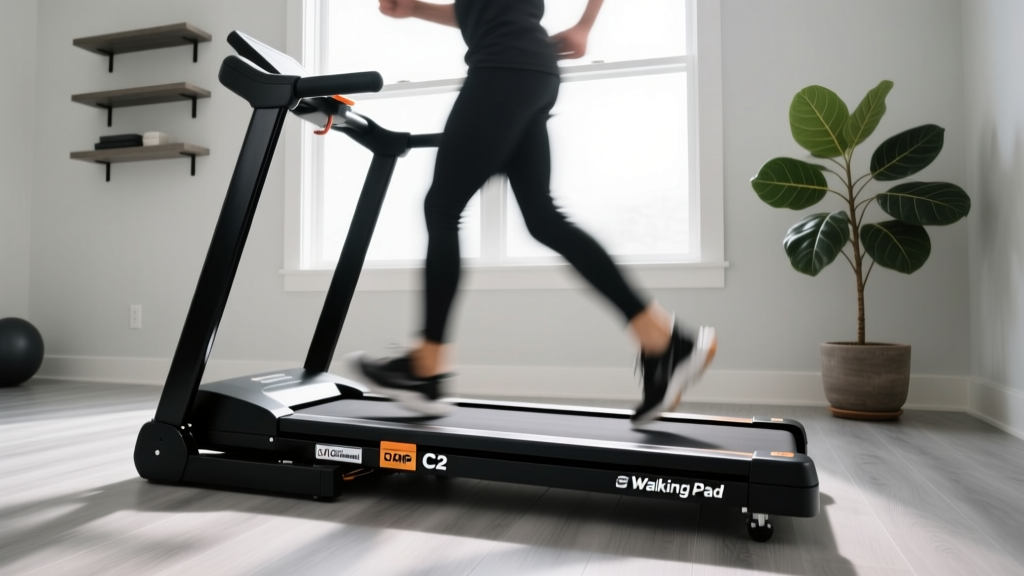
WalkingPad C2 Foldable Walking Treadmill vs Standard: Motor HP Guide
We compare the WalkingPad C2 foldable walking treadmill motor against standard 3.0 CHP treadmills. Learn how peak vs continuous horsepower impacts your workout.

When shopping for home cardio equipment in 2026, motor specifications are often the most misunderstood metrics on the spec sheet. Manufacturers frequently throw around terms like 'Peak Horsepower' and 'Continuous Duty' to make compact machines sound more powerful than they are. To cut through the marketing noise, we are putting the ultra-popular WalkingPad C2 foldable walking treadmill head-to-head against a traditional entry-level standard treadmill, the Horizon T101, to provide a definitive guide on treadmill motor size, horsepower, and real-world performance.
Decoding Treadmill Horsepower: Peak vs. Continuous (CHP)
Before comparing specific models, it is critical to understand how treadmill motors are rated. The fitness equipment industry relies on two primary metrics:
- Peak Horsepower (PHP): This is the absolute maximum power the motor can generate for a fraction of a second before the circuit breaker trips or the motor burns out. It is a largely useless metric for daily use but is heavily featured in marketing materials for compact walking pads.
- Continuous Duty Horsepower (CHP): This is the power the motor can sustain indefinitely under a normal user load without overheating. This is the only number that truly matters when evaluating a treadmill's longevity and performance.
According to engineering guidelines referenced by fitness equipment testers, a standard walking pad will typically feature a 1.0 to 1.5 CHP motor, while a full-sized residential running treadmill requires a minimum of 2.5 to 3.0 CHP to handle the kinetic impact of running gaits.
Head-to-Head: WalkingPad C2 vs. Horizon T101 Motor Specs
To illustrate how motor sizing scales with machine design, we have compared the KingSmith WalkingPad C2 (Model KS-WMC2) against the Horizon T101. This matchup perfectly highlights the engineering compromises and advantages of foldable walking pads versus traditional consoles.
| Specification | WalkingPad C2 Foldable Walking Treadmill | Horizon T101 Standard Treadmill |
|---|---|---|
| Motor Type | Brushless DC Motor | Brushless DC Motor |
| Peak Horsepower | 2.5 HP (Marketed) | N/A (Listed as CHP only) |
| Continuous Horsepower (CHP) | ~1.25 CHP (Estimated based on duty cycle) | 3.0 CHP |
| Max Speed | 3.7 mph (6 km/h) without handrail | 10.0 mph |
| Belt Dimensions | 43.3' x 17.3' | 55' x 20' |
| Max User Weight | 240 lbs (110 kg) | 300 lbs (136 kg) |
| Current Market Price | ~$449 - $499 | ~$699 - $799 |
Why the WalkingPad C2 Uses a Smaller Motor
At first glance, a 1.25 CHP motor might seem underpowered compared to the Horizon's 3.0 CHP. However, motor sizing is intrinsically linked to the physical footprint and intended use case of the machine. The WalkingPad C2 foldable walking treadmill is engineered specifically for low-impact, steady-state walking under a desk or in a living room.
The Physics of Belt Friction and Surface Area
A treadmill motor's primary job is to overcome the friction between the user's foot, the belt, and the deck. The Horizon T101 features a 55-inch long belt. When a user runs, the impact force can exceed 2.5 times their body weight, requiring massive torque to keep the belt moving smoothly. The C2's 43-inch belt restricts the user to a walking stride. Walking generates an impact force of only 1.2 times body weight. Consequently, the C2 requires significantly less torque, allowing KingSmith to utilize a smaller, quieter, and more energy-efficient motor that fits inside a 5-inch thick folding chassis.
⚠️ Expert Warning: Thermal Throttling in Compact MotorsBecause the WalkingPad C2 lacks the massive internal cooling fans and ventilation shrouds found in full-sized treadmills, its motor relies on passive and low-RPM active cooling. If you push the C2 to its 240 lb max weight limit while walking at 3.7 mph for more than 60 continuous minutes, the internal thermal sensor will trigger a safety shutoff to prevent the windings from melting. Always adhere to the manufacturer's recommended 90-minute daily duty cycle limits.
Motor Size and User Weight: The Hidden Variable
One of the most common mistakes consumers make is buying a treadmill based solely on the belt size, ignoring how their body weight interacts with the motor's continuous horsepower. The Centers for Disease Control and Prevention (CDC) heavily promotes daily walking for cardiovascular health, but your physical mass dictates the electrical draw required to sustain that walk.
As a general rule of thumb for treadmill motor sizing:
- Under 150 lbs: A 1.25 CHP motor (like the C2) is perfectly adequate for walking up to 4.0 mph.
- 150 lbs to 200 lbs: You need a minimum of 2.0 CHP for walking, and 2.5 CHP for jogging.
- Over 200 lbs: You must upgrade to a 3.0 CHP or higher (like the Horizon T101) to prevent premature motor burnout, even if you only plan to walk.
If a 220 lb user attempts to use the WalkingPad C2 daily, the motor will constantly operate near its peak thermal threshold. This drastically reduces the lifespan of the motor's internal bearings and the main control board's MOSFETs.
The Friction Factor: Maintenance as a Motor Saver
Motor horsepower does not exist in a vacuum. A 3.0 CHP motor can be destroyed just as easily as a 1.25 CHP motor if belt friction is ignored. In fact, smaller motors are more vulnerable to poor maintenance because they have less reserve torque to overcome a dry belt.
WalkingPad C2 Lubrication Protocol
The C2 uses a standard PVC belt over a low-friction wooden/MDF deck. According to KingSmith Fitness official maintenance documentation, the C2 requires manual application of 100% pure silicone treadmill lubricant every 100 miles (or roughly every 1-2 months for daily users). If you neglect this, the friction coefficient increases, forcing the 1.25 CHP motor to draw excess amperage from your wall outlet, leading to blown fuses or warped drive belts.
Horizon T101 Wax-Coated Advantage
Conversely, the Horizon T101 utilizes a wax-impregnated belt and a phenolic deck. This design requires zero manual lubrication for the first 1,000 miles. The 3.0 CHP motor is paired with a low-maintenance deck, making it a superior choice for users who know they will neglect routine equipment maintenance. For deeper insights into treadmill biomechanics and joint impact, resources from the American Council on Exercise (ACE) highlight how proper belt tension and deck lubrication directly correlate to reduced shear forces on the user's knees and ankles.
DC vs. AC Motors: What Powers Your Home Cardio?
Both the WalkingPad C2 and the Horizon T101 utilize Brushless Direct Current (DC) motors. DC motors are the gold standard for residential equipment because they are quieter, lighter, and can be controlled with precise PWM (Pulse Width Modulation) circuit boards, allowing for smooth speed transitions.
Alternating Current (AC) motors are reserved for commercial gym treadmills (like the Life Fitness Integrity Series). AC motors can run for 18 hours a day without overheating and generate massive torque, but they are incredibly heavy, loud, and require dedicated 20-amp or 240V electrical circuits. You will never find an AC motor inside a foldable walking pad due to the sheer weight of the copper stator windings.
Final Verdict: Which Motor Configuration Fits Your Routine?
Choosing between the WalkingPad C2 foldable walking treadmill and a standard 3.0 CHP treadmill comes down to your biometrics, spatial constraints, and fitness goals.
- Choose the WalkingPad C2 if: You weigh under 200 lbs, your primary goal is achieving 10,000 daily steps while working from home, you need to store the machine under a bed or sofa, and you are committed to applying silicone lubricant every 100 miles.
- Choose the Horizon T101 (or similar 3.0 CHP model) if: You weigh over 200 lbs, you want the option to break into a light jog (up to 10 mph), multiple users of varying weights will share the machine, and you prefer a low-maintenance, wax-coated deck system.
Ultimately, understanding the difference between marketed Peak HP and actual Continuous HP empowers you to buy the right tool for your physiological needs. Do not let a '2.5 HP' sticker on a compact walking pad fool you into thinking it can handle high-speed running; respect the engineering limits of continuous duty motors, and your equipment will easily last through 2026 and beyond.
More gear to consider
All reviews
Star Power Treadmill vs WalkingPad R2: 2026 Head-to-Head Review

Curved Manual vs Motorized Treadmill: How to Fix a Slipping Belt

Life Fitness 9500HR Treadmill vs Under Desk Treadmills for Office Use
Cybex 625T Treadmill vs Walking Pad: 2026 Comparison
Under Desk Treadmill Review: Layouts and Calories Burned on Treadmill
