
2026 Cardio Trends: Elliptical vs Treadmill Running Workout Data
Compare elliptical vs treadmill for home cardio. Explore 2026 market trends, injury rates, and data to optimize your treadmill running workout.

The 2026 Home Cardio Landscape: A Shift Toward Longevity
As we navigate the fitness equipment market in 2026, the debate between the elliptical and the treadmill has evolved significantly. The post-pandemic buying frenzy has stabilized, replaced by a highly informed consumer base prioritizing joint longevity, biomechanical efficiency, and smart integration. According to recent industry analyses highlighted by the American College of Sports Medicine (ACSM), home gym investments are no longer just about maximum calorie burn; they are about sustainable, injury-free cardiovascular health over a lifetime.
For home gym owners, choosing between an elliptical cross-trainer and a motorized treadmill requires looking past marketing hype and examining the raw data. Whether you are engineering a high-intensity interval session or a steady-state treadmill running workout, understanding the mechanical and physiological differences between these two cardio giants is critical for your 2026 purchasing decision.
Biomechanical Reality: Ground Reaction Forces (GRF)
The most significant differentiator between these two machines is Ground Reaction Force (GRF)—the force exerted by the ground (or treadmill belt) on a body in contact with it. When executing a standard treadmill running workout, the human body absorbs a GRF equivalent to 2.5 to 3.0 times its total body weight with every single footstrike. Over a 5-mile run, this equates to thousands of high-impact repetitions on the calcaneus (heel bone), tibia, and femoral joints.
Conversely, the elliptical machine operates on a closed kinetic chain. Because the feet never leave the pedals, the vertical GRF is reduced to less than 0.5 times body weight. This makes the elliptical the undisputed champion for active recovery, rehabilitation, and users with osteoarthritis or a history of meniscus tears.
Physiological & Mechanical Comparison Matrix
| Metric | Motorized Treadmill (Running at 6 mph) | Elliptical (High Resistance, 140 SPM) |
|---|---|---|
| Peak Ground Reaction Force (GRF) | 2.5x - 3.0x Body Weight | < 0.5x Body Weight (Near Zero) |
| Caloric Expenditure (70kg Individual) | ~600 - 750 kcal / hour | ~550 - 700 kcal / hour |
| Primary Muscle Activation | Calves, Hamstrings, Glutes, Core Stabilizers | Quadriceps, Glutes, Pectorals, Latissimus Dorsi |
| Bone Density Stimulus | High (Osteogenic loading) | Low (Insufficient for bone growth) |
| Achilles Tendon Shear Stress | Moderate to High | Negligible |
Expert Insight: The Bone Density Trade-Off
While the elliptical saves your joints, the American Heart Association and osteologists note that impact is necessary for bone remodeling. If you exclusively use an elliptical, you must supplement your routine with resistance training to maintain bone mineral density, a crucial factor for aging adults in 2026.
Engineering the Ideal Treadmill Running Workout
If your primary goal is race preparation, weight-bearing cardiovascular conditioning, or mimicking outdoor biomechanics, the treadmill remains irreplaceable. However, not all treadmills are engineered equally. To support a rigorous treadmill running workout without causing premature joint fatigue or motor burnout, you must evaluate three critical hardware specifications:
- Continuous Horsepower (CHP): In 2026, a 3.0 CHP motor is the absolute minimum for runners. Machines with 2.5 CHP or lower are designed for walking and will overheat during sustained running, leading to belt stuttering and eventual motherboard failure.
- Deck Cushioning Systems: Premium models now feature variable dampening. For example, the Sole F80 (retailing around $1,199) utilizes a Cushion Flex Whisper Deck that reduces impact by up to 40% compared to outdoor asphalt. Higher-end models like the NordicTrack Commercial 2450 (approx. $2,799) offer adjustable cushioning, allowing you to lock the deck for a firm, road-like feel or soften it for recovery days.
- Belt Dimensions and Rollers: A 22-inch wide by 60-inch long belt is mandatory for runners over 5'8'. Furthermore, look for machines utilizing 2.5-inch or larger polyurethane rollers, which dissipate heat far better than the 1.5-inch rollers found on budget models.
The '1% Incline' Rule and AI Pacing
When designing your indoor sessions, sports science dictates the '1% Rule'. Because treadmills lack air resistance and the belt assists with hip extension, setting the incline to a minimum of 1% accurately simulates the energetic cost of outdoor running on flat terrain. Modern 2026 smart treadmills now integrate AI-driven optical sensors that monitor your cadence and ground contact time, automatically adjusting the incline to keep you in your target heart rate zone without manual intervention.
The Elliptical Counter-Strategy: Cross-Training & Rehab
The elliptical is not merely a 'fallback' for injured runners; it is a strategic tool for building massive aerobic bases without the central nervous system (CNS) fatigue associated with running. The market has bifurcated into two main elliptical designs: the traditional rear-drive/front-drive stride machines and the high-intensity center-drive climbers.
Top 2026 Cross-Trainer Configurations
- Traditional Stride (e.g., Schwinn 430 - ~$899): Features a 20-inch stride length, which is biomechanically optimal for users between 5'4' and 6'0'. The eddy current magnetic resistance system provides whisper-quiet operation and requires zero friction maintenance.
- High-Intensity Climbers (e.g., Bowflex Max Trainer M9 - ~$2,299): These hybrid machines combine the zero-impact footpath of an elliptical with the vertical climbing mechanics of a stair stepper. They are engineered for ultra-short, high-VO2 max intervals (e.g., the 14-minute Max Interval protocol) and occupy less than half the square footage of a standard treadmill.
'The elliptical allows me to double my weekly cardiovascular volume without the micro-trauma to my shins and knees. It is the ultimate longevity hack for masters athletes.' — 2026 Sports Physiotherapy Consensus Report
5-Year Cost of Ownership & Maintenance Realities
When conducting a market analysis, the initial MSRP is only half the equation. The maintenance profiles of these two machines differ drastically over a 5-year lifespan.
Treadmill Maintenance: The Friction Factor
Treadmills require active maintenance. The friction between the running belt and the wooden deck generates immense heat. Owners must apply 100% silicone lubricant under the belt every 150 miles or every 3 months. Failure to do so increases the amperage draw on the motor, eventually frying the motor control board (a $300 to $500 repair). Additionally, treadmill belts stretch and require periodic tensioning.
Elliptical Maintenance: The Bearing Reality
Ellipticals are largely maintenance-free regarding the drive system, as they rely on magnetic resistance and sealed ball bearings. The primary failure points on an elliptical are the pivot joints and the console wiring harnesses if the machine is subjected to aggressive, uncontrolled rocking. However, a high-quality elliptical with sealed bearings can easily go 5 to 7 years without requiring mechanical intervention.
Final Decision Matrix: Aligning Equipment with Physiology
To finalize your 2026 purchasing decision, use this practical framework based on your physiological profile and fitness objectives:
Choose the Treadmill If:
- You are training for a 5K, marathon, or obstacle course.
- You need to maintain or improve bone mineral density.
- You want to practice specific outdoor pacing and downhill running mechanics (requires a machine with -3% decline capability).
- You have a dedicated space with adequate ceiling clearance (minimum 10 feet).
Choose the Elliptical If:
- You have a history of plantar fasciitis, IT band syndrome, or spinal compression issues.
- Your goal is pure cardiovascular health and caloric expenditure without CNS fatigue.
- You live in an apartment or multi-story home where impact noise and structural vibration are concerns.
- You want a machine that allows for simultaneous upper-body push/pull engagement.
Expert Verdict & Future Projections
The 2026 cardio equipment market proves that neither machine is universally superior; they are highly specialized tools for different physiological demands. The treadmill remains the gold standard for sport-specific conditioning and bone health, provided you invest in a model with a minimum 3.0 CHP motor and advanced deck dampening. Meanwhile, the elliptical has cemented its status as the ultimate longevity and recovery tool, offering near-identical cardiovascular benefits with a fraction of the orthopedic toll.
For the ultimate home gym setup, sports scientists recommend a 70/30 split: utilizing the treadmill running workout for high-intensity, bone-loading sessions, and pivoting to the elliptical for high-volume, low-impact aerobic base building. By aligning your equipment choice with your biomechanical reality, you ensure that your home cardio investment yields dividends in health, performance, and mobility for decades to come.
For more in-depth reviews on 2026 cardio models, including torque testing and decibel readings, explore our comprehensive ACE Fitness aligned buying guides on FitGearPulse.
More gear to consider
All reviews
Treadmill LISS Workout Setup: Motor Size & Installation Guide

DogPacer Treadmill Reviews vs Rowing Machine Buying Guide & Technique
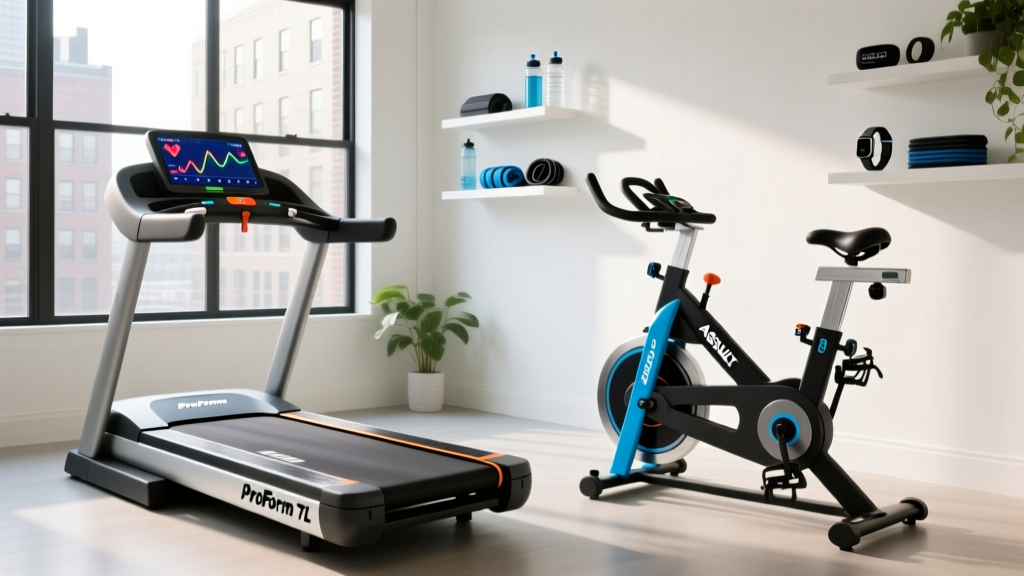
ProForm TL Treadmill vs Air Bikes: 2026 Assault Bike Market Trends

Weslo Cadence G 5.9 Treadmill vs Walking Pads: 2026 Review

Horizon Fitness 101 Treadmill Maintenance: Belt Lubrication Guide
