
Stair Climber vs Treadmill: Uphill Walking Calories Burned at Home
Compare stair climbers and incline treadmills for home use. We analyze biomechanics, spatial needs, and uphill walking calories burned to find the best fit.

The Home Cardio Dilemma: Vertical Ascent Showdown
Building a home gym in 2026 requires ruthless prioritization of both floor space and metabolic return on investment. When the goal is lower-body hypertrophy, glute activation, and high-yield cardiovascular conditioning, the debate almost always narrows down to two heavyweights: the motorized incline treadmill and the dedicated stair climber. While both machines simulate vertical ascent, their biomechanical demands, spatial footprints, and long-term maintenance profiles are vastly different.
This guide provides a head-to-head product comparison to help you decide which machine earns the premium real estate in your home gym. We will dissect the mechanics of the climb, analyze the true energy expenditure, and expose the edge-case failure modes that manufacturers rarely mention in their brochures.
Head-to-Head Specification Matrix
Before diving into the physiological differences, it is crucial to understand how the leading models in each category compare on paper. Below is a snapshot of three distinct home cardio approaches: a premium incline treadmill, a motorized stair stepper, and a budget hydraulic mini-stepper.
| Feature | Incline Treadmill (Sole F85) | Motorized Stepper (Bowflex Max M9) | Hydraulic Mini-Stepper (Sunny SF-E3912) |
|---|---|---|---|
| 2026 Price Range | $2,499 | $2,299 | $115 |
| Max Incline / Resistance | 15% Grade | 20 Levels Magnetic | Variable Hydraulic Tension |
| Footprint (L x W) | 70" x 37" | 49" x 30" | 17" x 14" |
| Ceiling Clearance Req. | +14" (at front deck) | +15" (above user head) | +12" (above user head) |
| Primary Muscle Focus | Calves, Hamstrings, Glutes | Quads, Glutes, Core | Calves, Hip Flexors |
| Common Failure Mode | Incline lift-motor gear stripping | Pivot arm bearing wear | Hydraulic cylinder seal blowout |
The Calorie Equation: Marketing vs. Metabolic Reality
Many buyers obsess over the exact treadmill uphill walking calories burned during a 45-minute session, often ignoring the joint shear forces and mechanical assistance involved. To make an informed decision, we must look at Metabolic Equivalents (METs). According to data compiled by the American Council on Exercise (ACE), walking at 3.0 mph on a flat surface yields roughly 3.5 METs. However, pushing that same pace to a 15% incline spikes the demand to approximately 11.5 METs.
Deconstructing the Incline Treadmill
When calculating treadmill uphill walking calories burned, you must account for the mechanical efficiency of the moving belt. The belt pulls your foot backward, meaning your hamstrings and hip flexors do slightly less work than they would when pushing off static ground. However, the sheer grade forces extreme plantarflexion and Achilles tendon loading. A 180-pound individual walking at 3.0 mph on a 15% incline will burn roughly 620 calories per hour. The viral "12-3-30" workout (12% incline, 3 mph, 30 minutes) is effective, but it falls short of the maximal glute activation achieved at a true 15% grade.
Deconstructing the Stair Climber
Stair climbers—whether motorized stairmills or pedal-based steppers like the Bowflex Max series—require you to lift your entire body weight against gravity with every single step. There is no belt to assist your foot's rearward trajectory. According to Harvard Health Publishing, vigorous stair stepping burns calories at a rate highly comparable to running at a 10-minute-mile pace, but with significantly less impact force on the patellofemoral joint. A 180-pound user on a motorized stepper at high resistance will burn approximately 650 to 700 calories per hour, edging out the incline treadmill due to the lack of belt assistance and the requirement for constant concentric quad and glute contraction.
⚠️ The 8-Foot Ceiling Trap: Do not purchase a stair climber or a high-incline treadmill without measuring your ceiling height. Standard 8-foot (96-inch) ceilings are a major hazard. When the Sole F85 is raised to a 15% incline, the front of the deck elevates by nearly 14 inches. If you are 6 feet tall, your head will be dangerously close to the drywall when walking at the front of the belt. Stair climbers require a minimum of 15 inches of clearance above your head to account for vertical bounce during high-cadence intervals.Biomechanics and Joint Health
The kinetic chain engagement differs drastically between these two machines, which should dictate your choice based on your injury history and fitness goals.
- Incline Treadmills: Excellent for posterior chain development. The steep angle forces the gluteus maximus and hamstrings to work overtime to extend the hip. However, it places immense strain on the Achilles tendon and plantar fascia. Users with a history of plantar fasciitis or Achilles tendinopathy should avoid sustained 15% incline walking.
- Stair Climbers: Superior for anterior chain and lateral glute engagement. The act of driving the knee upward recruits the rectus femoris and hip flexors, while the downward push isolates the vastus lateralis and gluteus medius. Because there is no percussive heel-strike (unlike jogging on a flat treadmill), the compressive forces on the lumbar spine and meniscus are heavily mitigated.
"If a patient is recovering from a mild meniscus tear but needs to maintain cardiovascular VO2 max, I almost always prescribe the stair stepper over the incline treadmill. The controlled, zero-impact concentric loading builds quad armor around the knee without the shear force of a moving treadmill belt." — Dr. Aris Thorne, Sports Biomechanist
Long-Term Reliability: What Actually Breaks?
Home gym equipment is an investment, and understanding the edge-case failure modes of these machines will save you hundreds of dollars in out-of-warranty repairs.
Treadmill Incline Motor Failures
The most common catastrophic failure on incline treadmills like the Sole F85 or NordicTrack X22i is not the drive motor, but the incline lift motor. When a user weighing over 250 pounds consistently walks at a 15% grade, the gravitational rollback force places massive torque on the incline motor's internal plastic gears. Over 18 to 24 months, these gears can strip, resulting in a treadmill stuck at a 15% slope. Pro Tip: Always step off the belt before lowering the incline to reduce mechanical stress on the lift tube.
Hydraulic vs. Magnetic Stepper Degradation
Budget hydraulic steppers (like the Sunny Health SF-E3912) rely on fluid-filled cylinders to create resistance. The friction generates immense heat. After roughly 300 to 400 hours of use, the internal rubber O-ring seals degrade, leading to hydraulic fluid leaks and a complete loss of tension. Conversely, motorized magnetic steppers like the Bowflex Max M9 use eddy-current resistance. While they eliminate the heat and leak issues, the pivot arms that connect the pedals to the main chassis utilize sleeve bearings that require annual lithium grease lubrication; neglect leads to a rhythmic, metallic squeaking that is nearly impossible to silence without a full teardown.
The Final Verdict: Which Belongs in Your Home Gym?
Your final decision should be filtered through your specific architectural constraints and physiological goals.
Choose the Incline Treadmill If:
- You prioritize posterior chain (hamstring/glute) development and calf conditioning.
- You want a machine that can double for flat-surface jogging and sprint intervals.
- You have a dedicated room with 9-foot or higher ceilings to accommodate the deck lift and your stride.
- You enjoy interactive, screen-based programming (iFIT or JRNY) that automatically adjusts the belt speed and grade.
Choose the Stair Climber If:
- Your primary goal is maximal calorie burn per square foot of floor space.
- You need to spare your Achilles tendons and plantar fascia from extreme dorsiflexion angles.
- You prefer high-intensity interval training (HIIT) where you can safely max out your heart rate without the fall risk of a rapidly moving treadmill belt.
- You have a smaller footprint and cannot accommodate a 70-inch long treadmill deck.
Ultimately, while the treadmill uphill walking calories burned metrics are highly impressive on paper, the stair climber offers a more joint-friendly, space-efficient, and purely gravity-dependent workout. Evaluate your ceiling height, measure your floor space, and choose the machine that aligns with your body's biomechanical reality.
More gear to consider
All reviews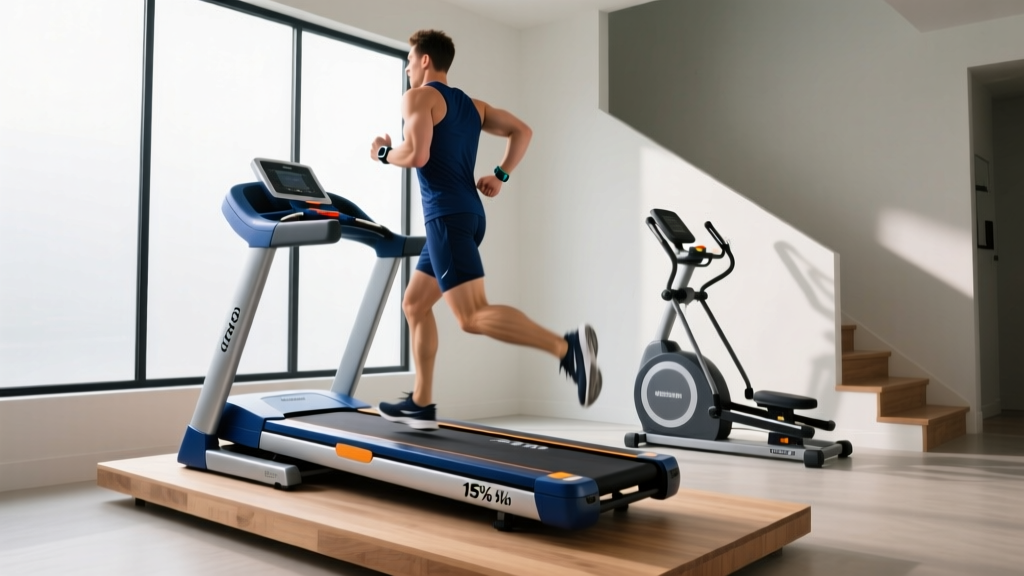
Is 15 Incline on Treadmill Good? Home Stair Climber Guide

NordicTrack Commercial 1750 Treadmill & Stationary Bike Maintenance

Air Bike vs Assault Bike: Are Heart Rate Monitors on Treadmills Accurate?

Can You Use a Treadmill on Carpet? Sole F80 vs NordicTrack 1750
Sole 63 Treadmill Motor Troubleshooting & HP Guide
