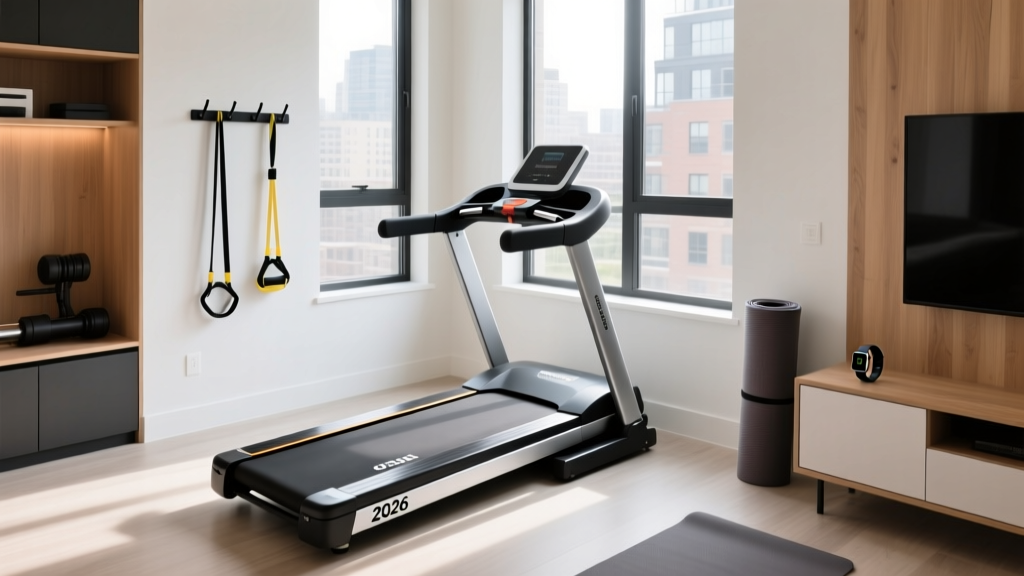
Using a Treadmill at Home: Top Folding Treadmills for 2026
Discover the best folding treadmills for small spaces in 2026. Expert reviews, spatial layout tips, and safety clearances for using a treadmill at home.

When square footage is at a premium, the idea of dedicating a massive 70-inch by 30-inch footprint to a cardio machine can feel impossible. Yet, the physiological benefits of daily walking and running remain unmatched. For urban dwellers, apartment renters, and homeowners with multi-use rooms, folding treadmills offer a vital compromise between performance and spatial efficiency. However, not all folding mechanisms are created equal, and the term 'space-saving' is frequently abused by manufacturers.
In this comprehensive 2026 review, we approach cardio equipment from a strict space optimization and interior layout perspective. We will dissect the actual folded dimensions, structural integrity, and spatial realities of using a treadmill at home, ensuring you choose a machine that respects both your fitness goals and your floor plan.
The Spatial Reality: Beyond the Folded Dimensions
Most buyers focus exclusively on the folded footprint, but true space optimization requires analyzing the machine in three distinct states: the active footprint, the folded footprint, and the transition zone. The transition zone is the physical arc required to safely lower or raise the deck. If your ceiling height is a standard 8 feet (96 inches), a treadmill with a 75-inch folded upright height requires careful angling to avoid scraping drywall during deployment.
Furthermore, visual weight matters immensely in small spaces. A bulky, matte-black treadmill with thick uprights will make a 150-square-foot room feel claustrophobic, even when folded. Modern 2026 designs increasingly utilize low-profile consoles, matte white or grey finishes, and hidden hydraulic hinges to reduce visual clutter and blend with contemporary living room aesthetics.
The Invisible Footprint: Clearance and Safety Zones
A critical, often overlooked aspect of spatial planning is the mandatory safety clearance. According to the U.S. Consumer Product Safety Commission (CPSC), treadmills require specific clearance zones to prevent severe friction burns and impact injuries in the event of a fall.
Spatial Safety Rule: You must maintain a minimum of 2 feet (24 inches) of clear space on both sides of the treadmill, and a minimum of 6 feet (72 inches) of unobstructed space directly behind the rear roller. Do not place walls, glass doors, or heavy furniture in this rear ejection zone.This means a treadmill with a 70-inch long deck actually demands a 142-inch long operational zone. When mapping out your room layout, measure from the front of the motor housing to the wall behind you, not just the edges of the machine.
2026 Folding Treadmill Comparison Matrix
Below is a data-driven comparison of three top-tier folding treadmills evaluated specifically for small-space living. We prioritize the ratio of active belt size to folded volume.
| Model | Active Belt (W x L) | Folded Dimensions | Motor & Speed | Est. Price (2026) |
|---|---|---|---|---|
| Horizon Fitness T202 | 20 in x 60 in | 34 x 27 x 76 in | 2.75 CHP / 12 MPH | $799 |
| NordicTrack T Series 10 | 20 in x 55 in | 29 x 29 x 58 in | 2.6 CHP / 12 MPH | $599 |
| WalkingPad X21 Dual-Fold | 19 in x 47 in | 38 x 22 x 8 in | 1.25 HP / 7.5 MPH | $549 |
Deep Dive: Top Space-Saving Models Reviewed
1. Horizon Fitness T202: The Mid-Range Spatial Champion
The Horizon T202 remains a benchmark for users who need a full 60-inch running deck but cannot sacrifice permanent floor space. Its patented FeatherLight folding system uses a hydraulic cylinder that allows users of all strengths to lower the deck safely with a single latch release.
- Pros: Excellent 2.75 CHP motor prevents overheating during long runs; 3-zone cushioning reduces joint impact; Bluetooth audio integration.
- Cons: The 76-inch folded height requires standard or vaulted ceilings; the console remains visually prominent even when folded.
- Edge Case & Failure Mode: Users exceeding 275 lbs may notice slight deck flex at maximum incline (12%). Over time, the hydraulic hinge may require lubrication to prevent squeaking during the fold/unfold transition.
2. NordicTrack T Series 10: The Smart Compact Option
For those prioritizing interactive training via iFit but lacking a dedicated gym room, the T Series 10 offers a highly compact 29x29 inch folded base. The upright folds down to just 58 inches, making it ideal for rooms with low ceilings or sloped attic walls.
- Pros: Extremely small base footprint when folded; built-in tablet holder; automatic incline adjustment up to 10%.
- Cons: The 55-inch belt is too short for runners with a stride longer than 45 inches; requires an ongoing iFit subscription for optimal UX.
- Edge Case & Failure Mode: The compact motor housing limits airflow. If used for continuous running at high inclines in a warm room (above 75°F), the thermal safety shutoff may engage. It is strictly designed for walking, jogging, and interval training, not marathon-pace endurance runs.
3. WalkingPad X21 Dual-Fold: The Ultra-Compact Disruptor
The WalkingPad X21 abandons the traditional upright design entirely, utilizing a patented 180-degree dual-fold hinge. It folds into an 8-inch thick slab that can slide under a bed or stand vertically in a closet. This is the ultimate solution for micro-apartments.
- Pros: Unmatched storage versatility; zero visual weight when stored; plug-and-play setup with no assembly required.
- Cons: No incline capability; 19-inch width demands strict running form; lacks traditional safety handrails.
- Edge Case & Failure Mode: The 1.25 HP motor is strictly for walking and light jogging. Attempting to run at the 7.5 MPH max speed for extended periods will cause rapid belt degradation and motor strain. Furthermore, the lack of a front handrail makes it unsuitable for users with balance impairments.
Layout Hacks for Micro-Apartments and Dens
Integrating a cardio machine into a living space requires deliberate interior design choices. According to American Heart Association (AHA) guidelines on home workouts, creating a dedicated, psychologically distinct zone for exercise improves long-term adherence, even in small rooms.
Design Tip: Use lighting to define the space. A dedicated, color-tunable LED floor lamp positioned behind the folded treadmill can create a 'gym mode' ambiance, psychologically separating your workout zone from your living area without requiring physical walls.
Consider placing the treadmill facing a window rather than a blank wall or a television. Natural light improves circadian rhythm alignment during morning walks, and the outward focus reduces the feeling of confinement in small rooms. If the machine must face a wall, mount a large, frameless mirror above the console. This reflects light and creates the optical illusion of doubled square footage.
Structural Integrity, Acoustics, and Floor Protection
When using a treadmill at home, the dynamic load placed on your flooring is significantly higher than the static weight of the machine. A 180 lb runner striking a 150 lb treadmill deck generates impact forces exceeding 500 lbs per footfall. In multi-story homes or apartments, this translates to severe low-frequency acoustic transfer that will disturb neighbors or family members below.
To mitigate this, spatial planning must include acoustic decoupling. Do not rely on the thin PVC mats included in the box. Invest in a 3/8-inch thick, high-density EVA foam puzzle mat or a specialized vulcanized rubber treadmill mat (minimum 40 lbs per square yard density). This layer absorbs the kinetic energy of footfalls, protecting hardwood floors from micro-denting and reducing airborne and structure-borne noise by up to 45%.
Final Verdict on Spatial Optimization
Choosing the right folding treadmill is an exercise in balancing biomechanical needs with architectural constraints. If you are a dedicated runner with standard ceilings, the Horizon T202 provides the necessary 60-inch deck while still folding away. If your space is severely restricted and your routine consists of daily power walking and light jogging, the WalkingPad X21 offers an unparalleled storage-to-performance ratio. Always measure your transition zones, respect the rear safety clearances, and invest in proper acoustic dampening to ensure your home gym enhances your living space rather than compromising it.
More gear to consider
All reviews
How to Center a Treadmill Belt: Ultimate Maintenance Guide

Treadmill Trail Tech: 2026 Folding Treadmill for Small Spaces Review

Echelon Stride 6s Treadmill vs Rowers: Buying Guide & Technique

Air Bike vs Assault Bike: Better Than Great Treadmill Workouts?

How to Use a Treadmill for Weight Loss: Setup & Buyer Guide
