Power Rack vs Squat Rack vs Squat Stand: Dumbbell Coffin Press Guide
Compare power racks, squat racks, and squat stands for heavy lifting and the dumbbell coffin press. Expert 2026 guide on dimensions, safety, and cost.

The Architectural Divide: Choosing Your Gym's Centerpiece
Building a comprehensive home gym in 2026 requires balancing spatial constraints, budget, and biomechanical safety. While standard barbell squats and bench presses dictate the baseline requirements for your lifting station, programming advanced isolation movements introduces complex spatial challenges. A prime example is the dumbbell coffin press—a highly effective, narrow-grip pressing and fly hybrid that targets the sternal pectorals and triceps. Executing this movement safely with heavy loads demands specific clearance and spotter configurations that not all racks can accommodate.
Whether you are outfitting a commercial facility or a garage gym, understanding the structural nuances between a full power rack, a squat rack (half rack), and independent squat stands is critical. This guide breaks down the engineering, safety profiles, and real-world failure modes of each setup, ensuring your equipment matches your programming.
Power Racks: The Ultimate Safe Haven for Heavy Isolation
Full power racks (often called cages) feature four to six upright posts connected by top and bottom crossmembers. They are the gold standard for solo lifters handling maximal loads.
Key Specifications and Clearances
- Upright Dimensions: Premium 2026 models like the Rogue R-3 or Titan T-3 utilize 11-gauge 3x3-inch steel tubing.
- Interior Width: Standard interior clearance is 43 to 49 inches. This width is the defining factor for wide-wing dumbbell movements.
- Hole Spacing: 'Westside' hole spacing (1-inch gaps in the bench/press zone) allows for micro-adjustments of safety spotter arms, crucial for dialing in the exact range of motion for a dumbbell coffin press.
Why Power Racks Excel for the Dumbbell Coffin Press
The dumbbell coffin press involves lying on a narrow bench, pressing the dumbbells together or in a tight, inward arc. If you reach muscular failure with 90-pound dumbbells, you cannot simply dump the weight forward as you would with a barbell. You must drop the dumbbells laterally or inward. A full power rack equipped with nylon safety straps (rather than rigid pin-and-pipe safeties) provides a continuous, forgiving catch zone that prevents metal-on-metal damage and dangerous bounce-backs.
Squat Racks (Half Racks): The Middle Ground
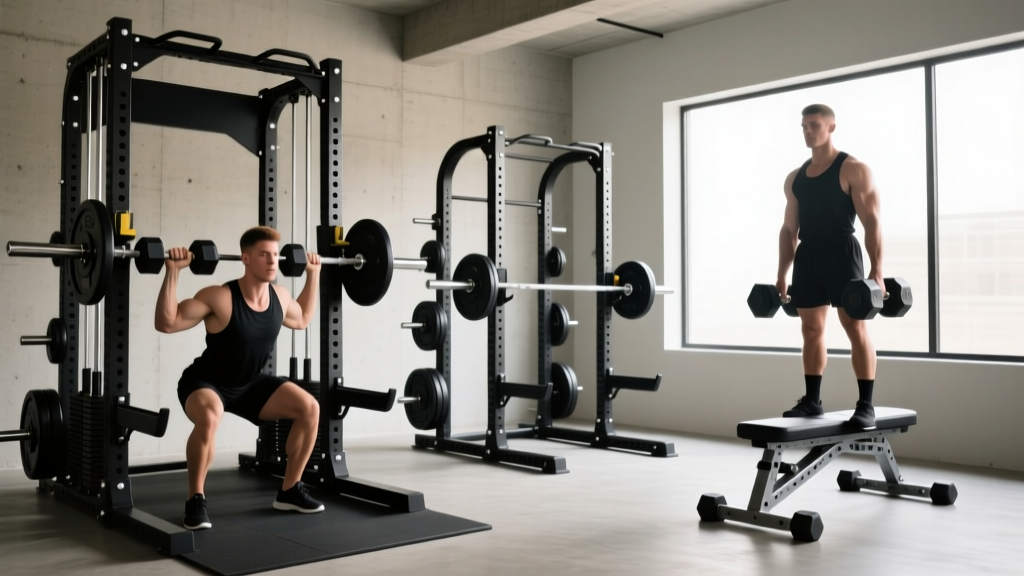
Squat racks, or half racks, typically feature two main uprights with an open front, sometimes supplemented by two shorter rear posts used for weight plate storage. Models like the REP Fitness PR-4000 Half Rack offer a hybrid approach.
Pros and Cons for Advanced Pressing
Pros:
- Unrestricted bar path for Olympic lifts (cleans, snatches).
- Easier to maneuver adjustable benches in and out of the lifting zone.
- Rear weight storage horns act as a counterbalance, increasing overall footprint stability.
Cons:
- Front spotter arms extend outward, creating tripping hazards in tight spaces.
- Lateral safety is compromised; if a dumbbell rolls off the edge of a bench during a coffin press, front spotter arms will not catch it unless they are exceptionally wide and positioned perfectly.
Squat Stands: Minimalist Footprints and Storage Realities
Squat stands consist of two independent uprights with weighted bases. They are the most budget-friendly and space-efficient option, with models like the Rogue S2 Squat Stand 2.0 dominating the entry-level market.
Expert Warning: Squat stands are strictly designed for vertical loading. Performing any movement where the center of gravity shifts laterally—such as walking a heavy dumbbell out for a coffin press—introduces a severe tipping hazard if the stands are not bolted into a concrete subfloor.
While excellent for budget-conscious lifters focusing purely on barbell squats and overhead presses, squat stands lack the lateral enclosure required to safely fail a dumbbell pressing movement. If you miss a rep on the coffin press, the dumbbells will fall to the floor, potentially damaging your subfloor, the equipment, or your joints if you attempt to awkwardly catch them.
Biomechanics of the Dumbbell Coffin Press: A Spatial Analysis
To understand why rack geometry matters, we must analyze the movement. The dumbbell coffin press bridges the gap between a close-grip bench press and a pec deck fly. According to biomechanical analyses featured on ExRx.net, maintaining adduction (bringing the weights together) while pressing maximizes sternal pec activation.
The Clearance Math
Consider a standard Olympic lifting bench, which is 12 inches wide. Inside a 49-inch interior power rack, you have 18.5 inches of clearance on either side of the bench. When your arms are fully extended holding dumbbells, your wingspan will easily exceed 60 inches. Therefore, the dumbbells will extend outside the uprights of the rack at the top of the movement. As you lower the weight into the deep stretch of the coffin press, the dumbbells move inward, crossing over the uprights and into the protected safety zone. This transition from unprotected to protected space requires precise spotter arm placement, which is only reliably achievable in a 4-post power rack.
2026 Market Comparison Matrix
The following table compares the three rack categories based on current 2026 market averages for premium, 11-gauge steel models suitable for heavy home gym use.
| Feature | Full Power Rack | Squat Rack (Half Rack) | Squat Stands |
|---|---|---|---|
| Avg. Price Range (2026) | $3,200 - $4,500+ | $1,100 - $1,800 | $400 - $750 |
| Footprint (L x W) | 48" x 48" to 53" x 53" | 48" x 48" (plus front arms) | 24" x 24" per stand |
| Lateral Safety Catch | Excellent (Straps/Pipes) | Poor to Fair (Front Arms) | None |
| Dumbbell Coffin Press Viability | High (with strap safeties) | Moderate (Requires wide arms) | Not Recommended |
| Pull-Up Rigidity | Maximum (4-post cross-tie) | Moderate (can wobble laterally) | N/A |
Real-World Failure Modes and Edge Cases
When evaluating squat stands versus full cages, buyers often overlook dynamic failure modes that occur outside of standard barbell lifting.
1. The 'Walk-Out' Snag (Half Racks)
When setting up for a heavy dumbbell movement, lifters often sit on the edge of the bench, kick the dumbbells up, and scoot backward. In a half rack, the extended front spotter arms frequently catch the lifter's elbows or the dumbbell handles during this setup phase, leading to bruised joints or dropped weights before the set even begins.
2. Bench Slippage on Concrete (Squat Stands)
Independent squat stands rely on the weight of the loaded barbell to stabilize the uprights. However, an adjustable bench placed between the stands has no physical connection to the uprights. During an intense dumbbell coffin press, the natural tendency to drive your feet into the floor will slide the bench backward, misaligning your press path with the stands and creating a catastrophic tipping risk.
3. UHMW Plastic Degradation (Power Racks)
High-end power racks feature UHMW (Ultra-High Molecular Weight) plastic liners on the J-cups and safety straps to protect barbell knurling. However, repeatedly dropping cast-iron or rubber-coated dumbbells onto these safety straps during failed coffin press reps can cause premature micro-tearing in the nylon and plastic components. Solution: Use dedicated, thick rubber crash mats over your safety straps when programming heavy dumbbell isolation work.
Final Verdict: Matching Your Budget and Space
If your programming heavily features unilateral work, heavy dumbbell pressing, and advanced isolation movements like the dumbbell coffin press, the Full Power Rack is a non-negotiable investment. The ability to utilize wide safety straps and micro-adjust the catch height ensures you can train to absolute failure safely. The Rogue R-3 or equivalent 3x3 power racks remain the industry benchmark for this exact use case.
Choose a Squat Rack (Half Rack) only if your garage gym ceiling height prohibits a full cage, or if Olympic weightlifting is your primary focus. Opt for Squat Stands strictly as a budget-conscious solution for barbell squats and overhead presses, but plan to perform dumbbell coffin presses on the floor or a dedicated flat bench away from the stands to mitigate tipping hazards.
Frequently Asked Questions
Can I perform the dumbbell coffin press on the floor instead of in a rack?
Yes, the floor press variation limits the range of motion, which inherently protects the shoulder joint and eliminates the need for spotter arms. However, you lose the deep stretch at the bottom of the movement, which is where the primary hypertrophic stimulus for the sternal pecs occurs.
What width bench is best for use inside a power rack?
A 12-inch wide flat bench is ideal. Benches wider than 14 inches will severely restrict the lateral clearance needed for dumbbell fly and coffin press variations inside a standard 43-inch interior cage.
More gear to consider
All reviews
Barbell Clamps Compared: Safety for Your Dumbbell Gym Workout

Upgrading Dumbbell Workouts at Home: Barbell Setup & Knurl Guide

Olympic Barbell Guide: Weight, Knurling & Double Dumbbell Snatch

Neutral Grip Dumbbell Press Muscles Worked: 2026 Rack Trends
Power Rack vs Squat Rack vs Stand for Dumbbell 45 Hyperextension