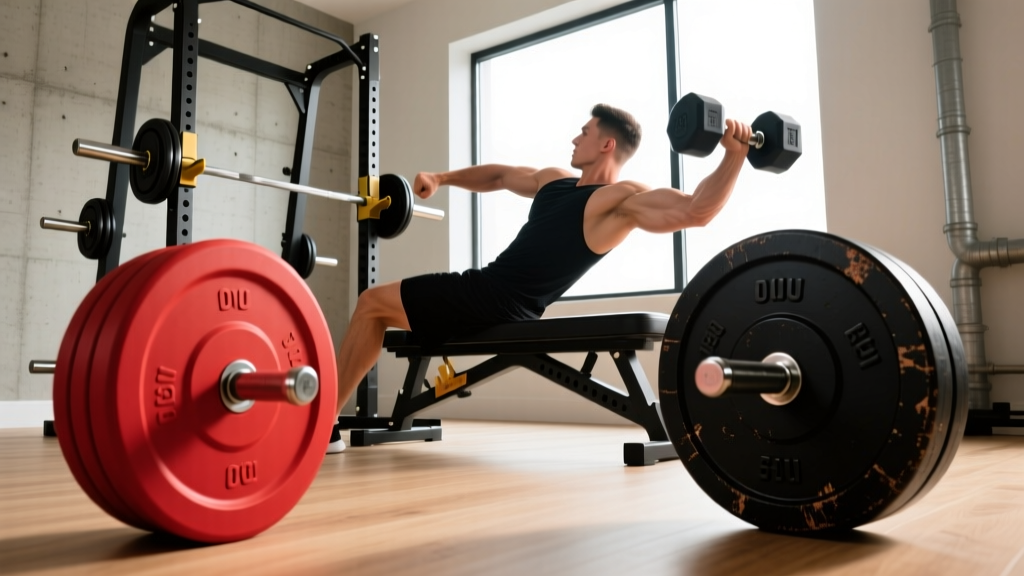
Bumper vs Iron Plates & Leaning Away Dumbbell Lateral Raise
Expert comparison of bumper vs iron plates for your home gym, plus a biomechanical guide to the leaning away dumbbell lateral raise for boulder shoulders.

Building a comprehensive home gym in 2026 requires a strategic approach to equipment acquisition. You need the raw, unyielding mass for heavy compound movements, alongside precision tools for targeted hypertrophy. This dual requirement brings us to two critical discussions for any serious lifter: the foundational bumper plate vs iron plate comparison for your barbell work, and the biomechanical mastery of isolation movements like the leaning away dumbbell lateral raise for optimal shoulder development.
As equipment reviewers who have tested thousands of pounds of free weights and analyzed joint kinetics, we are breaking down the material science of weight plates and the kinesiology of shoulder abduction. Whether you are outfitting a garage gym or upgrading your commercial facility, these insights will ensure your budget translates directly to performance.
The Foundation: Bumper Plate vs Iron Plate Comparison
The debate between cast iron and rubber bumper plates is often reduced to 'dropping vs. not dropping,' but the reality involves nuanced differences in manufacturing tolerances, floor impact, and barbell whip. According to equipment specifications from Rogue Fitness, the inner diameter machining and steel insert quality dictate the lifespan of your plates.
Material Science & Manufacturing Tolerances
Cast Iron Plates: Traditional iron plates are cast from molten pig iron and steel scrap, then coated in baked enamel or polyurethane. The critical metric here is the inner diameter (ID) tolerance. Premium 2026 iron plates maintain an ID of 50.4mm (+/- 0.1mm). This snug fit minimizes barbell rattle during heavy deadlifts and reduces wear on your bar's chrome or cerakote sleeves. However, their high density means a 45lb plate is relatively thin (approx. 1.5 inches), allowing you to load more weight onto the bar sleeve before running out of space.
Bumper Plates: Bumpers feature a forged stainless steel insert overmolded with virgin or recycled rubber. The rubber's hardness is measured on the Shore A durometer scale. Training bumpers typically sit around 85 HA (offering a moderate bounce), while competition bumpers push past 90 HA for a 'dead bounce' that prevents the bar from rebounding dangerously during Olympic lifts. The primary drawback is thickness; a 45lb bumper can be up to 3.25 inches thick, limiting max sleeve loading to around 500-600 lbs depending on the barbell.
Expert Insight: If your programming heavily features power cleans, snatches, or high-volume touch-and-go deadlifts, virgin rubber bumpers are non-negotiable. If you are strictly powerlifting (squats, bench, controlled deadlifts), machined cast iron offers superior sleeve capacity and a more stable base for floor presses.Head-to-Head Comparison Matrix
| Feature | Cast Iron Plates (Enamel) | Virgin Rubber Bumpers | Crumb Rubber Bumpers |
|---|---|---|---|
| Average Cost (per lb) | $2.00 - $2.50 | $3.50 - $4.50 | $2.50 - $3.00 |
| Thickness (45lb Plate) | 1.4 - 1.6 inches | 3.0 - 3.25 inches | 3.5 - 4.0 inches |
| Durometer / Bounce | N/A (Clanks/Zero Bounce) | 85-90 HA (Low Bounce) | 70-75 HA (High Bounce) |
| Drop Rating | Low (Will crack floors) | High (10,000+ drops) | Medium (Degrades over time) |
| Best Use Case | Powerlifting, Bodybuilding | Olympic Lifting, CrossFit | Budget Home Gyms |
The Accessory Finisher: Leaning Away Dumbbell Lateral Raise
Once your foundational plate setup is dialed in, attention must shift to joint health and aesthetic isolation. The standard lateral raise is a staple, but it suffers from a flawed resistance profile: tension is maximal at 90 degrees of abduction and virtually zero at the bottom of the movement. This is where the leaning away dumbbell lateral raise becomes a game-changer for medial deltoid hypertrophy.
Biomechanics & The Resistance Curve
According to kinesiology data cataloged by the ExRx Kinesiology Database, the standard standing lateral raise primarily loads the deltoid at the top of the arc. By gripping a power rack upright or an incline bench and leaning your body away at a 15 to 30-degree angle, you alter the line of gravitational pull.
This shift creates a moment arm at the very bottom of the movement. The medial deltoid and the supraspinatus (which initiates the first 15 degrees of abduction) are now placed under maximum stretch and tension from rep one. Furthermore, leaning naturally forces you into the scapular plane (scaption)—roughly 30 degrees forward of the frontal plane—which aligns the humerus with the glenoid fossa, drastically reducing the risk of subacromial impingement.
Step-by-Step Execution Guide
- The Anchor: Stand beside a power rack or sturdy squat stand. Grab the upright with your inside hand at roughly waist height.
- The Lean: Plant your feet close to the base of the rack and lean your body outward until your working arm is fully extended and supporting your body weight. Your body should form a straight line from ankles to head, angled at roughly 20 degrees.
- The Scapular Plane: Hold the dumbbell in your outside hand. Rotate your torso slightly so the dumbbell rests just in front of your thigh, not directly at your side.
- The Concentric Phase: Lead with your elbow, raising the weight until your upper arm is parallel to the floor. Do not exceed 90 degrees to avoid upper trapezius takeover.
- The Eccentric Phase: Lower the weight slowly (3-second negative) all the way down until it lightly taps your thigh, maintaining tension thanks to the altered gravity vector.
"The leaning variation eliminates the 'dead zone' at the bottom of the lateral raise. If you aren't utilizing altered gravity vectors or cable laterals to load the bottom range of motion, you are leaving significant medial deltoid growth on the table." — 2026 Biomechanics & Hypertrophy Consensus
Equipment Pairings: What to Buy in 2026
To execute the leaning away dumbbell lateral raise effectively, you need dumbbells that offer micro-loading capabilities. Jumping from 20 lbs to 25 lbs is often too large a leap for the small muscle groups of the shoulder.
- Adjustable Dumbbells (Top Pick): The Nuobell 80lb Adjustable Dumbbells (approx. $429/pair). Their traditional knurled steel handle and 2.5lb increment dial system make them vastly superior for isolation work compared to cage-style dumbbells, which can feel unwieldy during delicate scaption movements.
- Incline Bench (For Anchor): The Rep Fitness AB-3100 2.0 (approx. $349). While you can use a rack, setting an adjustable bench to a 75-degree incline and leaning against the backrest provides a highly stable, repeatable angle for your leaning lateral raises.
- Plate Storage: If mixing iron and bumpers, invest in a vertical plate tree with polyurethane-lined pegs to prevent the steel inserts of your bumpers from scratching your cast iron plates.
Real-World Failure Modes & Edge Cases
When investing in free weights, understanding how equipment fails saves money and prevents injury. Here are the edge cases we monitor in our testing lab:
Plate Degradation
Bumper Insert Separation: The most common failure point in cheap bumper plates is the rubber tearing away from the steel hub. This occurs when the manufacturer uses a smooth steel insert rather than a hooked or grooved insert. Always verify that the brand uses a 'hooked' or 'milled' insert that mechanically locks the rubber in place.
Iron Enamel Flaking: In humid environments (like unclimate-controlled garage gyms), cast iron plates with thin enamel coatings will develop sub-surface rust, causing the paint to bubble and flake onto your floor. Opt for powder-coated or urethane-coated iron plates if humidity exceeds 60% in your workout space.
Shoulder Impingement Risks
When performing the leaning away dumbbell lateral raise, the most frequent error is 'pouring the pitcher' (internally rotating the humerus at the top of the movement). The National Strength and Conditioning Association (NSCA) consistently warns that internal rotation combined with abduction narrows the subacromial space, grinding the supraspinatus tendon against the acromion. Keep your thumbs slightly higher than your pinkies throughout the entire range of motion to maintain a safe, open joint space.
Final Verdict
Equipping a high-performance gym is about balancing the macro and the micro. For your heavy compounds, the bumper plate vs iron plate comparison ultimately comes down to your specific lifting discipline: buy virgin rubber for Olympic drops, and machined cast iron for max-effort powerlifting sleeve capacity. For your accessory work, integrating the leaning away dumbbell lateral raise into your programming will exploit altered resistance curves, ensuring your shoulder hypertrophy matches the raw strength built by your barbell work. Train smart, invest in precision tolerances, and respect the biomechanics.
More gear to consider
All reviews
Dumbbell Deadlift to Press: Loadable Dumbbell ROI
Cast Iron vs Competition Bells & Good Arm Workouts with Dumbbells

Budget Storage for Dumbbell Chest Workouts With Bench: 2026 Guide
Adjustable Dumbbell Review: One Arm Dumbbell Row Bench Supported 2026
Power Rack vs Squat Rack vs Stand for Heavy Dumbbell Press Weight
