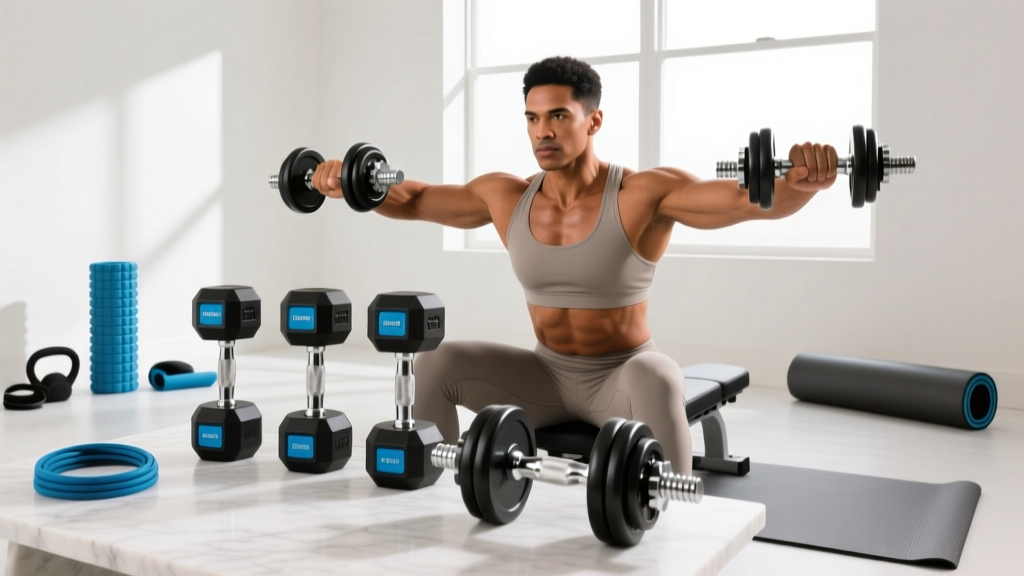
Exercise for Upper Chest with Dumbbells: Loadable Budget Guide
Master the best exercise for upper chest with dumbbells. Compare loadable handles vs. fixed sets with our budget breakdown and value analysis.

The Biomechanical Case for Loadable Micro-Loading
Building the clavicular head of the pectoralis major requires precise angles, strict isolation, and meticulous progressive overload. When programming an exercise for upper chest with dumbbells, most lifters default to the 30-degree incline press or the incline fly. However, the traditional fixed dumbbell rack presents a massive financial and biomechanical hurdle for home gym owners: the dreaded 5-pound weight jump.
According to anatomical mapping by ExRx, the clavicular fibers are highly active during shoulder flexion and horizontal adduction at an upward angle. Isolation movements like the incline dumbbell fly place the shoulder joint in a vulnerable, stretched position. Forcing a 5-pound jump per hand (a 10-pound total increase) on a micro-muscle group often leads to form breakdown, anterior deltoid takeover, and rotator cuff strain. This is where the loadable dumbbell with interchangeable plates becomes a game-changer for hypertrophy and long-term joint health.
Optimal Incline Angles for Upper Chest
Research published in the European Journal of Sport Science (Lauver et al., 2015) demonstrates that a 30-degree bench incline maximizes upper pectoral activation while minimizing front deltoid involvement. At 45 degrees, the anterior deltoid begins to dominate the movement. Ensure your adjustable bench locks securely into the 30-degree notch before loading your interchangeable dumbbells.
Fixed Rack vs. Loadable Handles: The 2026 Budget Breakdown
To understand the true value of loadable dumbbells, we must compare them against the industry standard: a full rack of fixed rubber hex dumbbells. In the 2026 home gym market, supply chain stabilizations have slightly lowered cast iron prices, but urethane and rubber-coated fixed dumbbells remain a premium investment.
| Equipment Setup | Weight Range | Estimated Cost (2026) | Cost Per Pound |
|---|---|---|---|
| Fixed Rubber Hex Set (10 pairs) | 5 - 50 lbs | $850 - $1,100 | ~$1.55/lb |
| Rogue Loadable Handles + Urethane Plates | 5 - 50+ lbs | $525 - $600 | ~$3.50/lb (plates only) |
| Titan Fitness Loadable + Cast Iron Plates | 5 - 50+ lbs | $290 - $340 | ~$2.00/lb (plates only) |
The Value Synthesis: While the upfront cost of premium plates (like Rogue Urethane) seems high per pound, you are only buying the weight you need. A fixed set forces you to buy 15, 25, and 35-pound dumbbells that you may rarely use for upper chest isolation. A loadable setup allows you to buy handles once and incrementally add 1.25lb, 2.5lb, and 5lb plates, saving over 50% compared to a full commercial rack.
Top Loadable Dumbbell Systems Evaluated
Not all loadable dumbbells are created equal. When performing an exercise for upper chest with dumbbells—especially flyes where the weight hovers directly over your face and shoulder joints—collar security and sleeve tolerance are non-negotiable safety metrics.
1. Rogue Fitness Loadable Dumbbell (The Premium Standard)
- Price: ~$175 per pair (handles only)
- Sleeve Diameter: Standard 1.97-inch (50mm)
- Collar Type: Machined steel screw collars with O-rings
- Expert Verdict: Rogue's loadable handles feature a 1.5-inch grip diameter with deep, aggressive knurling. The machined steel collars utilize an internal O-ring that creates immense friction against the plates, completely eliminating the 'rattle' and slippage common in cheaper models. For heavy incline presses, this is the safest option on the market.
2. Titan Fitness Loadable Dumbbell Handles (The Budget Workhorse)
- Price: ~$89 per pair
- Sleeve Diameter: 2-inch Olympic
- Collar Type: Spring collars or standard spin-locks (depending on bundle)
- Expert Verdict: Titan offers incredible value, but the 2-inch Olympic sleeves make the dumbbell physically bulky. During close-grip incline presses, the thick sleeves can prematurely bump against each other or your chest, limiting your range of motion. Furthermore, if using standard spring collars, you must double-check them before every set of incline flyes, as the lateral force of the eccentric stretch can compress the springs over time.
3. Yes4All Standard Spin-Lock (The Ultra-Budget Entry)
- Price: ~$55 per pair (often includes basic cast iron plates)
- Sleeve Diameter: 1-inch Standard
- Collar Type: Threaded star-nut spin-locks
- Expert Verdict: While accessible, the failure modes here are significant. The chrome plating on the threaded sleeves often chips after a few months, causing the star-nut collars to cross-thread and jam. More dangerously, the smooth grip shaft lacks adequate knurling, making heavy incline presses a slipping hazard. Only recommended for light rehabilitation or strict isolation work where heavy loading isn't required.
Plate Selection: The Secret to Upper Chest Hypertrophy
The true advantage of a loadable dumbbell with interchangeable plates lies in micro-loading. To effectively target the upper chest without overloading the anterior deltoid, you need fractional plates.
⚠️ Safety Warning for Incline Flyes: Never use standard 10lb or 25lb cast iron plates on loadable dumbbells for incline flyes. The large diameter of the plates will hit the floor or bench pad before your pectorals reach a full stretch, robbing you of the most hypertrophic portion of the movement. Always use smaller diameter fractional plates (1.25lb to 5lb) for isolation exercises.
Recommended Plate Loadout for Upper Chest Focus:
- 1.25lb Fractional Plates (4x): Essential for progressing on incline flyes. Moving from 20lbs to 25lbs per hand is a 25% load increase—a recipe for tendonitis. Adding 1.25lbs per hand is a sustainable 5% increase.
- 2.5lb Technique Plates (4x): Perfect for transitioning between your warm-up sets and working sets on the 30-degree incline press.
- 5lb and 10lb Cast Iron/Urethane (Multiple): The foundational weight for your heavy 6-8 rep incline press blocks.
Execution: Programming Your Loadable Setup
To maximize your investment, structure your upper chest training to leverage the micro-loading capabilities of your interchangeable plates.
The 'Micro-Step' Incline Protocol
Set your bench to 30 degrees. Begin with a weight you can comfortably press for 10 reps. Instead of resting and repeating the same weight, utilize the rest-pause micro-load method:
- Perform 8 reps to near failure with 30lb dumbbells.
- Rack the dumbbells, rest 45 seconds.
- Swap the outer 2.5lb plates for 1.25lb plates (dropping the total weight by 2.5lbs per hand).
- Immediately perform another 4-6 reps.
- Drop the weight by another 2.5lbs and perform a final burnout set of 3-5 reps.
This mechanical drop-set approach is nearly impossible to execute smoothly with fixed dumbbells in a crowded commercial gym, but in a home gym with loadable handles and pre-sorted interchangeable plates, it takes less than 15 seconds to swap the outer plates.
Frequently Asked Questions
Can I use bumper plates on loadable dumbbells for upper chest exercises?
Technically yes, if you are using Olympic-sleeve handles like the Titan Fitness models. However, bumper plates are highly impractical for dumbbell work. Their massive 17.5-inch diameter will severely restrict your range of motion on incline presses and make incline flyes physically impossible without the plates colliding at the top of the movement. Stick to machined steel, urethane, or standard cast iron plates with a smaller footprint.
How do I prevent the collars from loosening during incline flyes?
The lateral torque applied during the eccentric stretch of an incline fly can vibrate standard spin-lock collars loose. To prevent this, invest in handles with machined screw collars (like Rogue) or use heavy-duty aluminum clamp collars (like Lock-Jaw) on Olympic sleeves. Always tighten collars against the plates with firm hand pressure, and give the dumbbell a gentle shake over a padded surface before lying back on the bench.
Is a 45-degree incline better for the upper chest than 30 degrees?
While 45 degrees is commonly found on fixed commercial benches, biomechanical studies indicate that a 30-degree incline optimally isolates the clavicular head of the pectoralis major. A 45-degree angle shifts a significant portion of the load onto the anterior deltoids. If your adjustable bench only has 45-degree and flat settings, consider placing a sturdy block or folded mat under the front leg of the bench to create a custom 30-degree angle.
More gear to consider
All reviews
Decline Press With Dumbbells: Power Rack vs Squat Rack Guide

Dumbbell Rack Layouts: Storing Iron and Wrist Straps for Dumbbells

Budgeting a Chest Muscle Workout with Dumbbells: Hex vs Urethane

Rubber Hex vs Urethane: 2026 Trends & Best Dumbbell Exercise for Triceps

Setup: Barbell Knurling & Dumbbells for Back Shoulder Exercises
