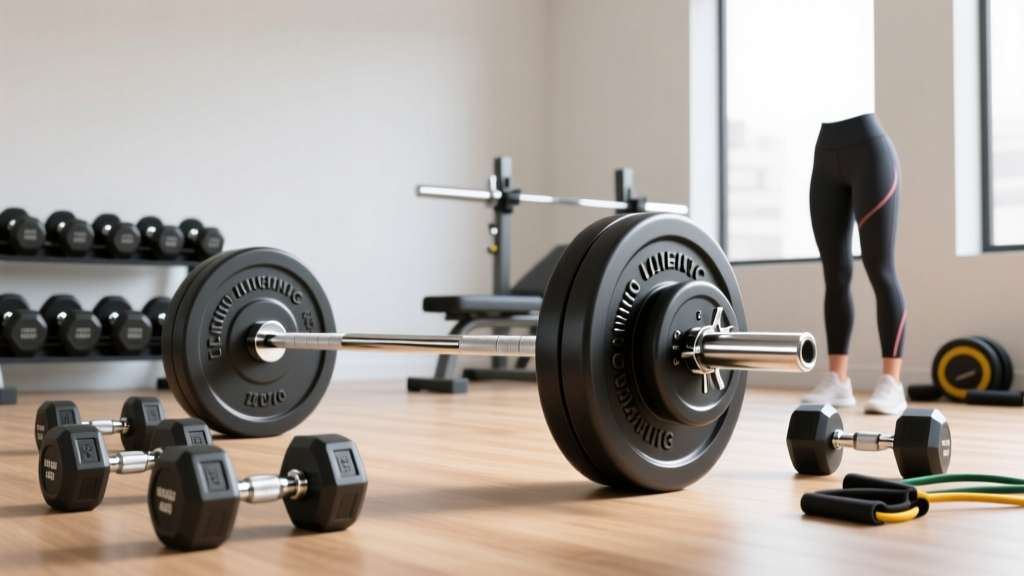
Olympic vs Standard Plates Setup & 15 Minute Upper Body Workout Dumbbells
Master your home gym with our Olympic vs standard weight plates setup guide, plus a 15 minute upper body workout dumbbells finisher to test your new gear.

The Foundation: Why Plate Diameter Dictates Your Rack Setup
Building a dedicated lifting space in 2026 requires precision, spatial awareness, and an understanding of equipment interoperability. When unboxing a new power rack, barbell, and weight plates, the most critical—yet frequently overlooked—variable is the center hole diameter of your plates. Choosing between Olympic and standard weight plates is not merely a matter of preference; it dictates the structural integrity of your barbell, the safety of your rack installation, and your long-term progression ceiling.
This comprehensive setup walkthrough will guide you through the physical installation of your barbell station, break down the exact dimensional differences between plate types, and conclude with a high-intensity 15 minute upper body workout dumbbells routine to test your new gym layout and get a massive pump without taxing your central nervous system on heavy barbell lifts.
Olympic vs. Standard: The Dimensional Breakdown
Before you begin tightening bolts on your squat rack, you must verify that your plates match your barbell sleeves. The fitness industry is largely divided into two diameter ecosystems.
| Feature | Olympic Plates (2-Inch) | Standard Plates (1-Inch) |
|---|---|---|
| Center Hole Diameter | 50.8 mm (2 inches) | 25.4 mm (1 inch) |
| Barbell Sleeve Compatibility | Olympic Barbell (Rotating Sleeves) | Standard Straight Bar (Fixed Sleeves) |
| Max Safe Load Capacity | 500 lbs to 1,500+ lbs | 150 lbs to 200 lbs (Deflection Risk) |
| Average Cost Per Pound (2026) | $1.80 - $3.50 / lb | $0.90 - $1.40 / lb |
| Plate Material Options | Cast Iron, Urethane, Crumb Rubber, Virgin Rubber Bumpers | Cast Iron, Cement/Vinyl Encased |
Step-by-Step Rack and Barbell Station Installation
Assuming you have invested in the superior 50.8mm Olympic ecosystem (the undisputed standard for serious lifters, as noted by BarBend's equipment experts), follow this walkthrough to set up your station safely.
- Floor Preparation & Matting: Lay down 3/4-inch thick vulcanized rubber horse stall mats. Ensure the seams are tightly butted and secured with heavy-duty double-sided carpet tape to prevent the plates from catching the lip during deadlifts.
- Rack Anchoring: If bolting your rack (e.g., a Rogue SML-2 Monster Lite) to a concrete slab, use 3/8-inch wedge anchors. Drill 1/2-inch holes to a depth of 3 inches, clear the concrete dust with a vacuum, and torque the anchors to 30 ft-lbs.
- Hardware Tightening: Assemble the uprights and crossmembers. Use a calibrated torque wrench to tighten all 3/4-inch Grade 8 bolts to exactly 110 ft-lbs. This specific torque ensures the sandwich-bolt connections are rigid without stripping the threads or crushing the UHMW plastic spacers.
- J-Cup Spacing: Install your J-cups at a height that allows you to unrack the barbell with a slight 1/4 squat. For a standard 7-foot Olympic barbell, set the J-cups 42 inches apart to clear the inner knurl marks and ensure the load rests entirely on the steel shaft, not the sleeves.
Testing the Space: 15 Minute Upper Body Workout Dumbbells Finisher
Once your heavy barbell station is bolted down, you need to test the spatial flow of your gym. The most efficient way to do this without frying your CNS on heavy squats or bench presses is a targeted accessory session. Adjustable dumbbells (like the Nuobell 80s or PowerBlock Elite USA) are perfect here, as their compact footprint allows you to move freely inside the rack footprint.
Below is a highly effective 15 minute upper body workout dumbbells AMRAP (As Many Rounds As Possible) protocol. This routine is designed to drive blood into the muscle, test your floor clearance, and validate your gym's ergonomics.
'The goal of this 15-minute block is metabolic stress and spatial utilization. Keep your rest periods strictly under 15 seconds between transitions. According to the American Council on Exercise (ACE), minimizing rest in multi-joint dumbbell circuits significantly elevates post-exercise oxygen consumption (EPOC).'
The 15-Minute AMRAP Protocol
- 12 Dumbbell Push Presses: Use the leg drive to move heavier weights (e.g., 50-60 lbs per hand). This tests your overhead clearance within the rack.
- 15 Bent-Over Dumbbell Rows: Hinge at the hips, keeping the back flat. Pull the dumbbells toward your hip pocket. This utilizes the floor space directly in front of the rack.
- 20 Dumbbell Floor Presses: Lie directly on the rubber matting inside the rack footprint. Press the weights up, allowing your triceps to lightly tap the floor at the bottom. This protects your shoulders while hammering the chest and triceps.
- 24 Alternating Hammer Curls: Stand tall and alternate arms. Focus on the brachialis and forearm brachioradialis to build elbow stability for your heavy barbell pulling days.
Long-Term Investment & Edge Cases
When outfitting your gym, understanding the failure modes of your equipment is just as important as the installation. Standard 1-inch barbells are notorious for catastrophic deflection. If you load 200 lbs onto a standard 1-inch bar, the tensile strength of the low-grade steel will cause the bar to bend permanently, and the sleeve welds can snap under the shear force of a dropped lift.
Conversely, Olympic plates and bars are built to the specifications of the International Weightlifting Federation. A quality Olympic barbell features a tensile strength of 190,000 to 215,000 PSI, allowing it to whip and return to true center without permanent deformation. While the upfront cost of Olympic plates (such as the Rogue Echo Bumper Plates) is higher, the cost-per-pound drops significantly when buying in 500+ lb sets, and the resale value remains remarkably high in the secondary market.
Frequently Asked Questions
Can I mix rubber bumper plates and cast iron plates on the same barbell?
Yes, provided they are both Olympic (2-inch) plates. However, always load the iron plates on the outside of the bumpers if you are dropping the bar, as the steel hubs of iron plates can crack the rubber of bumper plates upon high-impact drops.
Do I need a specific dumbbell handle diameter for the 15-minute workout?
Standard adjustable dumbbells usually feature a 1-inch to 1.15-inch handle. This is ideal for high-rep upper body work, as it allows for a secure grip without the excessive forearm fatigue associated with thick-grip (2-inch) axle dumbbells.
More gear to consider
All reviews
Beyond Dumbbell Cardio: Cast Iron vs Competition Kettlebells
Barbell Collar Clamp Types & Dumbbell Skull Crusher Workout Safety

Power Rack vs Squat Rack: Hitting Dumbbell Bench Press Standards

Setup Guide: Biceps Exercises With Dumbbells At Home

Cast Iron vs Competition Kettlebells & Big Arms Workout with Dumbbells Care