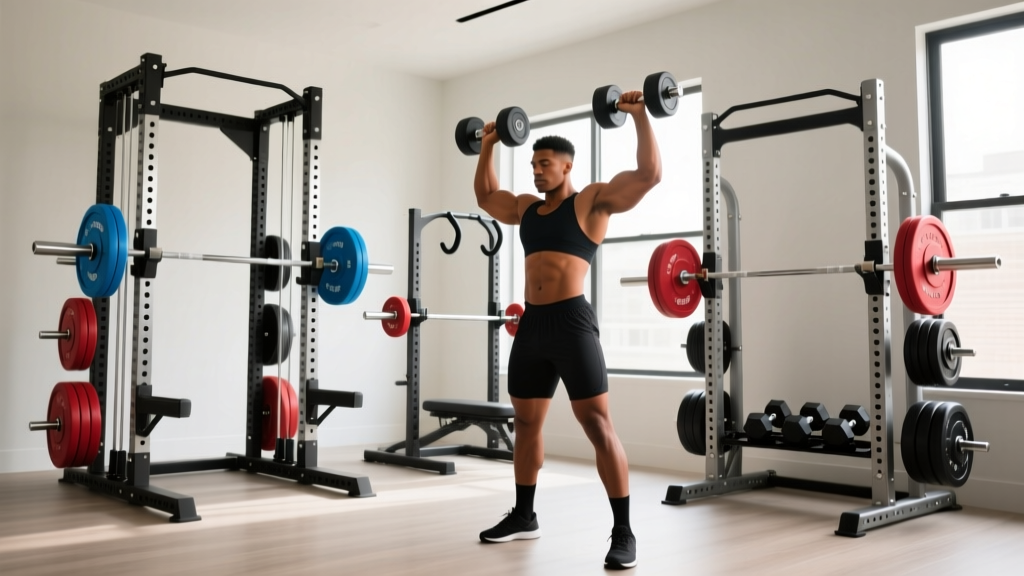
Power Rack vs Squat Rack vs Stand: Work Shoulders with Dumbbells
Compare power racks, squat racks, and stands for your 2026 home gym. Learn which setup safely lets you work shoulders with dumbbells and lift heavy.

The Hidden Danger of Heavy Dumbbell Shoulder Presses
When outfitting a home gym in 2026, most buyers focus on barbell squats, bench presses, and deadlifts. However, a critical and often overlooked requirement is the ability to safely work shoulders with dumbbells at near-maximal loads. The seated dumbbell shoulder press is a staple for anterior deltoid hypertrophy, but it carries a unique risk profile. Unlike a barbell overhead press, where the bar can be safely dumped forward or caught on a rack, independent dumbbells require complex stabilization.
According to the American Academy of Orthopaedic Surgeons, the shoulder joint is highly vulnerable to rotator cuff tears and impingement when placed under heavy load in an externally rotated and abducted position—the exact biomechanical state of your arms at the bottom of a dumbbell press. If you fail a rep with 90 lb or 100 lb dumbbells, your arms can buckle outward, leading to catastrophic shoulder injuries. Therefore, the type of rack you choose dictates not just your barbell safety, but your ability to safely push dumbbells to failure.
Power Racks (Full Cages): The Gold Standard for Safety
A full power rack, characterized by four uprights and an enclosed cage, is the undisputed champion for heavy dumbbell work. Models like the Rep Fitness PR-4000 or the Rogue RML-390F (typically ranging from $999 to $1,450 in 2026) offer 3x3-inch 11-gauge steel uprights with Westside hole spacing (1-inch spacing in the bench press zone).
Why Full Cages Excel for Dumbbell Shoulders
- Adjustable Spotter Arms: You can slide pin-and-pipe safety catches or UHMW-lined safety straps into the uprights at the exact height needed to catch the dumbbells if your elbows give out.
- Internal Footprint: A standard 47-inch interior width allows you to position an adjustable FID (Flat/Incline/Decline) bench squarely inside the rack, keeping you centered and preventing the dumbbells from clipping the uprights during the ascent.
- Pull-Up and Attachment Ecosystem: Full cages allow for the addition of lat pulldown modules, which pair perfectly with shoulder-focused accessory work.
Half Squat Racks: The Open-Front Compromise
Half racks, such as the Titan Fitness T-3 Half Rack ($650–$850) or the Rogue HR-2, feature two main uprights with a rear storage crossmember. They are designed to save floor space and provide an open front for Olympic lifting variations.
The Dumbbell Dilemma in Half Racks
While half racks do include spotter arms that extend forward, they present a spatial challenge for dumbbell shoulder presses. To safely work shoulders with dumbbells, you must drag your adjustable bench entirely inside the footprint of the spotter arms. Because half racks often have a shallower overall depth (around 34 to 40 inches) compared to full cages, positioning a bench inside while leaving enough room to kick the dumbbells up from your knees can feel claustrophobic.
Furthermore, if you fail a rep and drop the dumbbells laterally (outward), the spotter arms on a half rack might not be wide enough to catch them, leaving your rotator cuffs exposed. Half racks are excellent for barbell work, but they are a secondary choice for heavy, independent dumbbell pressing.
Squat Stands: Minimalist, But Are They Safe for Dumbbells?
Squat stands are essentially two independent metal posts, such as the Rogue SML-1 Monster Lite ($495) or budget options like the Fitness Reality 8000 ($250–$350). They boast the smallest footprint and are ideal for garage gyms with low ceilings or tight square footage.
The Fatal Flaw for Shoulder Pressing
Squat stands are engineered for one primary purpose: catching a barbell during a back squat or bench press. The safety catchers are spaced to match the width of a standard 7-foot Olympic barbell. When you sit on a bench to work shoulders with dumbbells, your hands are operating entirely outside the footprint of the safety arms. If you reach muscular failure at the bottom of the movement, there is absolutely nothing to catch the weights. You are forced to dump the dumbbells to the floor—a maneuver that is not only dangerous for your shoulders but can also destroy your flooring and the dumbbells themselves. We do not recommend squat stands for lifters who prioritize heavy dumbbell shoulder work.
2026 Equipment Comparison Matrix
The table below breaks down the critical specifications for home gym buyers evaluating these three setups, specifically through the lens of dumbbell safety and versatility.
| Equipment Type | Avg. Price Range (2026) | Footprint (L x W) | Safety for DB Shoulder Press | Best Use Case |
|---|---|---|---|---|
| Power Rack (Full Cage) | $950 – $1,500+ | 48" x 48" to 53" x 53" | Excellent (Enclosed, adjustable straps) | Heavy lifters, training to failure safely |
| Half Squat Rack | $650 – $900 | 36" x 48" to 43" x 48" | Moderate (Limited lateral catch area) | Garages with low ceilings, Olympic lifts |
| Squat Stand | $250 – $550 | 30" x 30" to 36" x 40" | Poor (No lateral safety for DBs) | Beginners, tight spaces, strict barbell use |
Step-by-Step: Rigging Your Rack for Seated Dumbbell Presses
If you have invested in a full power rack, you must set it up correctly to maximize safety and biomechanical efficiency. Follow this protocol to properly work shoulders with dumbbells:
- Set the Bench Angle: According to ExRx.net, a completely vertical 90-degree bench can cause impingement and force the lumbar spine into excessive extension. Set your adjustable bench to a 75 to 80-degree incline. This aligns the scapula optimally and targets the anterior deltoids safely.
- Position the Bench: Slide the bench into the center of the power rack. Ensure the backrest is aligned with the center of the uprights so your arms have equal clearance on both sides.
- Set the Safety Straps: Sit on the bench with empty hands in the bottom position of the press (dumbbells at ear level, elbows bent at 90 degrees). Measure the distance from the floor to your wrists. Set the safety straps or pin-and-pipe catches exactly 2 to 3 inches below this height. This allows full range of motion while ensuring that if your elbows collapse, the weights are caught before your shoulder capsule is overstretched.
- The Kick-Up Technique: Rest the dumbbells on your thighs. Use your knees to kick the weights up to your shoulders one at a time. Lean back into the 80-degree pad. When the set is over, do not drop the weights from the top. Bring them to your shoulders, tuck your chin, and ride the bench back to an upright position, guiding the dumbbells safely to your knees.
Frequently Asked Questions (FAQ)
Can I use a squat stand if I only use light dumbbells?
If you are strictly using light neoprene or hex dumbbells (e.g., 15 to 35 lbs) for high-rep endurance work or physical therapy, a squat stand is perfectly fine. The risk of severe rotator cuff tearing from a failed 20 lb dumbbell is minimal, and you can easily control the descent or drop them safely to your lap. The danger arises when you progress to heavy loads (60+ lbs per hand) where momentum and fatigue compromise your joint stability.
Do I need a rack with a pull-up bar for shoulder health?
While a pull-up bar is not strictly required to work shoulders with dumbbells, it is highly recommended for structural balance. Heavy overhead pressing tightens the lats and pecs. Hanging from a pull-up bar (dead hangs) decompresses the spine and opens up the subacromial space in the shoulder, helping to prevent the very impingement issues that heavy dumbbell pressing can exacerbate. Most full cages and half racks include a multi-grip pull-up bar as standard.
What is the best dumbbell type for rack-based shoulder presses?
For heavy rack work, urethane-coated round or 12-sided dumbbells are superior to rubber hex dumbbells. Hex dumbbells have protruding edges that can scrape against the steel uprights or safety straps of your power rack if your lateral clearance is tight. Urethane is also significantly more durable; if you accidentally clip the rack during a grueling set, urethane will absorb the impact without tearing or leaving black scuff marks on your equipment.
Final Verdict: What Should You Buy in 2026?
If your training philosophy involves pushing your overhead presses to absolute failure and you want to safely work shoulders with dumbbells, the full power rack is the only logical choice. The ability to enclose your bench and set lateral safety straps transforms a highly dangerous exercise into a safe, muscle-building staple. Look for a cage with 3x3 uprights, 5/8-inch or 1-inch hole spacing, and invest in a set of heavy-duty safety straps.
Half racks are a viable compromise if you are severely limited on depth but still want some safety features, provided you are meticulous about bench placement. Squat stands, while excellent for budget-conscious barbell squatters, should be avoided by anyone serious about heavy, independent dumbbell hypertrophy work. Visit the Rogue Fitness Racks catalog or check out Rep Fitness's latest 2026 lineup to find the exact dimensions that fit your garage space and your lifting ambitions.
More gear to consider
All reviews
EZ vs Straight Bar Care: Longevity & Dumbbell Curl Technique Form
Olympic vs Standard Plates for the Dumbbell Front Raise Exercise

Best Neoprene Dumbbells for a Women's Dumbbell Workout (2026)
Bumper vs Iron Plates: 2026 Trends & Devils Press Dumbbell Boom

Meeting Dumbbell Press Standards: Hex vs Urethane Layouts
