Old Weider Home Gym Models: Space-Saving Beginner Starter Kit Guide
Optimize small spaces around old Weider home gym models. Discover layout blueprints, clearance metrics, and the ultimate beginner supplement kit for 2026.

The Vintage Advantage: Building a Beginner Kit Around Legacy Equipment
For many beginners stepping into the world of home fitness, the journey doesn't start with a brand-new $3,000 functional trainer. Often, it starts with an inheritance, a garage cleanup, or a $150 Facebook Marketplace steal: one of the many old Weider home gym models. While fitness influencers push the latest compact smart mirrors, legacy Weider all-in-one machines—like the Pro 2980 or the 9940 dual-stack—remain incredibly effective for building foundational muscle. However, they present a massive spatial challenge. These vintage behemoths were designed for sprawling 1990s basements, not modern compact home gyms.
If you are a beginner looking to build an essential home gym starter kit around an existing or newly acquired vintage Weider machine, space optimization is your primary hurdle. This guide will walk you through exact clearance metrics, layout blueprints, and the specific supplemental gear you need in 2026 to turn a bulky relic into a highly efficient, space-saving beginner sanctuary.
Identifying Your Weider Model and Its Spatial Footprint
Before you can optimize your layout, you must understand the exact spatial demands of your machine. Old Weider home gym models generally fall into three categories, each with distinct dimensional challenges:
- Weider Pro 2980 (and similar single-stack variants): The most common garage-sale find. Features a 130-lb vinyl or cast-iron weight stack and a basic high/low pulley system.
- Weider 9940 / Pro 4900 (Dual-Stack or Multi-Station): Much larger, often featuring a dedicated leg press attachment and dual weight stacks. These require significant lateral clearance.
- Weider System 100 / Compact Series: Rare, foldable, or smaller-footprint models designed specifically for apartments. Easier to place but limited in weight capacity.
⚠️ Critical Safety Inspection for Vintage Cables
Before finalizing your layout, inspect the aircraft cables. According to the U.S. Consumer Product Safety Commission (CPSC), frayed or oxidized cables on older exercise equipment are a leading cause of home gym injuries. If your Weider model has been sitting in a damp garage, replace the 3/16-inch nylon-coated aircraft cables and check the pulley bearings for flat spots before bringing it into your optimized space.
Spatial Geometry: Clearance Metrics and the 'Triangle of Movement'
A common beginner mistake is pushing a legacy Weider machine flush against a wall. This restricts plate loading (if it uses add-on pins), prevents cable travel, and traps dust. To optimize a small room, you must map out the 'Triangle of Movement'—the three primary zones where the user operates the machine (high pulley, low pulley, and press station).
| Weider Model Category | Machine Footprint (W x L) | Minimum Wall Clearance | Total Usable Zone Required |
|---|---|---|---|
| Single Stack (e.g., Pro 2980) | 50" x 70" | 24" (Rear/Sides) | 8' x 10' |
| Dual Stack / Multi-Station | 65" x 85" | 36" (All sides) | 11' x 12' |
| Compact / Foldable | 35" x 55" | 12" (Rear) | 6' x 8' |
Optimizing the High-Pulley Arc
Old Weider home gym models utilize a high-pulley lat pulldown system. When a beginner performs a lat pulldown, the bar travels down and slightly forward. If you place the machine in a corner with only 12 inches of rear clearance, the user's knees will hit the wall or the weight stack will scrape the drywall. Always anchor the rear of the machine exactly 24 inches from the wall to allow the user to sit facing outward, utilizing the room's open space for their knee arc.
The Essential Beginner Supplement Kit (Filling the Gaps)
While your vintage Weider provides excellent guided resistance for chest presses, lat pulldowns, and leg extensions, it lacks free-weight stabilization and horizontal pulling variations. To build a complete essential home gym starter kit without sacrificing your optimized floor plan, you need compact, high-yield supplemental gear.
1. Space-Saving Adjustable Dumbbells
Do not buy a traditional dumbbell rack; it will destroy your spatial layout. In 2026, the gold standard for compact spaces remains dial-adjustable dumbbells. The PowerBlock Sport 24 (approx. $179) or the Nuobell 55 (approx. $349) replace up to 15 pairs of fixed dumbbells, occupying less than 1 square foot of floor space. Use these to supplement the Weider's fixed-path movements with stabilizing exercises like dumbbell lunges, lateral raises, and Romanian deadlifts.
2. Heavy-Duty Loop Resistance Bands
Old Weider models often max out at 130 to 180 lbs on the stack, which beginners will eventually outgrow on compound movements like leg presses or seated rows. Instead of buying bulky weight plates to pin onto the stack, invest in a set of SlingShot Mark Bell loop bands or Serious Steel bands ($40–$80). You can loop these around the base of the Weider and the lat bar to add 50+ lbs of accommodating resistance, completely eliminating the need for extra iron storage.
3. Interlocking Horse Stall Mats
Protect your subfloor and dampen the acoustic impact of dropping dumbbells. Skip the thin PVC yoga mats. Purchase two or three 3/4-inch thick vulcanized rubber horse stall mats (typically 4'x6', available from agricultural suppliers like Tractor Supply Co. for about $55 each). Cut them to fit precisely around the Weider's baseboards to create a seamless, wall-to-wall lifting zone that visually shrinks the machine's footprint by blending it into the floor.
Layout Blueprints: 3 Space-Saving Configurations
Depending on your room's geometry, choose one of these three layout blueprints to integrate your Weider machine and supplemental kit.
Blueprint A: The 'Corner Tuck' (Best for 10x10 Spare Bedrooms)
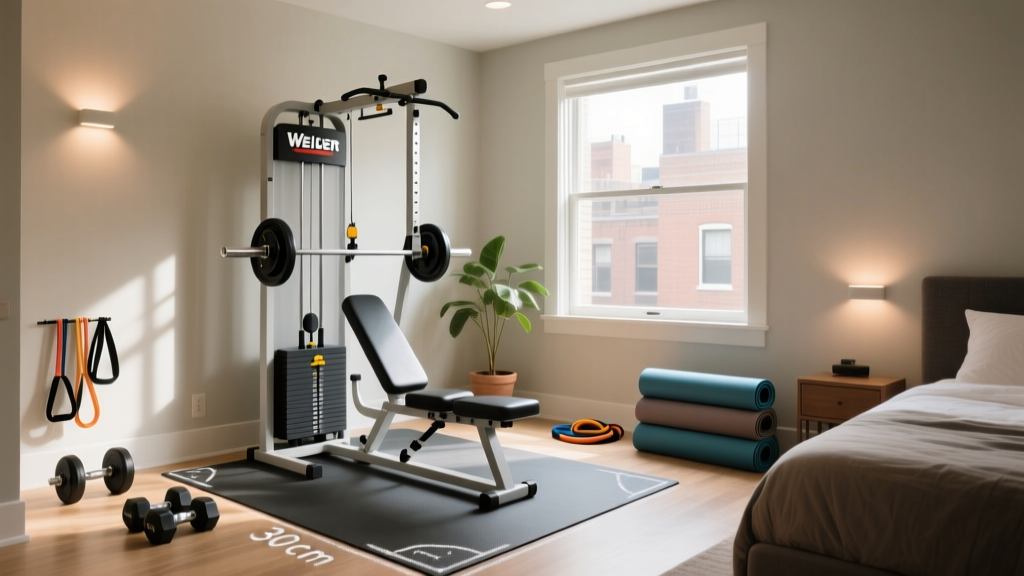
Position the Weider machine diagonally in the corner of the room, facing inward. This creates a triangular dead-space behind the machine where you can store your adjustable dumbbells, resistance bands, and cleaning supplies in a narrow, tiered shelving unit. The open center of the room remains completely clear for floor work, stretching, and dumbbell movements.
Blueprint B: The 'Room Divider' (Best for Open-Concept Basements)
If you are building a gym in an unfinished basement, use the back of the Weider machine as a physical room divider. Place the machine perpendicular to the main wall, leaving 36 inches of clearance on all sides. Mount a full-length mirror on the wall behind the user's seat. This layout creates a dedicated 'lifting zone' on one side of the machine and a 'cardio/mobility zone' on the other, optimizing multi-use spaces without building walls.
Blueprint C: The 'Closet Collapse' (Best for Apartments)
For those using smaller, foldable old Weider home gym models, dedicate a deep walk-in closet or an alcove. Install heavy-duty wall hooks (rated for 50+ lbs) on the side walls to hang your resistance bands, lifting belts, and jump ropes vertically. Keep the adjustable dumbbells on a low, rolling cart that can be pushed under the machine's seat when not in use.
"When designing a home gym around legacy equipment, think vertically. The floor space is dominated by the machine, so your storage for bands, mats, and accessories must utilize wall height up to 7 feet to keep the primary movement zones unobstructed."
Maintenance and Upkeep for Legacy Equipment
Space optimization is useless if the machine is out of order. Maintaining old Weider home gym models requires a specific routine to ensure smooth operation in a tight space where you cannot easily access the rear panels.
- Monthly Pulley Lubrication: Use a dry PTFE (Teflon) spray lubricant on the guide rods and pulley bearings. Avoid wet oils like WD-40, which attract dust and create a grimy buildup that will stain your space-optimized rubber flooring.
- Cable Tension Checks: Vintage Weider cables stretch over time. Locate the tensioning bolt at the top of the weight stack carriage and tighten it until there is zero slack when the pin is inserted into the top plate.
- Upholstery Care: Older vinyl seats crack and peel. If your Weider's bench pad is deteriorating, wrap it tightly in marine-grade vinyl using a heavy-duty staple gun, or purchase a universal neoprene bench cover ($25) to prevent black vinyl flakes from ruining your clean layout.
By respecting the spatial geometry of your equipment and supplementing it with modern, compact gear, you can transform an old Weider home gym model from a garage-cluttering eyesore into a highly efficient, professional-grade beginner training facility. As Mayo Clinic's home fitness guidelines suggest, the most effective home gym is one that removes friction from your daily routine—and a well-optimized, thoughtfully laid-out space does exactly that.
More gear to consider
All reviews
Teeter FitForm Home Gym: Layout & Design Review 2026

Beginner Bowflex Home Gym Workout Guide & Floor Plan

Apartment Home Gym Walls: Complete Small Space Setup Walkthrough

Bowflex Blaze Home Gym: Complete Strength Setup & Installation Guide
Foldable Home Gyms 2026: Buying Guide & Marcy Workout Routine PDF