Loadable Dumbbell Care for Your 15 Pound Dumbbell Workout
Master loadable dumbbell maintenance with our expert guide. Learn thread care, knurling restoration, and weight math for your 15 pound dumbbell workout.

The Hidden Wear-and-Tear of Interchangeable Plate Systems
Loadable dumbbells remain one of the most cost-effective and scalable pieces of equipment in any home gym or commercial facility. Unlike fixed-weight rubber or urethane dumbbells that require massive storage racks, a single pair of loadable handles with interchangeable plates can replace an entire wall of iron. However, this mechanical versatility introduces unique failure points. Thread stripping, knurling degradation, and sleeve friction are constant threats to the longevity of your gear.
When programming a 15 pound dumbbell workout for muscular endurance, rotator cuff rehabilitation, or high-rep metabolic conditioning, precision and equipment reliability are non-negotiable. According to the Centers for Disease Control and Prevention (CDC), adults should engage in muscle-strengthening activities of moderate or greater intensity that involve all major muscle groups on two or more days a week. For smaller stabilizer muscles targeted in a 15 pound dumbbell workout, exact loading prevents compensatory movement patterns and joint strain. If your collars slip during a high-rep lateral raise, or if your handle weight is miscalculated, the biomechanical intent of the exercise is compromised.
The National Strength and Conditioning Association (NSCA) emphasizes that equipment calibration and routine maintenance are critical for consistent feedback and injury prevention. In this guide, we break down the exact maintenance protocols, weight mathematics, and longevity upgrades required to keep your loadable dumbbells in peak condition for years to come.
Calculating True Load: The Math Behind a 15 Pound Dumbbell Workout
One of the most common mistakes lifters make with loadable dumbbells is assuming the weight of the plates equals the total working load. This is a critical error when executing a strict 15 pound dumbbell workout, where a variance of even two pounds can alter the stimulus on the medial deltoids or the biceps brachii.
To calculate the true weight, you must account for the handle, the collars, and the plates. As of 2026, a pair of Titan Fitness 10-inch Olympic loadable handles retails for approximately $45, while premium options like the Rogue Fitness 15-inch loadable handles sit around $95. These handles are not weightless.
| Handle Model | Handle Wt. | Collar Wt. | Plates Needed for 15 lbs Total |
|---|---|---|---|
| CAP Barbell 14in Standard (1in) | 5.5 lbs | 1.2 lbs (pair) | Two 4.15 lb plates (Rare) |
| Titan Fitness 10in Olympic (2in) | 7.5 lbs | 0.8 lbs (pair) | One 5 lb + Two 1.25 lb bumpers |
| Rogue 15in Loadable (2in) | 10.0 lbs | N/A (Spring) | One 2.5 lb + One 1 lb micro |
Standard 2.5 lb plates make it mathematically impossible to hit exactly 15 lbs on most Olympic loadable handles. Investing in urethane micro-plates (e.g., 0.5 lb and 1 lb fractional plates from Rogue Fitness, typically $25 to $40 per pair) is mandatory for precise rehabilitation and isolation protocols. Without fractional plates, your 15 pound dumbbell workout is likely being performed at 16 or 17 pounds, accelerating fatigue and altering your rep scheme.
Thread and Collar Maintenance: Preventing the Spin-Lock Slip
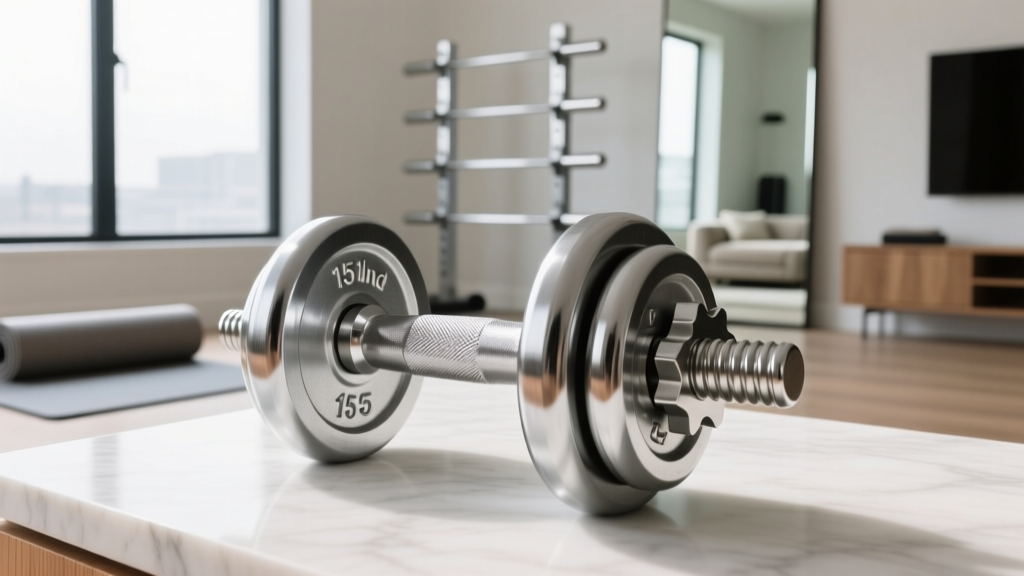
The traditional spin-lock collar is the most ubiquitous securing method on standard 1-inch loadable dumbbells. While cheap, they are highly susceptible to cross-threading and chalk buildup. When sweat and magnesium carbonate (gym chalk) mix, they form a concrete-like paste that settles into the threads. Over time, forcing the collar on and off strips the zinc coating and degrades the steel threads, leading to dangerous slippage during dynamic movements like dumbbell snatches or renegade rows.
Upgrading Your Collar System
If your 15 pound dumbbell workout involves high-rep circuits where speed of weight changes is essential, abandon spin-lock collars entirely. Upgrading to modern spring collars or lever-lock systems drastically improves safety and longevity.
- Spring Collars (e.g., Lock-Jaw or standard Olympic clips): Cost around $15 per pair. They exert constant radial pressure on the sleeve, preventing plate rattle, but can lose tension after 12 to 18 months of heavy use.
- Lever-Lock Collars (e.g., HG Collars): Retailing for approximately $35 per pair in 2026, these utilize a cam-lever mechanism that locks plates securely without relying on thread friction. They eliminate thread wear entirely and allow for 3-second weight changes.
Knurling Restoration and Rust Prevention Protocol
The knurling on a loadable dumbbell handle is designed to dig into the epidermal ridges of your hands to prevent slippage. However, those same microscopic valleys trap dead skin, sweat (which is highly acidic), and environmental moisture. If left untreated, the steel will oxidize, forming red rust that permanently destroys the knurl pattern and can cause skin infections.
Follow this 4-step monthly deep clean protocol to preserve your handles:
- Dry Brush the Knurling: Use a brass wire brush (never steel, as it will strip the zinc or black oxide finish). Brush in a circular motion for 30 seconds per handle to dislodge dried chalk and skin cells.
- Solvent Cleanse: Spray a microfiber cloth with a mild degreaser or isopropyl alcohol (70% or higher). Wipe down the entire handle, focusing on the sleeve ends where cast iron plate dust accumulates.
- Lubrication and Protection: Apply 3 to 4 drops of 3-IN-ONE Multi-Purpose Oil or a specialized barbell oil onto the knurling. Use a stiff nylon brush to work the oil deep into the grooves. This displaces residual moisture and creates a hydrophobic barrier.
- Sleeve Wipe Down: Cast iron plates have rough, unfinished hubs. As they slide on and off the steel sleeve during your 15 pound dumbbell workout, they create micro-shavings. Wipe the sleeves with an oiled cloth to prevent these shavings from fusing to the steel via oxidation.
Environmental Controls and Storage Solutions
Where you store your loadable dumbbells dictates their lifespan. Leaving them on the floor of a garage gym exposes the steel sleeves to ambient humidity and concrete moisture. In coastal or high-humidity environments, unprotected steel can develop surface rust within 48 hours.
Invest in a dedicated vertical dumbbell rack or a horizontal tree rack. Storing the handles vertically (if using Olympic loadable handles with a wide base) or horizontally on plastic-lined rack shelves prevents the knurling from pressing against abrasive metal surfaces. Furthermore, keeping the plates loaded on the handles when stored can actually cause long-term sleeve deformation on cheaper, lower-grade steel handles due to constant gravitational torque. Always unload your interchangeable plates after your session to relieve mechanical stress on the sleeve welds.
Frequently Asked Questions
Can I use WD-40 to clean my loadable dumbbell handles?
Standard WD-40 is a solvent and water-displacer, not a long-term lubricant. While it is excellent for breaking down heavy rust or removing sticky sap and adhesive residue from new handles, it will strip away protective oils and leave the steel vulnerable to flash-rusting. For routine maintenance, use a dedicated barbell oil, mineral oil, or 3-IN-ONE. If you must use the WD-40 brand, opt for their Specialist White Lithium Grease for the spin-lock threads, as it provides lasting lubrication without attracting excessive chalk dust.
Why do my cast iron plates wobble on the loadable handle?
Wobbling is caused by a tolerance mismatch between the plate hub diameter and the handle sleeve diameter. Standard 1-inch handles often measure exactly 1 inch, but cheap cast iron plate holes can vary from 1.02 to 1.08 inches due to inconsistent sand-casting manufacturing processes. To fix this without buying new plates, wrap a single layer of athletic tape or use a specialized rubber sleeve adapter around the handle sleeve to take up the excess space, ensuring a tight, rattle-free fit during your 15 pound dumbbell workout.
How often should I replace my spring collars?
Spring collars rely on the tensile strength of the steel spring. If you are frequently dropping the dumbbells during metabolic conditioning or CrossFit-style workouts, the springs will fatigue. Inspect your collars monthly; if you can compress them with one hand without significant resistance, or if they slide off the sleeve when the dumbbell is pointed vertically at the floor, they have lost their clamping force and must be replaced immediately to prevent catastrophic plate slippage.
More gear to consider
All reviews
Free Weights vs Dumbbells: Bumper Plate vs Iron Plate Guide

Rubber Hex vs Urethane: Which 40 lb Dumbbell Wins?

2026 Storage Trends: Racks to Elevate Your Bicep Dumbbell Routine

Cast Iron vs Competition Kettlebells & Dumbbell Core Exercises Standing

Power Rack vs Squat Stand: Exercises with Dumbbells for Arms