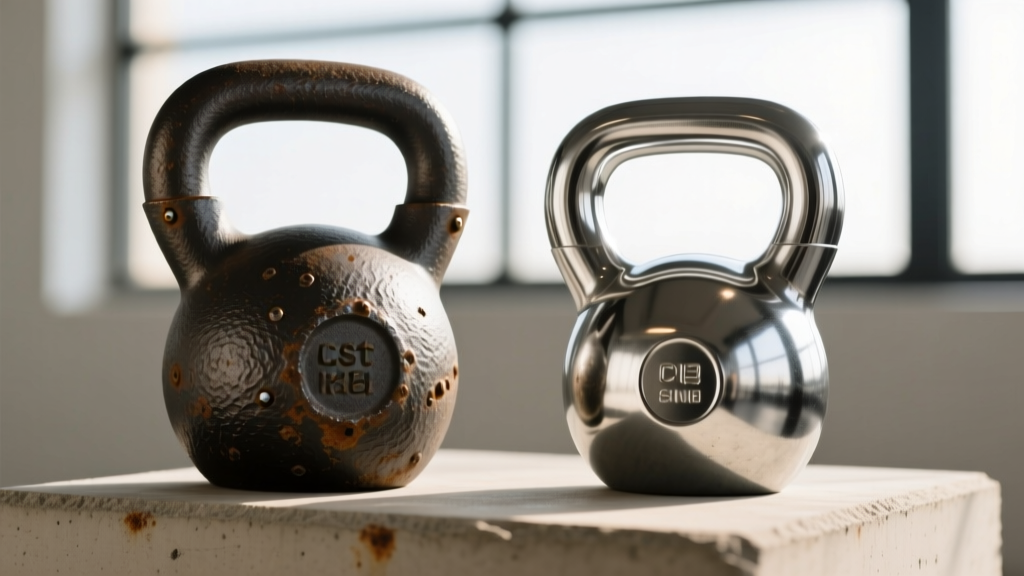
Cast Iron vs Competition Kettlebell Care (Beyond a Dumbbell Biceps Curl GIF)
Master kettlebell longevity with our 2026 maintenance guide. Compare cast iron vs competition care, rust prevention, and handle restoration techniques.

The Physics of Wear: Why Kettlebells Demand Rigorous Maintenance
If you have ever studied a standard dumbbell biceps curl gif or tutorial video to perfect your isolation form, you will notice the equipment barely leaves the hands, and the weights are gently lowered with zero impact. Kettlebell training is the exact opposite. The ballistic nature of swings, cleans, and snatches subjects your equipment to violent deceleration forces, aggressive handle friction, and repeated impacts against racks and flooring.
When deciding between cast iron and competition kettlebells, most buying guides focus solely on dimensions and price per pound. However, as a long-term investment, understanding the maintenance care and longevity profiles of these two distinct metallurgical categories is critical. A $150 competition bell can be ruined in a single humid summer if neglected, while a $60 cast iron bell can last three generations with basic lipid barrier maintenance.
2026 Market Context
As of 2026, the price gap between premium cast iron and entry-level competition bells has narrowed. Premium e-coated cast iron bells now average $2.20 to $2.80 per pound, while standardized steel competition bells sit between $3.50 and $4.50 per pound. Because the financial barrier to entry is higher than ever, proactive maintenance is no longer optional—it is essential for protecting your investment.
Cast Iron Kettlebell Maintenance: Fighting Oxidation and Coating Degradation
Cast iron kettlebells are typically finished in one of three ways: bare iron, powder-coated, or e-coat (electrophoretic deposition). Each requires a distinct maintenance protocol to prevent structural degradation and cosmetic failure.
1. Powder-Coated Cast Iron (e.g., Titan Fitness, Standard Rogue)
Powder coating provides a thick, textured grip but is highly susceptible to micro-fractures. When dropped on concrete or steel racks, the coating chips, exposing the porous iron beneath to oxygen and sweat.
- The Chalk Trap: Powder coat textures trap gym chalk and dead skin. Over time, this mixture absorbs ambient moisture, creating a localized rust incubator.
- Cleaning Protocol: Use a stiff nylon bristle brush (never brass or steel wire, which will strip the powder) and a damp microfiber cloth weekly. Avoid chemical degreasers, which break down the polymer bonds of the powder coat.
- Touch-Up Strategy: For deep chips down to the bare iron, apply a drop of rust-inhibiting primer followed by a matte black enamel touch-up pen to seal the breach before oxidation blooms.
2. E-Coat and Bare Cast Iron (e.g., Eleiko, Premium Rogue)
E-coat finishes are incredibly thin, preserving the tactile feel of the iron while providing superior rust resistance compared to powder coat. However, they show fingerprints and require lipid maintenance.
- The 3-2-1 Oiling Method: Once a month, apply 3 drops of food-grade mineral oil or 3-IN-ONE oil to the handle, rub it in for 2 minutes with a coarse rag to penetrate the micro-pores, and let it cure for 1 hour before buffing off the excess. Never use WD-40, as it is a solvent that strips existing protective barriers and leaves a residue that ruins grip friction.
Competition Kettlebell Longevity: Preserving Steel and Paint Bands
Competition kettlebells are engineered to exact International Union of Kettlebell Lifting (IUKL) specifications. They feature a hollow steel core, a uniform 35mm handle diameter (regardless of weight), and color-coded painted bands at the base to denote kilogram increments. Maintaining them requires addressing two primary failure modes: handle oxidation and band chipping.
Handle Restoration and Callus Management
Unlike cast iron, competition bell handles are typically bare, polished steel or lightly chromed. They are designed for high-rep snatches where a textured grip would tear the palms. However, bare steel oxidizes rapidly when exposed to the lactic acid and salts in human sweat.
- Immediate Post-Workout: Wipe the handle down with a dry towel immediately after your session. Do not leave sweat to air-dry on the steel.
- Monthly Sanding Protocol: When you feel 'hot spots' or microscopic rust blooms, it is time to sand. Use 400-grit aluminum oxide sandpaper to gently strip the oxidation. Follow immediately with 800-grit sandpaper to polish the steel back to a smooth, callus-friendly finish.
- Chalk Management: Competition lifters use minimal chalk. If you must use it, opt for liquid chalk with a high alcohol content that evaporates quickly, leaving less particulate matter to scratch the polished steel during the rack position.
Protecting the Color-Coded Paint Bands
The painted bands on competition bells (e.g., yellow for 16kg, green for 24kg) are notorious for chipping when the bells are racked closely together or set down aggressively on hard surfaces.
Pro-Tip for Paint Preservation: Apply two coats of clear, high-gloss automotive polyurethane clear coat over the factory paint bands upon unboxing. This adds a sacrificial, impact-resistant layer that absorbs the shock of rack impacts without shattering the underlying color pigment.Material Breakdown & Maintenance Matrix
Use the following matrix to determine which maintenance profile aligns with your training environment and willingness to perform upkeep.
| Feature | Powder-Coated Cast Iron | E-Coated Cast Iron | Competition (Steel) |
|---|---|---|---|
| Primary Threat | Coating chips leading to sub-surface rust | Cosmetic fingerprinting, surface oxidation | Handle rust, paint band shattering |
| Cleaning Agent | Damp microfiber, nylon brush | Mineral oil, dry cloth | Dry towel, 400/800 grit sandpaper |
| Chalk Tolerance | High (texture grips chalk well) | Low (chalk smears on smooth e-coat) | Very Low (chalk scratches polished steel) |
| Drop Tolerance | Moderate (coating will fracture) | High (e-coat flexes with the iron) | Low (hollow core welds can stress-fracture) |
| Maintenance Time | 5 mins/week (brushing) | 10 mins/month (oiling) | 15 mins/month (sanding & clear coat) |
Environmental Controls and Storage Solutions
The longest-lasting kettlebells are those stored correctly. The enemy of both cast iron and steel is ambient humidity. According to metallurgical standards for carbon steel and cast iron, keeping your gym environment below 50% relative humidity drastically reduces the oxidation rate.
Proper Racking Techniques
Never store kettlebells directly on concrete floors, which wick moisture and promote base rust. Invest in a dedicated steel or heavy-duty wood rack. If you must store them on the floor, use 3/4-inch vulcanized rubber horse stall mats. Avoid storing competition bells outdoors or in unclimate-controlled garages, as the hollow core can trap condensation, leading to internal rust that eventually compromises the structural integrity of the handle welds.
Frequently Asked Questions
Can I use a wire wheel on an angle grinder to strip rust from my cast iron kettlebell?
No. An angle grinder with a wire wheel will aggressively strip the rust, but it will also gouge the soft cast iron, creating deep pitting that will trap moisture and accelerate future rusting. Always use hand-sanding with 120-grit paper for localized rust spots, followed by a cold-bluing solution or e-coat touch-up paint to seal the metal.
Why do competition kettlebell handles feel 'sticky' after oiling?
Competition bell handles are polished to a mirror finish to prevent tearing during high-rep snatches. If you apply mineral oil and do not buff it completely dry, the residual oil mixes with gym chalk to create a sticky, paste-like friction that will rip your calluses. Competition bells should generally be kept completely dry and bare, relying on the natural oils in your skin and meticulous post-workout wiping rather than artificial lipid barriers.
'The longevity of your equipment is a direct reflection of your discipline outside of the workout. A rusted handle is a failure of maintenance, not a failure of metallurgy.' — Adapted from Kettlebell Kings equipment care guidelines.
Whether you are executing high-tension grind movements or ballistic swings that look vastly different from the controlled isolation of a standard dumbbell curl, your kettlebells endure immense physical stress. By matching your maintenance protocol to the specific metallurgy of your bells—whether powder-coated iron or hollow-core steel—you ensure your equipment remains safe, grippy, and structurally sound for decades.
More gear to consider
All reviews
Rubber Hex vs Urethane: Dumbbell Press to Bench Press Calculator Data

Rear Deltoid Exercises with Dumbbells: Adjustable Setup & 2026 Review

Neoprene Dumbbells: Mnemonic Cholinergic Benefits & Home Guide

Loadable Dumbbell Care: Why Dumbbell Hip Huggers Prevent Plate Wear
2026 Trends: Bumper vs Iron Plates and the Kickback Dumbbell Market
