
Heavy Dumbbell Training Spaces: Cast Iron vs Competition Kettlebells
Optimize your home gym layout for heavy dumbbell training by integrating the right kettlebells. Compare cast iron vs competition bells for space efficiency.

Home gym owners face a brutal reality when transitioning to heavy dumbbell training: the footprint required for a comprehensive set of hex dumbbells and a multi-tier rack can easily consume 15 to 20 square feet of prime floor space. As you push past the 80-pound mark per hand, the physical volume of the equipment grows exponentially. To maintain a functional, space-optimized layout without sacrificing heavy resistance, many lifters are strategically integrating kettlebells to supplement or replace specific heavy dumbbell movements.
However, not all kettlebells are created equal when it comes to spatial geometry. The choice between traditional cast iron and uniform competition kettlebells drastically alters your storage layout, floor clearance, and movement mechanics in tight spaces. This guide breaks down the dimensional science of cast iron versus competition kettlebells, specifically through the lens of space optimization and heavy resistance training.
The Spatial Dilemma of Heavy Dumbbell Training
Consider the industry-standard Rogue Monster 3-Tier Dumbbell Rack. It measures 42.5 inches long and 30 inches wide. While the rack itself takes up roughly 9 square feet, you must account for a 24-inch clearance zone in front of the rack for safe loading, unloading, and staging heavy bells before a set. This effectively deletes a 4x4 foot zone from your gym's usable floor plan.
When designing a compact home gym (e.g., a 10x10 spare bedroom or a single-car garage bay), sacrificing 16 square feet to a single storage unit is a massive compromise. By utilizing heavy kettlebells for overlapping movements—such as goblet squats, heavy single-leg RDLs, and unilateral floor presses—you can drastically reduce your reliance on massive dumbbell sets, provided you select the right kettlebell profile for your spatial constraints.
Cast Iron vs. Competition: A Dimensional Breakdown
The fundamental difference between cast iron and competition kettlebells lies in volumetric scaling. Cast iron kettlebells grow radially as the weight increases. A 16kg cast iron bell might be compact, but a 48kg (106 lb) cast iron bell is a massive, unwieldy sphere with a thick handle and a wide base. Competition kettlebells, machined from steel with a hollow core, maintain identical external dimensions regardless of weight.
| Specification | Cast Iron (e.g., Kettlebell Kings Standard) | Competition (e.g., Kettlebell Kings Steel) |
|---|---|---|
| 24kg Base Diameter | ~16.5 cm | 28.0 cm (Uniform) |
| 32kg Base Diameter | ~18.5 cm | 28.0 cm (Uniform) |
| 48kg Base Diameter | ~22.0 cm | 28.0 cm (Uniform) |
| Handle Diameter | 32mm - 35mm (Scales up) | 33mm (Strict IUKL Standard) |
| Horn Width | Varies widely | Uniform for consistent racking |
| Storage Predictability | Low (Requires staggered shelving) | High (Allows flush, grid-like stacking) |
Layout Optimization: Storing Heavy Iron
When optimizing your gym layout, the geometry of your equipment dictates your storage solutions. Here is how to integrate both types into a space-constrained environment:
1. The Flush-Wall Strategy (Competition Bells)
Because every competition kettlebell shares a 28cm x 28cm footprint, you can build or purchase a simple, low-profile wooden or steel grid shelf against a load-bearing wall. You can stack a 24kg, 32kg, and 40kg bell perfectly flush against one another, maximizing corner dead-space. This creates a dense, organized 'iron library' that protrudes no more than 12 inches from the wall.
2. The Heavy-Duty Horizontal Rack (Cast Iron)
If you prefer the tactile feel of cast iron for heavy dumbbell training alternatives (like heavy renegade rows or floor presses), you must use a reinforced horizontal rack. Wall-mounted cantilever racks often fail under the concentrated shear force of a 40kg+ cast iron bell. Instead, utilize a freestanding, A-frame kettlebell rack positioned in a low-traffic corner. Ensure the rack features a 45-degree angled cradle to prevent the rounded bells from rolling off the pegs.
Biomechanical Overlap in Tight Spaces
According to research published in the Journal of Strength and Conditioning Research, kettlebell swings elicit comparable posterior chain activation to traditional heavy barbell and dumbbell deadlifts, making them an exceptional space-saving alternative for hamstring and glute development. But how does this translate to heavy pressing and squatting in a cramped room?
- Unilateral Floor Press: A 100lb hex dumbbell requires significant lateral clearance to maneuver into position. A 48kg (106lb) competition kettlebell, with its uniform 33mm handle and predictable horn width, can be cleaned and pressed in a space barely wider than your shoulders. This is critical if your bench is positioned less than 24 inches from a wall.
- Heavy Goblet Squats: Cast iron bells become excessively bulky at 32kg+, often colliding with the lifter's wrists or chest due to the expanding sphere size. Competition bells maintain a compact 28cm profile, allowing for a tight, secure rack position even at 48kg, preserving your form and spatial awareness.
As noted by the Cleveland Clinic, the offset center of mass in kettlebells demands greater core stabilization than dumbbells. In a small home gym where you might not have the floor space to set up a heavy dumbbell walking lunge, stationary heavy kettlebell reverse lunges provide the same hypertrophic stimulus with zero forward spatial displacement.
2026 Market Pricing & Space-to-Cost Ratio
When budgeting for heavy iron, the cost per pound and the longevity of the coating matter. Here is the current market landscape for premium heavy bells:
- Kettlebell Kings Cast Iron (Powder Coat): Averaging $1.60 to $1.80 per pound. Excellent for heavy rows and presses, but the powder coat can chip if dropped on bare concrete during heavy dumbbell training complexes.
- Rogue Fitness Single-Cast Kettlebells: Averaging $2.00 per pound. Machined with a flat base and a slightly narrower horn, offering a middle-ground between traditional cast iron and competition geometry.
- Kettlebell Kings / Onnit Competition Steel: Averaging $2.50 to $3.00 per pound. The premium price buys you dimensional uniformity, a 33mm steel handle that will never chip, and the ability to stack them safely in high-density layouts.
Frequently Asked Questions
Can I use competition kettlebells for heavy renegade rows?
It is not recommended. Competition kettlebells have a wide, 28cm base but a relatively smooth, rounded top. When placed on a hard floor for renegade rows, they can easily tip or roll under heavy axial loading. Cast iron bells, particularly those with a machined flat base and wider footprint, are much safer for heavy, weight-bearing floor exercises.
How much floor space does a heavy kettlebell setup save compared to dumbbells?
A complete set of heavy hex dumbbells (50-100 lbs in 10lb increments) requires a 3-tier rack taking up roughly 16 square feet of operational space. A heavy kettlebell arsenal (16kg, 24kg, 32kg, 40kg, 48kg) can be stored flush against a wall in a 2x4 foot footprint, reclaiming up to 80% of your storage area.
Do I need special flooring for dropping heavy kettlebells?
Yes. Dropping a 48kg steel competition bell or a solid cast iron bell directly onto concrete or standard home gym foam tiles will cause catastrophic damage to both the floor and the bell. You must use, at minimum, 3/4-inch (43oz) high-density rubber horse stall mats, ideally with a plywood sub-layer for force dissipation in concentrated drop zones.
More gear to consider
All reviews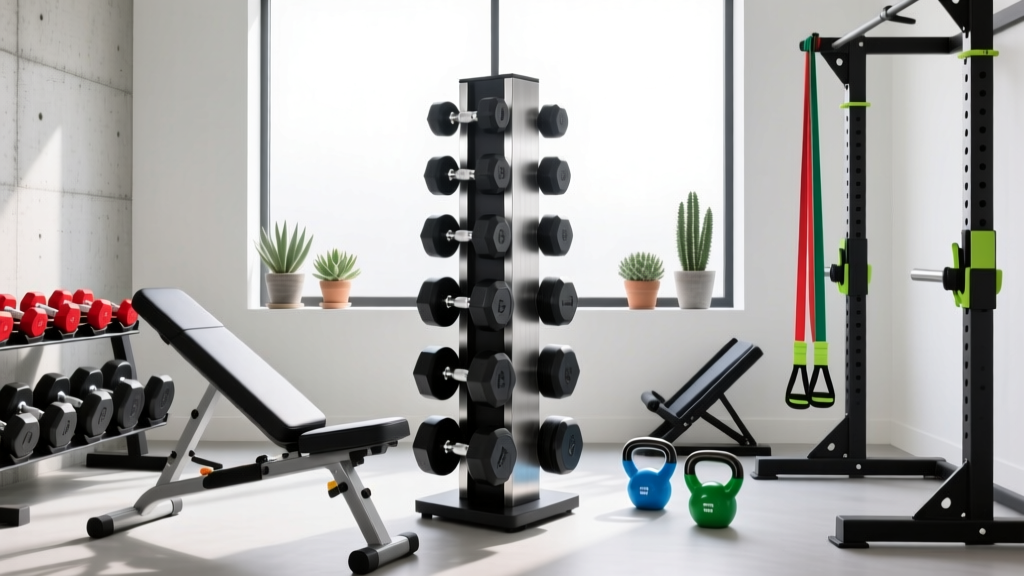
2026 Trends: Dumbbell Racks & Alternatives to Incline Dumbbell Press

Olympic vs Standard Plates Setup + Full Body Dumbbell Workout PDF

Kettlebell Buying Guide: Space Layouts & Dumbbell Workouts Plan

Rubber Hex vs Urethane: Budgeting Your Arm Workout With Dumbbells

Barbell Collar and Clamp Types Comparison: Securing Heavy Shrugs Without a Dumbbell Shrug Machine
