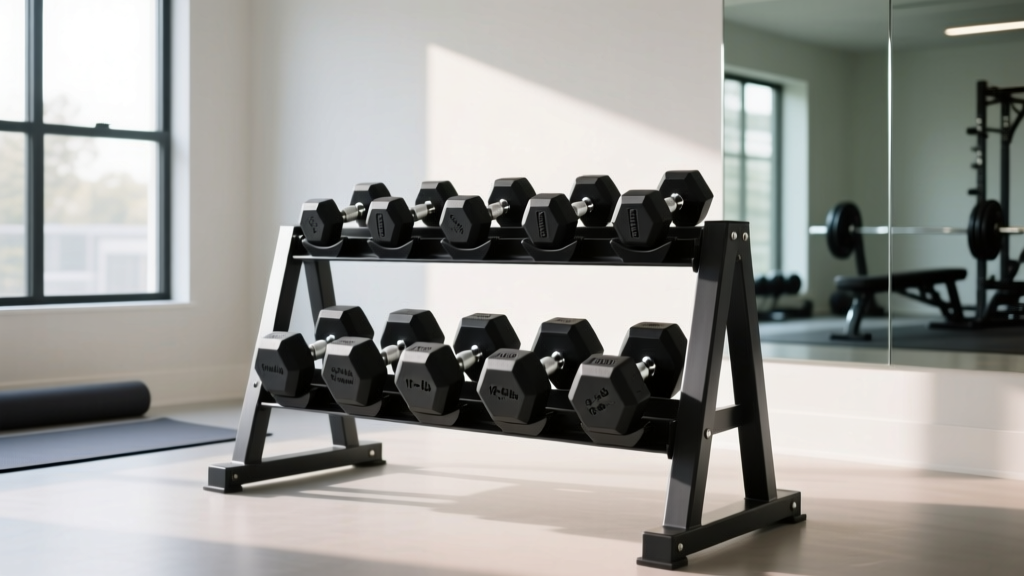
Bumper vs Iron Plates: Space Layouts & The Average Dumbbell Press
Optimize your home gym layout by comparing bumper vs iron plates. Learn how thickness, storage, and the average dumbbell press impact your floor plan.

The Spatial Economics of Free Weights in 2026
Designing a high-functioning home gym in 2026 is less about acquiring endless equipment and more about the spatial economics of your floor plan. With real estate premiums rising and multi-use spaces becoming the norm, every square foot of your garage or spare room must justify its footprint. One of the most critical decisions in this layout process is choosing between bumper plates and traditional cast iron plates. While the debate often centers on noise reduction or drop-safety, the most overlooked factor is how plate thickness dictates storage hardware, barbell sleeve capacity, and the surrounding clearance required for auxiliary movements.
According to comprehensive equipment analyses by Garage Gym Reviews, the physical dimensions of your weight plates will fundamentally alter your gym's traffic flow. This is especially true when you are trying to preserve an open floor zone for the average dumbbell press, a movement that demands significant lateral clearance to execute safely without striking nearby storage trees or walls.
Dimensional Breakdown: Bumper vs. Cast Iron
To understand the layout implications, we must first look at the raw geometry of the plates. Bumper plates are manufactured to a universal 450mm (17.7-inch) diameter regardless of weight, meaning a 10-pound bumper takes up the same spatial footprint on a storage rack as a 45-pound bumper. Cast iron plates, conversely, scale in both diameter and thickness relative to their weight.
| Plate Type (45lb / 20kg) | Average Thickness | Diameter | Max Capacity on 16.4" Sleeve | Storage Tree Footprint |
|---|---|---|---|---|
| Standard Urethane Bumper | 3.25 inches | 17.7 inches | 4 Plates (plus collar) | 36" x 36" (Base) |
| Machined Cast Iron | 1.30 inches | 14.5 inches | 10 Plates (plus collar) | 24" x 24" (Base) |
As highlighted by strength equipment experts at BarBend, the thickness discrepancy is massive. If your programming requires loading 405 lbs onto a barbell, you can easily achieve this with iron plates on a standard Olympic sleeve. Attempting the same with standard bumpers requires specialized 15kg technique plates or a longer deadlift bar, which introduces unnecessary equipment clutter into a space-optimized gym.
The Average Dumbbell Press and Floor Clearance
Why does plate thickness matter for a bench press or dumbbell movement? The answer lies in the geometry of the lifting arc and the placement of your storage hardware.
Layout Rule of Thumb: The average dumbbell press (typically performed with 50lb to 75lb dumbbells per hand) requires a minimum of 36 inches of lateral clearance on either side of the bench. This accounts for the width of the dumbbell, the lifter's elbow extension, and a safety buffer to prevent knuckle strikes against nearby objects.When you utilize freestanding vertical plate trees to store thick bumper plates, you are forced to place these bulky units at least 4 feet away from your bench to maintain the clearance needed for the average dumbbell press. In a standard 10x10 foot room, two bumper plate trees and a bench will effectively consume the entire usable floor space, leaving no room for kettlebell swings, lunges, or yoga.
Conversely, because cast iron plates are significantly thinner and feature built-in hand-holes or raised lips, they can be stored on wall-mounted plate pegs. By moving your iron plate storage vertically onto the drywall or the uprights of your power rack, you reclaim up to 12 square feet of floor space. This allows you to push your adjustable bench directly into the center of the room, guaranteeing the unobstructed lateral clearance required for heavy, high-rep dumbbell pressing without the fear of backing into a metal plate tree.
Storage Hardware and Footprint Analysis
Optimizing your layout requires matching the plate type to the correct storage apparatus. Here is how the two materials dictate your hardware choices:
Bumper Plate Storage Realities
- Vertical Trees: Require a wide, heavy base to prevent tipping when loaded with dense rubber. A fully loaded 5-peg tree takes up a 3-foot diameter circle of 'dead space' that cannot be used for any other exercise.
- Horizontal Cradles: Can be attached to the bottom of a power rack (like the Rep Fitness PR-4000), but they protrude 18+ inches outward, severely limiting the space needed to walk around the rack or set up for the average dumbbell press just outside the cage.
- Drop Zone Requirements: Bumpers are designed to be dropped. This necessitates a dedicated 4x8 foot rubber matting zone that must remain permanently clear of other equipment.
Iron Plate Storage Advantages
- Wall-Mounted Pegs: A standard wall-mount bracket holds up to 500 lbs of iron plates while protruding only 10 inches from the wall. This keeps the floor 100% clear for dynamic movements.
- Rack-Attached Horns: Because iron plates are lighter per unit of volume, you can safely store them on the rear uprights of a squat rack without compromising the rack's center of gravity or stability.
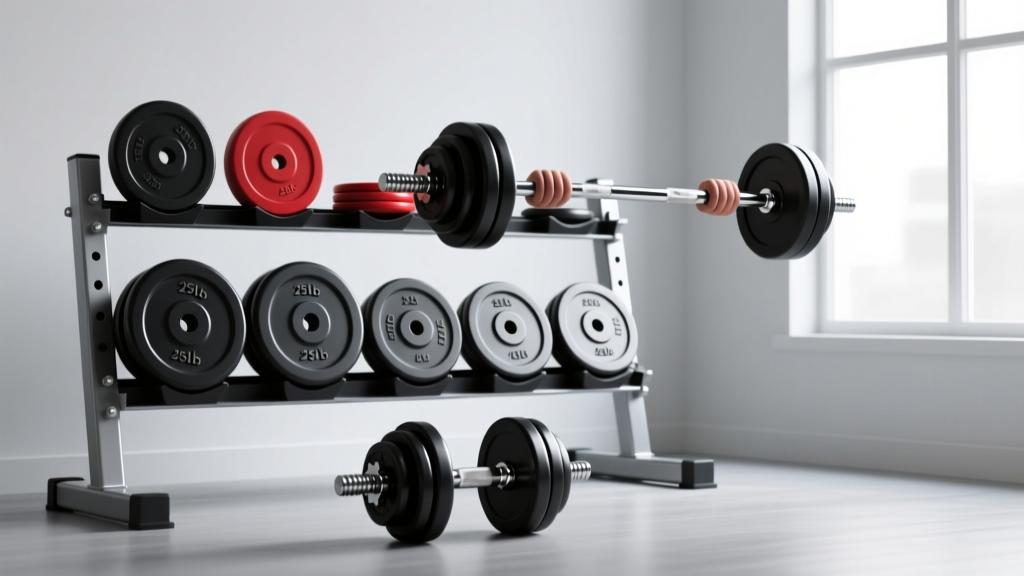
- A-Frame Stands: If wall mounting isn't an option, a compact steel A-frame holds an entire iron set in a 2x2 foot footprint, easily tucked into a corner.
2026 Cost vs. Space Matrix
When planning your gym layout, you must also weigh the financial cost against the spatial ROI (Return on Investment). As of early 2026, supply chain stabilizations have brought equipment prices back to predictable baselines.
The Hybrid Layout Strategy: You do not have to choose just one. The most space-efficient home gyms in 2026 utilize a 'Hybrid Layout'. Purchase a pair of 45lb and 25lb bumper plates strictly for Olympic lifts and drops. Then, fill the rest of your weight increments (10s, 5s, 2.5s, and extra 45s) with thin cast iron plates stored on wall mounts. This hybrid approach preserves your drop-zone integrity while maximizing your floor space for the average dumbbell press and accessory work.
A 250lb set of premium urethane bumpers will cost roughly $650 to $750 and require a minimum of 16 square feet of dedicated storage and drop-zone floor space. A 250lb set of machined cast iron plates costs between $400 and $450, requires only 4 square feet of wall space, and allows you to allocate the remaining 12 square feet to a premium adjustable dumbbell set and a dedicated pressing bench.
Frequently Asked Questions
Can I perform the average dumbbell press inside a power rack?
Yes, but only if you remove the safety straps or spotter arms that typically protrude inward. A standard power rack interior is 43 to 49 inches wide. If you are using 70lb dumbbells (which are roughly 15 inches long each), plus your shoulder width, you will have less than 4 inches of clearance on either side. This is why maintaining an open floor plan outside the rack, facilitated by space-saving iron plate storage, is highly recommended for heavy dumbbell pressing.
Do thin iron plates damage flooring if dropped?
Cast iron plates should never be dropped on standard flooring. If your gym layout does not include a dedicated 3/4-inch thick rubber drop pad, you must commit to lowering the barbell under control. If you require the ability to drop weights from overhead or the shoulder due to fatigue, you must allocate the floor space for bumper plates and accept the spatial trade-offs that come with them.
What is the best barbell sleeve length for space-constrained gyms?
More gear to consider
All reviews
Loadable Dumbbell Value: Budgeting for the Heavy Dumbbell Hammer Row

Bumper vs Iron Plates & Dumbbell Curl Bench Care

Beginner Brachioradialis Workout With Dumbbells: Neoprene Guide

Dumbbell Iron Cross Rack Maintenance and Longevity Guide
2026 Budget: Bumper vs Iron Plates & Dumbbell Lateral Raises