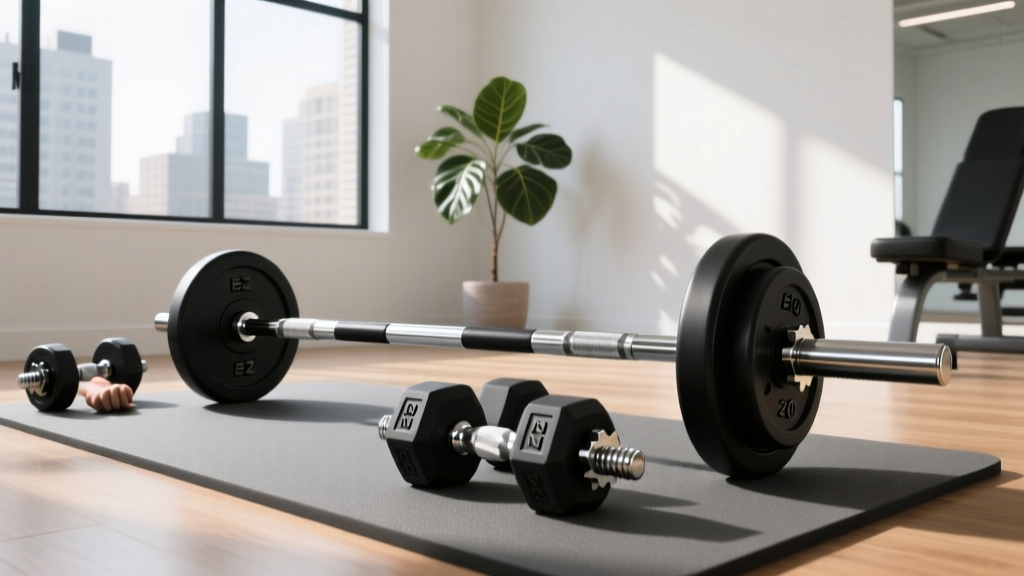
EZ Curl vs Straight Bar: Budget & Lat Exercise with Dumbbells
We analyze the true cost of EZ curl bars vs straight bars, plus the most effective lat exercise with dumbbells to complete your budget arm and back setup.

The 2026 Home Gym Dilemma: Allocating Your Barbell Budget
Building a comprehensive arm and back arsenal at home doesn't require a $2,000 equipment dump. However, when working within a strict budget, every dollar must be justified by biomechanical utility and long-term joint health. The debate between purchasing an EZ curl bar versus a standard straight barbell is one of the most common crossroads for home gym owners. Furthermore, because neither barbell variation effectively targets the latissimus dorsi, budget-conscious lifters must strategically integrate the best lat exercise with dumbbells to ensure a complete posterior chain and back development.
In this 2026 value analysis, we break down the exact costs, hidden financial traps, and physiological ROI of EZ versus straight bars, before detailing the ultimate dumbbell lat protocols to complete your setup.
EZ Curl Bar vs. Straight Bar: The Financial & Biomechanical Breakdown
To understand the true value, we must look beyond the sticker price and evaluate the 'cost per usable degree of freedom' and joint preservation. A standard Olympic straight bar forces the wrists into full supination (palms facing up). While this is optimal for peak bicep brachii contraction, it places significant valgus stress on the medial epicondyle of the elbow, often leading to golfer's elbow over time.
Conversely, the angled grips of an EZ curl bar place the wrists in 30 to 45 degrees of semi-supination. According to biomechanical analyses referenced by ACE Fitness, this slight pronation shifts a fraction of the load to the brachialis and brachioradialis, drastically reducing elbow strain and allowing for heavier, pain-free loading over a multi-year training cycle.
2026 Market Pricing & Model Comparison
| Equipment Type | Model Example (2026) | Avg. Cost | Loadable Sleeve Length | Primary Joint Impact |
|---|---|---|---|---|
| Standard EZ Curl Bar | CAP Barbell OB-85PB (47') | $55 - $70 | 7.5 inches | Low wrist/elbow strain |
| Premium EZ Curl Bar | Titan Fitness Super Curl (49') | $135 - $160 | 10.5 inches | Minimal strain, high load |
| 5ft Straight Barbell | CAP Barbell 5' Olympic | $80 - $95 | 11.5 inches | High wrist supination stress |
| 7ft Straight Barbell | Rogue Ohio Bar (7') | $295 - $350 | 16.5 inches | Moderate strain, versatile |
Most budget EZ curl bars (like the 47-inch CAP model) are too short to be safely racked in a standard power rack, which typically requires a minimum bar length of 49 inches to rest on the J-cups. If you buy a $55 short EZ bar but own a standard rack, you will be forced to perform heavy floor curls or buy separate squat stands. Always measure your rack's inner width before purchasing a budget curl bar.
The Missing Link: Why You Need a Lat Exercise with Dumbbells
Neither the EZ curl bar nor the straight bar is an effective tool for targeting the lats. While bent-over barbell rows are a staple, they heavily tax the lower back and hamstrings, often becoming a limiting factor before the lats reach true muscular failure. This is where budget allocation must pivot to hex or rubber dumbbells.
When searching for the most effective lat exercise with dumbbells, you need movements that isolate shoulder extension without overloading the spinal erectors. Below are the two highest-ROI dumbbell lat builders for your 2026 training block.
1. The Dumbbell Pullover (Stretch-Mediated Hypertrophy)
The dumbbell pullover is the undisputed king of isolation lat work. It targets the lats through a deep stretch, capitalizing on stretch-mediated hypertrophy—a mechanism proven to trigger significant muscle protein synthesis when the muscle is loaded in its lengthened position.
- Setup: Lie perpendicular across a flat bench, supporting only your upper back. Hips dropped low to create a slight arch.
- Execution: Hold a single heavy dumbbell (50–80 lbs for intermediates) by the inner collar. Lower the weight backward over your head until you feel an intense stretch in the lats and serratus anterior.
- The Cue: Do not bend the elbows excessively. Keep a slight, fixed bend, and imagine pulling the weight back to your belly button using only your armpits (shoulder extension), not your triceps.
- Prescription: 3 sets of 12-15 reps. Focus on a 3-second eccentric (lowering) phase.
2. The Kroc Row (Unilateral Overload)
Popularized by powerlifter Matt Kroczaleski, the Kroc Row is a high-rep, heavy single-arm dumbbell row designed to build massive lat thickness and grip endurance. It is the perfect complement to barbell curling.
- Stance: Stagger your feet, placing your non-working hand on a rack or bench for support. Keep your torso nearly parallel to the floor.
- The Pull: Use a heavy dumbbell (often 100+ lbs for advanced lifters). Pull the dumbbell toward your hip pocket, not your chest. This lower pull path ensures the latissimus dorsi does the work rather than the rhomboids or rear delts.
- The Kroc Factor: Unlike strict rows, the Kroc row allows for a slight amount of torso rotation at the top of the movement to achieve a peak contraction, followed by a controlled descent. Take the set to absolute failure (usually 20-30 reps).
For a deeper dive into unilateral back mechanics and proper scapular retraction, the exercise database at ExRx.net remains an invaluable, science-backed resource for mapping muscle activation paths.
The Complete $250 Arm & Back Equipment Blueprint
If you are starting from scratch and need to build a dedicated arm and back station in 2026 without buying a full power rack, here is the most mathematically efficient budget breakdown:
The $250 Budget Allocation
- Titan Fitness Super Curl Bar (49'): $145 (Rackable, 10.5" sleeves, premium knurl)
- Pair of 55 lb Rubber Hex Dumbbells: $80 (Ideal for Pullovers and Kroc Rows)
- Basic Flat Utility Bench: $25 (For pullover support and seated curls)
- Total: $250
Note: This setup bypasses the straight bar entirely. The curl bar handles all bicep, tricep (via skull crushers), and light rowing duties, while the heavy dumbbells take over the heavy lat isolation and unilateral back work.
Expert Verdict: Where Should Your Money Go?
From a pure value perspective, the EZ curl bar defeats the straight bar for dedicated arm training. The joint preservation alone offers a higher long-term ROI, preventing the medial epicondylitis that frequently sidelines home gym enthusiasts who strictly use straight bars for heavy curling. Furthermore, modern 49-inch EZ bars offer enough sleeve length to load upwards of 200 lbs, which is more than sufficient for 95% of the lifting population.
However, the true value of a home gym lies in its completeness. By saving money on an overly expensive 7-foot Olympic barbell, you free up capital to invest in heavy hex dumbbells. Mastering the dumbbell pullover and the Kroc row as your primary lat exercise with dumbbells will yield a wider, thicker back than endless sets of lightweight barbell rows, proving that strategic budget allocation always beats盲目 spending on traditional, one-size-fits-all equipment.
For further reading on outfitting your space with the most durable budget barbells, the testing methodology at Garage Gym Labs provides excellent tear-downs of knurl depth and tensile steel strength across varying price brackets.
More gear to consider
All reviews
Olympic vs Standard Weight Plates & Cardio Exercises with Dumbbells

The Practical Fitness Checklist: What Actually Works Based on 12 Years of Equipment Testing

Bumper vs Iron Plates: 2026 Trends & Dumbbell Cardio Exercises

EZ vs Straight Bar: Best Bicep Workout Without Dumbbells 2026
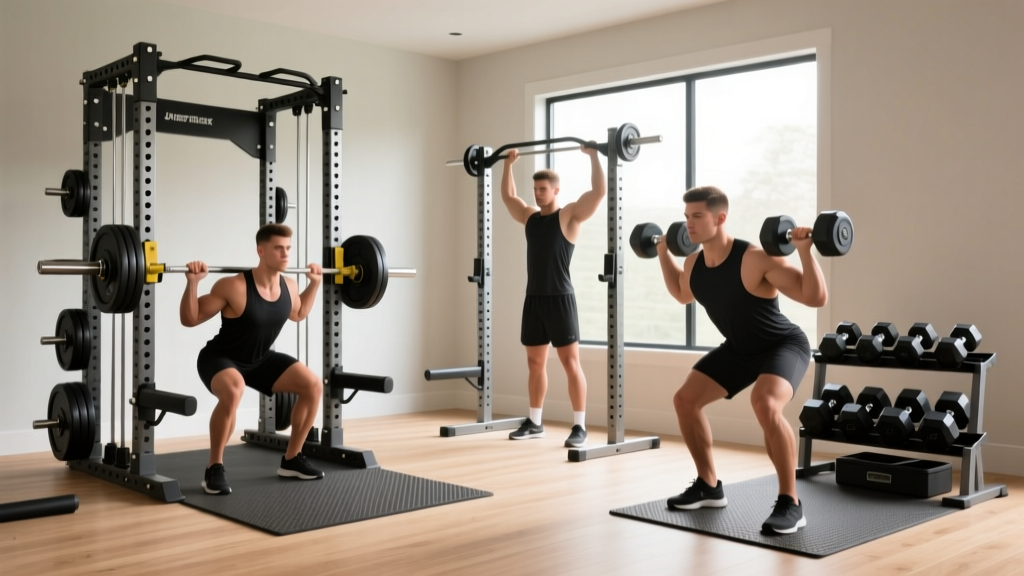
Power Rack vs Squat Rack vs Stand for Full Body Dumbbell Workouts
