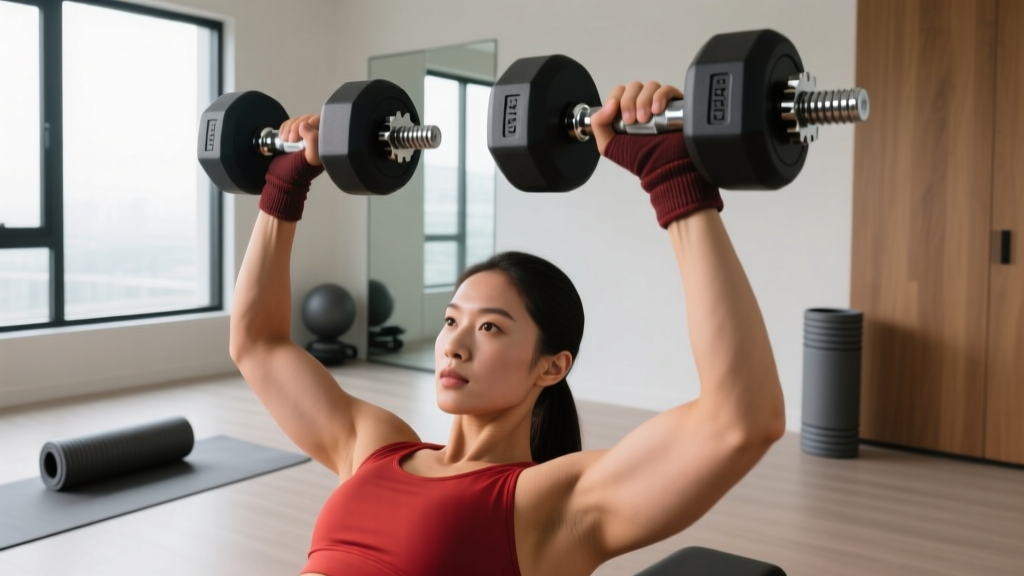
Arm Raises with Dumbbells: Mistakes & Adjustable Dumbbell Fixes
Master arm raises with dumbbells by fixing common form errors and gear issues. Compare top adjustable dumbbells for optimal lateral and front deltoid growth.

The Biomechanical Bottleneck: Why Adjustable Gear Complicates Isolation
When building a home gym, adjustable dumbbells are the undisputed kings of space efficiency. However, when it comes to isolation movements—specifically arm raises with dumbbells like lateral and front raises—the unique geometry of adjustable models can silently sabotage your deltoid development. Unlike fixed hex dumbbells, adjustable models feature elongated handles, bulky weight dials, and restrictive cage designs that alter your natural range of motion (ROM) and shift the mechanical tension away from the target muscle.
According to ExRx.net's kinesiology breakdown, the lateral deltoid operates on a highly sensitive moment arm. The resistance peaks when the arm is parallel to the floor (90 degrees of abduction). Because the side delts are relatively small muscles, even minor deviations in grip, weight distribution, or equipment bulk can force the upper trapezius and anterior deltoid to hijack the movement. In this comprehensive troubleshooting guide, we dissect the most common mistakes lifters make when performing arm raises with adjustable dumbbells and review the top 2026 models to find the ultimate isolation tool.
3 Gear-Induced Mistakes (And How to Troubleshoot Them)
Most lifters blame their form when an exercise feels "off," but often, the equipment is the culprit. Here are the three most frequent equipment-related errors during arm raises with dumbbells.
Mistake #1: The Thigh Strike (ROM Restriction)
The Problem: Many popular adjustable dumbbells retain the same physical length regardless of the weight selected. For example, the Bowflex SelectTech 552 measures 15.75 inches from end to end. When performing lateral raises, the medial head of the dumbbell frequently collides with your lateral thigh at the bottom of the movement, forcing you to widen your stance unnaturally or cut the eccentric phase short.
The Fix: Switch to a compact, telescoping adjustable dumbbell (like the Nuobell) that shrinks in length as you lower the weight, or adopt a staggered stance to create clearance for the elongated handle.
Mistake #2: The Micro-Load Gap (Trap Takeover)
The Problem: The side delts require precise progressive overload. Jumping from 15 lbs to 20 lbs represents a massive 33% increase in load. When lifters cannot micro-load, they compensate by using momentum and shrugging the scapula, leading to upper trap dominance and potential shoulder impingement—a common issue highlighted by the American Academy of Orthopaedic Surgeons (AAOS).
The Fix: Utilize adjustable dumbbells that offer strict 2.5 lb increments well past the 25 lb mark. If your gear only allows 5 lb jumps, implement mechanical drop sets or pause reps at 45 degrees to increase time-under-tension without adding weight.
Mistake #3: Cage Grip Interference (Wrist Supination Limits)
The Problem: Cage-style dumbbells (like the PowerBlock series) enclose the hand. During front raises or lateral raises with a "thumbs up" (internal rotation) bias, the cage can press uncomfortably against the forearm or restrict natural wrist pronation/supination, altering the moment arm and stressing the rotator cuff.
The Fix: Stick to traditional cylindrical handle designs for isolation work, or use wrist wraps to stabilize the joint and maintain a neutral grip against the cage padding.
2026 Adjustable Dumbbell Comparison Matrix for Isolation Work
To execute flawless arm raises with dumbbells, your gear must mimic the profile of a fixed iron dumbbell as closely as possible. Below is a data-driven comparison of the top models on the market, evaluated specifically for isolation suitability.
| Model | Length at 20 lbs | Increment Style | Handle Profile | Avg. Price (Pair) |
|---|---|---|---|---|
| Nuobell 80lb | 12.5" (Telescoping) | 2.5 lbs (All levels) | Standard Knurled | $349 |
| Bowflex 552 | 15.75" (Fixed) | 2.5 lbs (to 25), then 5 lbs | Standard Smooth | $399 |
| PowerBlock Sport 50 | 12.0" (Fixed Cage) | 2.5 lbs (via adder weights) | Enclosed Cage | $329 |
| Ironmaster Quick-Lock V2 | Varies (Screw-on) | 2.5 lbs (with add-ons) | Standard Knurled | $419 |
Nuobell 80lb: The Isolation Specialist
For arm raises with dumbbells, the Nuobell is currently the gold standard. Because the handle telescopes through the weight plates, the dumbbell physically shrinks as you drop the weight. At 15 lbs, it feels almost identical to a compact vinyl-coated fixed dumbbell, entirely eliminating the thigh-strike issue during lateral raises. Furthermore, the 2.5 lb increments all the way to 80 lbs allow for seamless progressive overload for both the lateral and anterior deltoids without requiring momentum.
Bowflex SelectTech 552: The Bulky Culprit
While the Bowflex 552 remains a phenomenal tool for presses and rows, its fixed 15.75-inch length makes it highly problematic for strict lateral raises. Lifters with shorter wingspans will find the medial plates clanking against their hips at the bottom of the ROM. Additionally, once you exceed 25 lbs, the 5 lb jump is often too aggressive for the supraspinatus and lateral deltoid, forcing sloppy form.
PowerBlock Sport 50: The Grip Fatigue Factor
PowerBlocks are virtually indestructible and excellent for heavy pressing. However, the enclosed cage design restricts wrist mobility. When performing front raises or lateral raises where a slight internal rotation (pouring the pitcher) is desired to target specific deltoid fibers, the cage digs into the wrist. It is highly recommended to use these for compound movements rather than strict isolation arm raises.
Form Fixes & Micro-Loading Protocols
Even with the perfect adjustable dumbbell, poor execution will result in trap dominance and joint pain. The ACE Fitness Exercise Library emphasizes strict scapular control during shoulder abduction. Follow this troubleshooting protocol to fix your arm raises with dumbbells:
- The Scapular Depression Check: Before initiating the raise, actively depress your shoulder blades (pull them down into your back pockets). This disengages the upper traps and forces the lateral deltoid to initiate the lift.
- The Lead-With-The-Elbow Cue: Imagine your hands are hooks holding the weight. The elbow should travel upward at the exact same rate as the wrist, or slightly faster. If the wrist leads, you are shifting tension to the anterior deltoid and biceps tendon.
- The 30-Degree Scapular Plane: Do not raise the dumbbells directly out to your sides (the frontal plane). Bring them roughly 30 degrees forward into the scapular plane. This aligns the humerus with the scapula, drastically reducing the risk of subacromial impingement.
- Eccentric Pacing: Lift the weight in 1 second, pause for 0.5 seconds at the 90-degree peak, and lower the weight over a strict 3-second count. Because adjustable dumbbells can sometimes feel unbalanced compared to solid iron, a slow eccentric phase stabilizes the wrist and ensures the target muscle absorbs the mechanical damage.
Expert Insight: "If you are using adjustable dumbbells that lack 2.5 lb increments, you must manipulate leverage rather than load. Move the dumbbell to the end of a 45-degree incline bench, lay chest-down, and perform chest-supported lateral raises. The altered angle increases the stretch-mediated hypertrophy stimulus, allowing you to use a lighter weight while achieving greater muscle fiber recruitment."
Expert Verdict: Which Adjustable Dumbbell Wins for Deltoid Work?
If your training split heavily prioritizes hypertrophy and you frequently perform arm raises with dumbbells, the Nuobell 80lb is the undisputed winner for 2026. Its dynamic telescoping length completely solves the thigh-strike geometry flaw inherent in older dial-adjustable models, and its relentless 2.5 lb micro-loading increments respect the biomechanical reality of small isolation muscles.
However, if you already own a pair of Bowflex 552s or PowerBlocks, you do not need to buy new gear. Simply adopt a staggered stance to clear the elongated handles, utilize the scapular plane for joint safety, and employ pause-reps to artificially increase the difficulty of your 5 lb weight jumps. By aligning your equipment's physical traits with proper biomechanical execution, you can safely and effectively build boulder shoulders in any home gym environment.
More gear to consider
All reviews
Power Rack vs Squat Rack vs Stand: Setup for Workouts with 1 Dumbbell
Dumbbell Snatch Muscles Worked: Beginner Guide for Neoprene Weights

Barbell Knurling Errors & Dumbbell Pullover for Serratus Anterior

Cheap vs Premium Breakdown: What $20, $85, and $220 Weights Actually Deliver
Rubber Hex vs Urethane vs the Bowflex Dumbbell: Expert Review
