EZ Curl Bar vs Straight Bar: Space Layouts & Gold Gym Dumbbells
Compare EZ curl bar vs straight bar for home gym space optimization. Discover layout strategies to integrate Gold Gym dumbbells and maximize floor plans.

The Spatial Geometry of Arm Day: Barbell Selection
When designing a home gym, most lifters obsess over the footprint of their power rack or the square footage required for a cardio zone. However, the micro-layouts of your free weight accessories—specifically your barbells and dumbbell sets—can quietly dictate the flow and functionality of your entire training space. The debate between an EZ curl bar and a straight bar is traditionally framed around wrist supination and elbow valgus stress. But from a space optimization and layout design perspective, the choice between these two bars fundamentally alters your lateral wall clearance, storage hardware requirements, and how you integrate supplementary free weights, such as a commercial-style set of Gold Gym dumbbells, into your floor plan.
As of 2026, with residential real estate at a premium and home fitness equipment becoming increasingly modular, understanding the exact spatial geometry of your gear is no longer optional. This guide breaks down the EZ curl bar vs straight bar comparison strictly through the lens of spatial efficiency, rack integration, and layout design.
Dimensional Matrix: Straight Bar vs. EZ Curl Bar
To optimize a room, you must first quantify the gear. According to standard Olympic specifications documented by international weightlifting guidelines, the dimensional differences between a standard Olympic straight bar and an Olympic EZ curl bar are drastic. These differences directly impact how much 'dead space' the equipment consumes when stored and when in use.
| Specification | Olympic Straight Bar | Olympic EZ Curl Bar |
|---|---|---|
| Total Length | 86.4 inches (7.2 ft) | 47 to 52 inches |
| Weight | 45 lbs (20 kg) | 18 to 30 lbs |
| Sleeve Length | 16.3 inches | 10 to 12 inches |
| Min. Lateral Clearance | 8.5 feet | 5.5 feet |
| Primary Storage Axis | Horizontal (J-Cups / Wall Cradles) | Horizontal or Vertical (Wall Docks) |
The Loading Clearance Factor
The most critical metric in the table above is Minimum Lateral Clearance. To safely load and unload a 45-pound Olympic straight bar with bumper plates, you need a minimum of 8.5 feet of unobstructed lateral wall space. If your home gym is situated in a narrow garage bay or a bedroom nook, a straight bar can quickly become a spatial liability, forcing you to angle the rack or leave plates pre-loaded, which clutters the floor.
Conversely, an EZ curl bar requires only about 5.5 feet of lateral clearance. This 3-foot spatial savings is massive in micro-gyms, freeing up wall real estate for vertical storage solutions or allowing you to position your power rack closer to a corner without sacrificing functionality.
Integrating Gold Gym Dumbbells into the Floor Plan
Barbells do not exist in a vacuum. A complete arm and upper-body layout usually requires a supplementary dumbbell set. Many home gym owners strive to replicate the classic commercial facility aesthetic by investing in urethane hex sets, commonly referred to as Gold Gym dumbbells due to their prevalence in that iconic franchise. A standard 10-pair set of Gold Gym dumbbells (ranging from 5 lbs to 50 lbs in 5-lb increments) presents a unique spatial challenge.
Spatial Footprint of a 5-50lb Dumbbell Set
A standard 3-tier horizontal dumbbell rack housing a full 5-50lb Gold Gym dumbbells set typically measures 52 inches wide, 24 inches deep, and 38 inches high. This consumes roughly 8.5 square feet of floor space and requires an additional 36 inches of frontal clearance for safe bending and lifting, bringing the total 'impact zone' to nearly 20 square feet.
Layout Scenario A: The 60-Square-Foot Nook (EZ Bar Priority)
If you are designing a compact gym in a spare bedroom or office (roughly 60 to 80 square feet), spatial efficiency is paramount.
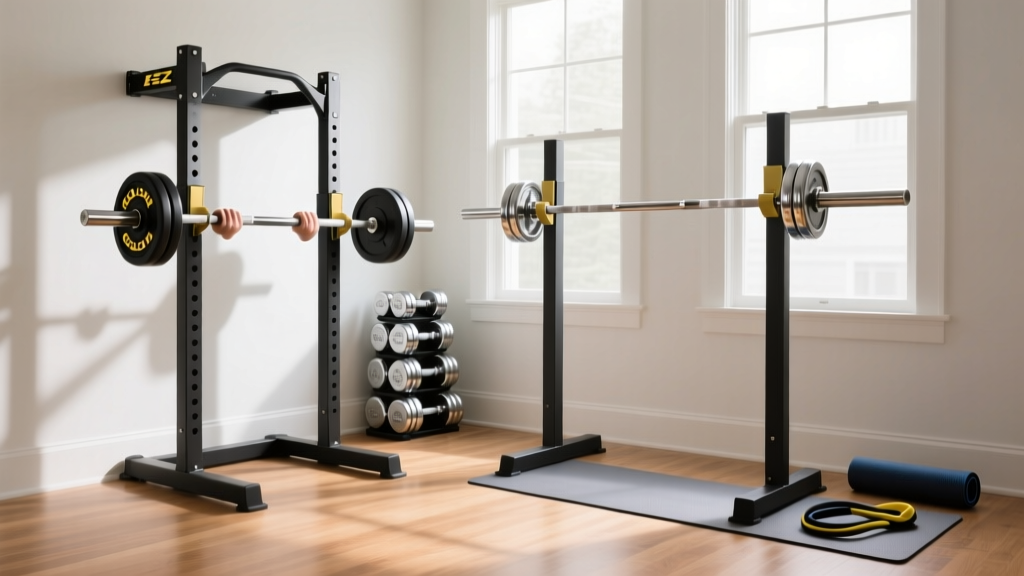
- The Barbell: Choose the EZ Curl Bar. Its 47-inch length allows you to store it vertically in a specialized wall-mounted barbell dock, reducing its storage footprint to a mere 6x6 inch wall profile.
- The Dumbbells: Because you saved 3 feet of lateral wall space by ditching the straight bar, you can mount a vertical A-frame dumbbell tree against the wall. A vertical tree for a 5-35lb subset of Gold Gym dumbbells occupies only 24x24 inches of floor space, leaving the center of the room open for a bench or mat work.
Layout Scenario B: The 150-Square-Foot Garage Bay (Straight Bar Priority)
In a standard single-car garage bay where depth is ample but width is constrained by vehicles, the layout shifts.
- The Barbell: The Straight Bar thrives here. You can utilize the full 86-inch length for heavy compound movements like floor presses or skull crushers without hitting the garage walls.
- The Dumbbells: Utilize the space beneath your wall-mounted plate storage. A low-profile, 2-tier horizontal rack for your Gold Gym dumbbells can slide directly under the bumper plates, utilizing 'dead air' space that would otherwise go unused.
Biomechanics vs. Square Footage: The Trade-Off
While space optimization is critical, it cannot entirely override biomechanical safety. According to kinesiology data from ExRx.net, the angled grip of the EZ curl bar places the wrists in a semi-supinated position, significantly reducing valgus stress on the medial epicondyle of the elbow compared to the fully pronated grip required by a straight bar.
If you have a history of elbow tendinopathy, sacrificing the spatial efficiency of the EZ bar for the straight bar is a poor trade-off. However, from a pure layout perspective, the straight bar's uniform shaft makes it compatible with almost every universal J-cup, landmine attachment, and wall cradle on the market. EZ bars, with their zig-zag shafts, often require specialized, wider cradles or padded horizontal holders to prevent the metal knurling from grinding against storage hardware.
"The best home gym layout is one where the equipment dictates the flow of movement, rather than the lifter having to navigate an obstacle course. If your barbell requires you to step over a dumbbell rack to load plates, your spatial geometry has failed."
Storage Hardware & Safety Clearances
When finalizing your layout, you must adhere to safety clearances recommended by fitness facility guidelines. Organizations like the American Council on Exercise (ACE) consistently emphasize the need for unobstructed egress and safe loading zones in home environments.
Recommended Hardware Pairings
- For the Straight Bar: Utilize a Rogue Fitness Wall-Mount Barbell Holder (designed for 3x3 uprights). This keeps the 7-foot bar off the floor but requires a continuous 8-foot horizontal wall span.
- For the EZ Curl Bar: Invest in a vertical floor-to-ceiling barbell tree or a specialized wall dock that grips the sleeve. This reduces the wall footprint by 90%.
- For Gold Gym Dumbbells: If floor space is under 100 square feet, avoid 3-tier horizontal racks. Opt for a 5-tier vertical dumbbell rack. While it increases the vertical visual weight of the room, it reclaims up to 12 square feet of usable floor mat space.
Expert Verdict: Which Bar Wins the Space War?
If your primary constraint is lateral wall width (e.g., a narrow hallway gym or a tight corner setup), the EZ curl bar is the undisputed champion of spatial efficiency. Its shorter shaft and sleeves allow for tighter rack placement, easier vertical storage, and leave ample room to integrate a vertical tree for your Gold Gym dumbbells without creating a claustrophobic training environment.
However, if your constraint is depth (e.g., a wide but shallow wall), the straight bar mounted horizontally high on the wall, with a low-profile dumbbell rack situated directly beneath it, utilizes vertical airspace brilliantly. Ultimately, mapping your exact room dimensions against the loading clearances outlined above will ensure your free weight zone is both biomechanically effective and architecturally sound.
More gear to consider
All reviews
Cheap vs Premium Breakdown: What $20, $85, and $220 Weights Actually Deliver
Loadable Dumbbell Care & Your Seated Dumbbell Exercises PDF

Bumper vs Iron Plates & the Ideal Dumbbell Weight for a Woman

Best Racks to Store Heavy Overhead Extension Dumbbells (2026)

Olympic Barbell Guide: Knurling, Weight & Seated Dumbbell Curls
