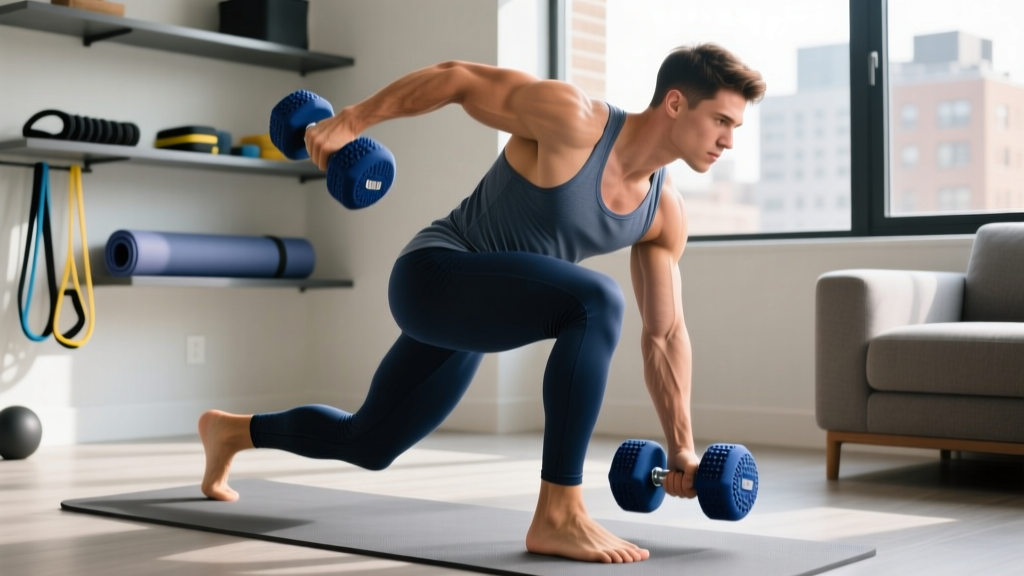
How to Do a Dumbbell Leg Press With Neoprene Weights
Learn how to perform a dumbbell leg press at home using neoprene-coated weights. Step-by-step beginner guide for safe, effective lower-body gains.

If you are building a home gym and searching for an effective leg press dumbbell alternative, you are not alone. The traditional leg press machine is a staple for isolating the quadriceps, but it requires a massive footprint and a budget that often exceeds $2,000. Fortunately, you can replicate the biomechanics of a leg press using a simple pair of neoprene-coated dumbbells right in your living room.
As a beginner, navigating lower-body training at home can be tricky. Without the guided sled of a machine, your stabilizing muscles must work overtime. This step-by-step guide will teach you how to execute two highly effective 'dumbbell leg press' variations using neoprene weights, ensuring maximum quad activation while protecting your home floors and your joints.
Why Neoprene is the Superior Coating for Home Leg Workouts
Before diving into the exercises, it is crucial to understand why neoprene (a synthetic rubber known as polychloroprene) is the optimal choice for home use compared to traditional hex rubber or bare steel.
- Floor Protection: Neoprene has a softer durometer (hardness rating) than urethane and standard cast iron. When you are performing floor-based leg presses or accidentally set a heavy weight down between sets, neoprene will not scuff hardwood floors or crack ceramic tiles.
- Sweat-Wicking Grip: Leg workouts induce heavy sweating. Bare metal or slick urethane dumbbells become dangerous slip hazards when held in a goblet position. Neoprene features a slightly porous, tactile texture that absorbs moisture and maintains friction.
- Odor Resistance: Unlike cheap recycled rubber dumbbells that off-gas a strong 'tire' smell for months, high-quality neoprene is virtually odorless, making it ideal for spare bedrooms and apartments.
Replicating Machine Mechanics: The Biomechanics
The leg press machine operates as a closed kinetic chain exercise where the torso is fully stabilized against a pad, allowing you to push heavy loads solely through knee and hip extension. To mimic this with free weights, we must minimize hip involvement and maximize knee flexion. According to ExRx's biomechanical breakdown of quad-dominant movements, shifting your center of gravity forward and elevating the heels are the two most effective ways to replicate the leg press sled's angle using free weights.
Below are the two best beginner-friendly variations to achieve this.
Variation 1: The Supine Floor Dumbbell Leg Press
This unilateral (single-leg) movement is the closest direct translation to a single-leg press machine. It is exceptional for beginners, physical therapy, and correcting left-to-right strength imbalances without loading the spine.
Step-by-Step Execution
- The Setup: Lie flat on your back on a thick yoga mat or carpeted floor. Bend your right knee and plant your right foot flat on the floor. Extend your left leg straight up toward the ceiling.
- Weight Placement: Have a partner hand you a neoprene dumbbell, or carefully roll it onto your thigh and guide it to your left foot. Place the flat head of the dumbbell securely against the arch and ball of your left foot.
- The Descent (Eccentric): Slowly bend your left knee, bringing the dumbbell down toward your chest. Stop when your knee reaches a 90-degree angle or you feel a deep stretch in the quad. Keep your hips pinned to the floor.
- The Press (Concentric): Drive through the mid-foot and heel, pressing the dumbbell back up until your leg is nearly straight (leave a micro-bend in the knee to keep tension on the quadriceps).
- Volume: Perform 3 sets of 10-15 reps per leg. The neoprene coating ensures the dumbbell head grips your shoe sole, preventing dangerous lateral slips.
Variation 2: The Heels-Elevated Goblet Squat (The 'Hack Squat' Mimic)
If you want to move heavier loads and work both legs simultaneously, the heels-elevated goblet squat is your best leg press dumbbell alternative. By elevating the heels, you artificially increase ankle dorsiflexion, allowing your knees to track far over your toes. This removes the glutes and lower back from the equation, isolating the quads exactly like a leg press.
Step-by-Step Execution
- Elevate the Heels: Stand with your feet shoulder-width apart. Place a sturdy weight plate, a wooden wedge, or a thick textbook under your heels (aim for a 1 to 1.5-inch elevation).
- The Grip: Hold a single heavy neoprene dumbbell vertically against your chest. Cup the top head of the dumbbell with both palms, keeping your elbows tucked tightly against your ribs.
- The Descent: Push your knees forward over your toes while keeping your torso completely upright. Do not hinge at the hips. Descend until your hamstrings completely cover your calves (ass-to-grass depth).
- The Press: Drive through the balls of your feet, extending the knees to return to the top. Squeeze the quads hard at the peak of the movement.
'Maintaining an upright torso during heel-elevated squats is critical. If you lean forward, you shift the load back to the glutes and lumbar spine, entirely defeating the purpose of the leg press mimicry.' — Guidelines adapted from the Mayo Clinic's strength training and posture recommendations.
Neoprene Dumbbell Sizing & Pricing Guide for Beginners
Leg muscles are remarkably strong and adapt quickly. A common beginner mistake is purchasing neoprene dumbbells that are too light, capping their progress within four weeks. Below is a 2026 market breakdown to help you purchase the right starting weights.
| Dumbbell Weight (Per Hand) | Est. Price Per Pair (2026) | Ideal Beginner Profile | Best Exercise Variation |
|---|---|---|---|
| 10 - 15 lbs | $35 - $55 | Absolute beginners, rehab patients | Supine Floor Press (Learning form) |
| 20 - 30 lbs | $70 - $110 | Novice lifters, endurance focus | Goblet Squat (High rep, 15-20) |
| 40 - 50 lbs | $140 - $190 | Intermediate, building muscle mass | Goblet Squat (Hypertrophy, 8-12) |
Pro-Tip: Neoprene dumbbell handles are typically thicker (1.2 to 1.4 inches in diameter) than standard Olympic barbells. When holding a 40 lb dumbbell in a goblet position for 45 seconds, your forearms will fatigue before your quads. Consider using lifting straps for the goblet variation if grip strength becomes your limiting factor.
Troubleshooting Common Failure Modes
Even with the best equipment, beginners often encounter mechanical breakdowns. Here is how to troubleshoot the most frequent issues:
1. Knee Valgus (Caving Inward)
During the heels-elevated goblet squat, your knees may cave inward as you push out of the hole. This places immense shear stress on the ACL and MCL. The Fix: Place a light resistance band just above your knees. The physical feedback will force your glute medius to fire, pushing your knees outward in line with your toes.
2. Dumbbell Slippage on the Floor Press
If the dumbbell slides off your shoe during the supine floor press, it is usually due to placing the weight on the toes rather than the mid-foot. The Fix: Ensure the flat, hexagonal head of the neoprene dumbbell is pressed directly into the arch and heel of your sneaker. The high-friction neoprene coating will lock against the rubber sole of your shoe.
3. Lower Back Rounding
In the goblet squat, rounding the upper back shifts the center of gravity forward, risking a dropped weight. The Fix: Engage your lats by imagining you are trying to 'bend the dumbbell' in half. This creates upper-back rigidity, a principle heavily emphasized in American Council on Exercise (ACE) core stabilization protocols.
Final Thoughts on Home Leg Training
You do not need a $3,000 commercial leg press sled to build impressive, powerful quadriceps. By understanding the biomechanics of closed-chain knee flexion and utilizing high-quality, floor-friendly neoprene dumbbells, you can create a highly effective, joint-friendly leg day in the comfort of your home. Start with the supine floor press to master unilateral balance, then progress to heavy, heels-elevated goblet squats to pack on serious muscle.
More gear to consider
All reviews
Elevated Dumbbell Squat Setup: Olympic vs Standard Plates

Who Invented the Dumbbell? History & Adjustable Setup Walkthrough

Seated Dumbbell Lateral Raise Mistakes & Adjustable Dumbbell Guide

Olympic vs Standard Plates for a Beginner Full-Body Dumbbell Workout

Power Rack vs Squat Rack vs Stand for Gold Gym Dumbbell Set
