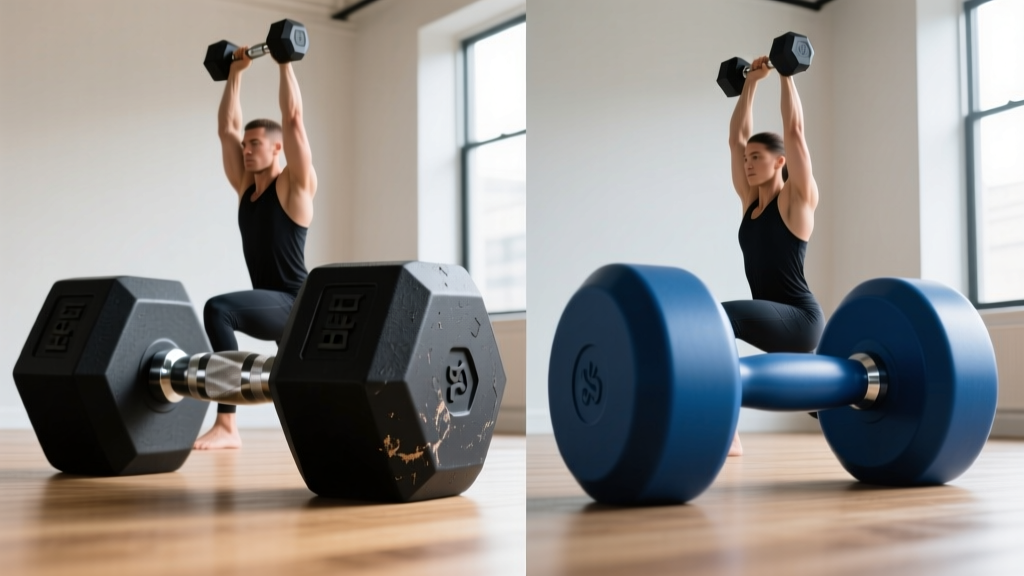
Overhead Press Dumbbells vs Olympic Barbells: Weight & Knurling
Compare overhead press dumbbells to Olympic barbells. Explore our barbell buying guide on weight tolerances, knurling patterns, and grip mechanics.

The strict overhead press is the ultimate test of shoulder strength, core stability, and grip endurance. When building a home gym or upgrading commercial equipment, lifters often debate the merits of using overhead press dumbbells versus a dedicated Olympic barbell. While dumbbells offer unparalleled unilateral benefits and joint-friendly stabilization, the barbell allows for absolute load progression and precise micro-loading. This guide bridges that gap, serving as a comprehensive Olympic barbell buying guide focused on weight tolerances and knurling, while directly comparing the barbell experience to heavy dumbbell pressing.
The Biomechanics of Overhead Press Dumbbells vs. Barbells
When you press dumbbells overhead, your body must stabilize two independent vectors of force. Electromyography (EMG) studies consistently show that dumbbell pressing requires 15% to 20% more stabilizer muscle activation in the anterior and middle deltoids, as well as the rotator cuff, compared to a barbell. According to ExRx.net's biomechanical breakdown of the shoulder press, the barbell locks your hands into a fixed pronated position, allowing you to transfer force directly through the skeletal structure without wasting energy on lateral stabilization.
However, the overhead press dumbbells modality suffers from the 'micro-loading problem.' Standard commercial hex dumbbells jump in 5 lb increments. Going from 50 lbs to 55 lbs per hand represents a 10% total load increase—a massive, often insurmountable leap for the relatively small muscle groups of the shoulder. The solution for home gym owners is investing in adjustable dumbbells like the PowerBlock Elite USA ($389), which allow 2.5 lb micro-jumps via add-on kits, effectively mimicking the fractional plates used on barbells.
Olympic Barbell Buying Guide: Weight Tolerances and Whip
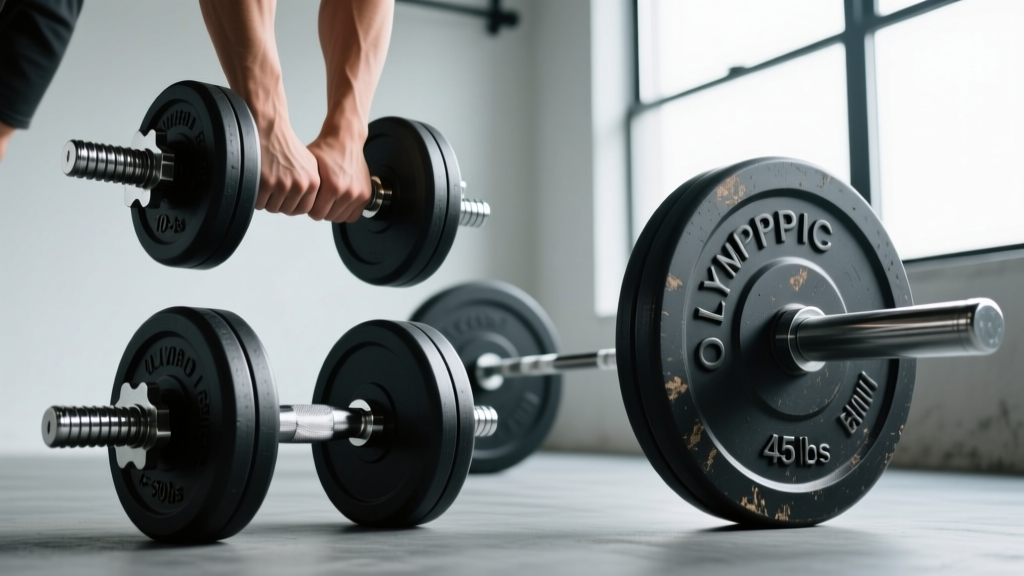
When transitioning to the barbell for strict pressing, the first metric to evaluate in any buying guide is weight tolerance. According to the International Weightlifting Federation (IWF) technical rules, competition barbells must adhere to strict weight tolerances, typically +/- 15 grams for the 20kg shaft.
Budget barbells (priced under $150) often have tolerances of +/- 50 grams or worse. While this seems negligible on paper, a 40-gram discrepancy on a 20kg bar creates an asymmetrical load. During a strict press, this asymmetry forces the lifter to compensate with lateral spinal flexion, increasing injury risk at maximal loads. Furthermore, you must consider 'bar whip' (oscillation), which is dictated by tensile strength and shaft diameter.
Shaft Diameter and Tensile Strength for Pressing
- 28mm Shaft (Weightlifting Bars): Typically rated at 190,000 PSI. These bars have high whip, which is excellent for the clean and jerk but detrimental to the strict press. The oscillation at lockout can destabilize the shoulder joint.
- 29mm Shaft (Power Bars): Typically rated at 205,000 PSI or higher. The Rogue Ohio Power Bar ($295) is a prime example. Its thicker shaft and higher tensile strength ensure zero permanent deformation and minimal whip, providing a rigid, stable platform for heavy overhead pressing.
Decoding Knurling for the Press: Volcano, Mountain, and Hill
Knurling is the most critical tactile interface between lifter and bar. For the overhead press, your grip must be secure enough to prevent the bar from rolling down your forearms, but not so aggressive that it tears your hands during the clean (the movement used to get the bar to your shoulders to initiate the press).
Knurling Profile Definitions
Mountain Knurling: Sharp, prominent peaks that bite deeply into the skin. Ideal for heavy deadlifts, but will tear calluses during high-rep cleans and presses.
Hill Knurling: Shallow, rounded peaks. Very mild and comfortable, but often lacks the friction needed for heavy, sweaty overhead presses.
Volcano Knurling: The peak of the mountain is machined off, leaving a crater-like rim. This provides maximum surface area friction without the deep puncture wounds of mountain knurling.
For dedicated overhead pressing, volcano knurling is the undisputed champion. It provides the 'velcro' effect necessary to hold a 225 lb bar securely in a false grip or standard grip without destroying the epidermis on your palms. As detailed in BarBend's comprehensive guide on barbell knurling, maintaining this knurling requires regular wire brushing to remove chalk and dead skin, ensuring the volcanic rims remain sharp and effective over years of use.
Head-to-Head Equipment Comparison Matrix
To help you decide how to allocate your equipment budget, here is a direct comparison between heavy fixed dumbbells and a dedicated power bar for the overhead press.
| Metric | Overhead Press Dumbbells (Fixed Hex) | Olympic Power Bar (29mm, Volcano) |
|---|---|---|
| Max Load Capacity | Limited by commercial availability (usually caps at 150 lbs/hand) | Virtually unlimited (1000+ lb rated sleeves) |
| Weight Increments | 5 lb jumps (10 lb total system increase) | 0.25 lb to 0.5 lb jumps (using fractional plates) |
| Grip Fatigue | Moderate (smooth or mild knurled handles) | High (requires chalk management on volcano knurl) |
| Stabilization Demand | High (independent vectors, high rotator cuff activation) | Low (fixed hand position, skeletal force transfer) |
| Cost per Pound | ~$2.50 to $3.50 per lb (Urethane) | ~$6.50 to $8.00 per lb (Bar + Bumpers/Plates) |
Real-World Failure Modes: Grip Fatigue and Chalk Management
When programming the overhead press, equipment failure rarely means the bar snapping; it usually means the lifter's grip giving out before the deltoids do. With overhead press dumbbells, the primary failure mode is handle slip. Standard dumbbell handles are typically 32mm to 34mm in diameter. If you use thick grip adapters (like Fat Gripz, which expand the diameter to 57mm), expect your strict press max to drop by 15% to 20% due to premature forearm flexor fatigue.
With a barbell, the failure mode shifts to skin tearing. If you use a bar with aggressive mountain knurling for high-volume pressing (e.g., 5 sets of 8), the repeated friction of cleaning the bar to the clavicle will rip your calluses by the third or fourth set. This is why investing in a power bar with properly machined volcano knurling is non-negotiable for serious pressing blocks. Furthermore, center knurling—a staple on power bars for squat alignment—is entirely irrelevant for the overhead press, but it does help you quickly find the exact center of the bar without looking, saving time between heavy sets.
Expert Tip: Never use liquid chalk on bare knurling without cleaning it immediately. Liquid chalk contains alcohol and rosin that dries into a cement-like paste deep inside the volcano knurling craters. Use standard magnesium carbonate block chalk and a stiff nylon brush after every session to maintain the bar's tactile friction.
Programming Both Modalities for Hypertrophy and Strength
Rather than viewing overhead press dumbbells and Olympic barbells as mutually exclusive, elite strength coaches program both to exploit their unique biomechanical advantages. Use the barbell for absolute strength development in the 1 to 5 rep range. The rigid 29mm shaft and secure volcano knurling allow you to safely overload the central nervous system without stabilization acting as the limiting factor.
Conversely, reserve dumbbells for the 8 to 12 rep hypertrophy range and for joint rehabilitation. The freedom to rotate your wrists into a neutral grip (palms facing each other) at the bottom of the movement opens up the subacromial space, reducing the risk of shoulder impingement during high-fatigue sets. By understanding the precise weight tolerances, knurling profiles, and structural differences outlined in this buying guide, you can curate a free weight arsenal that maximizes both shoulder health and overhead power.
More gear to consider
All reviews
Reverse Grip Dumbbell Curl: Rubber Hex vs Urethane Review
Barbell Knurling Guide & Benefits of Dumbbell Shoulder Press

Cast Iron vs Competition Kettlebells & MX55 Dumbbells Guide
Best Dumbbell Weight for Beginners: Rubber vs Urethane 2026 Trends

From Dumbbells Sketch to Steel: Rack Storage & Maintenance