Bumper vs Iron Plates: Space Layouts for Rogue Hex Dumbbells
Compare bumper vs iron plates for garage gym space optimization. Learn layout strategies integrating Rogue hex dumbbells for maximum floor efficiency.

The Spatial Footprint: Bumper Plates vs. Cast Iron
When designing a high-performance home gym in 2026, space optimization is just as critical as the equipment itself. The foundational debate for any garage gym layout revolves around the choice between bumper plates and traditional cast iron plates. This decision dictates not only your flooring requirements but also your rack clearance, storage density, and overall traffic flow. While bumpers are essential for Olympic weightlifting, iron plates offer unparalleled spatial efficiency for powerlifting and bodybuilding setups.
The primary spatial differentiator is diameter and thickness. According to International Weightlifting Federation (IWF) standards, all bumper plates weighing 10 pounds or more must share a uniform diameter of 450mm (17.7 inches). This standardization ensures the barbell is always elevated to the correct starting height for cleans and snatches. However, this uniform width creates a massive spatial footprint. In contrast, a standard 45-pound cast iron plate typically measures around 14.5 inches in diameter and roughly 1.5 inches in thickness, allowing for significantly tighter storage configurations and narrower rack footprints.
Dimensional Comparison and Rack Clearance
Understanding the exact dimensions of your plates is vital when selecting a power rack or squat stand. If you opt for bumpers, your rack interior must accommodate the 17.7-inch diameter without the plates scraping the uprights during heavy squats or bench presses.
| Plate Type (45 lb Pair) | Diameter | Thickness (Per Plate) | Min. Rack Interior Width | Wall Tree Depth Req. |
|---|---|---|---|---|
| Standard Bumper | 17.7 in (450mm) | 3.25 in | 52 in | 36 in |
| Cast Iron / Machined | 14.5 in | 1.5 in | 48 in | 22 in |
| Urethane Grip Plate | 15.5 in | 2.0 in | 49 in | 26 in |
As noted by experts at Garage Gym Reviews, choosing bumpers means you must invest in a rack with at least 52 inches of interior clearance to prevent the rubber from catching on the uprights during dynamic movements. Iron plates, however, allow you to utilize more compact, 48-inch interior racks, saving up to 15 square feet of total floor space when accounting for the rack footprint and surrounding walkway clearance.
Vertical Storage and Clearance Constraints
Floor space is a premium commodity, making vertical storage the cornerstone of garage gym layout design. However, bumpers and iron plates require entirely different vertical storage solutions.
Bumper Plate Storage: Bumper plates should ideally be stored horizontally on a plate tree or vertically on a heavy-duty wall-mounted rack. A critical failure mode in home gyms is storing thin (10lb or 15lb) bumper plates vertically on a single-peg tree for extended periods; the rubber will warp and deform, rendering them useless. If using a wall-mounted bumper rack, you need a minimum of 36 inches of protrusion depth to accommodate the 17.7-inch diameter plus the rack frame and loading clearance.
Iron Plate Storage: Cast iron is incredibly dense and structurally rigid. You can safely store hundreds of pounds of iron on a compact, 24-inch deep wall-mounted tree or even stack them vertically in a corner bin without fear of warping. This allows you to reclaim valuable wall space for other accessories like resistance bands, medicine balls, or belt squat attachments.
Expert Warning: Flooring and Drop ZonesNever design your layout assuming iron plates can be dropped. Dropping cast iron on standard residential garage concrete will cause severe spalling, cracking, and structural damage to the slab. If your layout incorporates Olympic lifting from the shoulder or overhead, you must allocate a dedicated 8x8 foot drop zone with 3/4-inch vulcanized rubber mats, which inherently favors the use of bumper plates in that specific quadrant of the gym.
The Dumbbell Zone: Integrating Rogue Hex Dumbbells
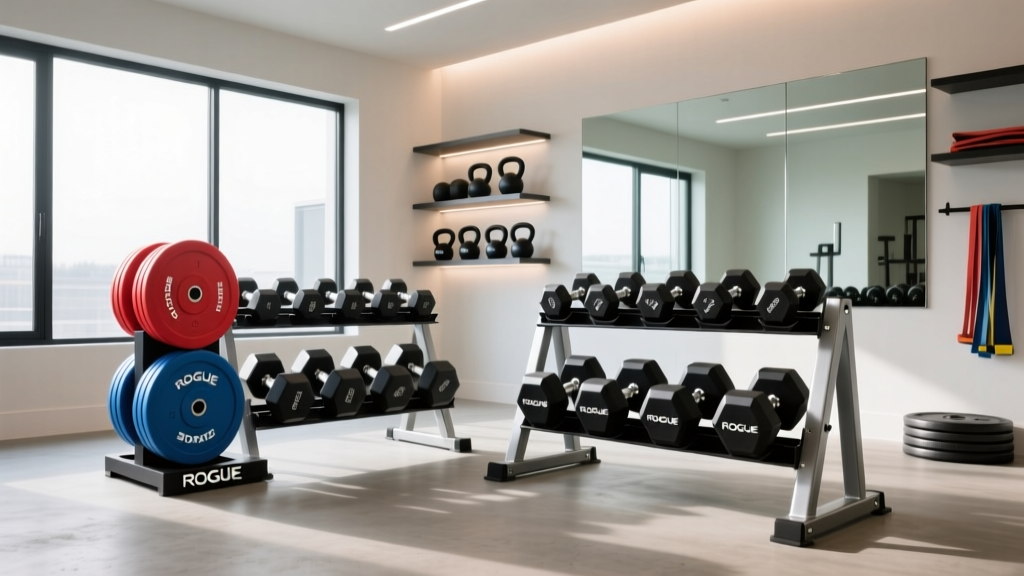
No free weight layout is complete without a dedicated dumbbell station, and this is where the rogue hex dumbbells excel in spatial optimization. Unlike round dumbbells that require individual saddles or extensive anti-roll barriers, the hexagonal profile of Rogue's rubber-encased hex dumbbells allows them to be stored flush against one another on tiered shelving.
When mapping out your gym's floor plan, the dumbbell zone must be positioned strategically to avoid interfering with the barbell's loading path. The most efficient layout pairs a 5-50lb set of Rogue hex dumbbells with the Rogue 3-Tier Dumbbell Rack. This specific rack measures 47.25 inches wide and 28 inches deep, holding up to 10 pairs of dumbbells in a highly condensed footprint.
Traffic Flow and the 'Triangle of Iron'
To optimize movement and safety, professional facility designers utilize the 'Triangle of Iron' concept. This involves placing your three primary free weight stations—the power rack, the plate storage, and the dumbbell rack—at the points of a triangle with a minimum of 36 inches of clear walkway between them.
- Point A (The Rack): Positioned against the longest uninterrupted wall to allow for safe spotting and band attachment.
- Point B (Plate Storage): Placed within 4 feet of the rack. If using iron plates on a rolling caddy, you can move the weight to the barbell without traversing the gym.
- Point C (Rogue Hex Dumbbell Station): Positioned perpendicular to the rack. Because hex dumbbells are often used for high-volume hypertrophy work, placing them near a mirror or an adjustable bench ensures the user doesn't have to carry heavy 50lb dumbbells across the gym floor, reducing the risk of toe injuries and floor scuffing.
Cost-to-Space Ratio Analysis
In 2026, the economics of gym equipment must be weighed against the cost per square foot of your real estate. Bumper plates are inherently more expensive per pound than iron. A 260lb set of high-quality Rogue Black Bumper Plates will cost upwards of $650, while a comparable set of Rogue Machined Iron Plates hovers around $500.
However, the true cost lies in spatial efficiency. If you are building a gym in a standard 2-car garage (roughly 400 square feet), dedicating 25% of your space to a massive bumper plate wall rack and an oversized 52-inch power rack might not be justifiable if your primary training modality is powerlifting or bodybuilding. By switching to iron plates and a compact 48-inch rack, you free up enough square footage to add a dedicated cable pulley system or a cardio zone, vastly increasing the utility of your space.
Frequently Asked Questions
Can I mix bumper plates and iron plates on the same barbell?
Yes, but only if the iron plates are loaded on the outside of the bumpers, and the total collar length allows for it. However, from a spatial and storage perspective, mixing them complicates your layout. You will need dual-purpose storage trees that can accommodate both the 17.7-inch diameter of the bumpers and the narrower hubs of the iron plates, which often leads to cluttered, inefficient storage zones.
Do Rogue hex dumbbells damage garage floors?
The rubber coating on Rogue hex dumbbells absorbs minor impacts, but dropping a 50lb dumbbell from shoulder height will still crack unsealed concrete. Always place your 3-tier dumbbell rack on top of a 3/4-inch horse stall mat or vulcanized rubber tile to protect the floor and dampen acoustic vibration when racking the weights.
What is the best layout for a 12x12 foot room?
In a 144-square-foot space, you must prioritize iron plates over bumpers. Utilize a wall-mounted iron plate rack to keep the floor clear, opt for a folding or wall-mounted squat rack that can be collapsed when not in use, and limit your Rogue hex dumbbell set to a 5-30lb range stored on a compact 2-tier A-frame rack to preserve your central workout area for mat work and kettlebell swings.
More gear to consider
All reviews
Power Rack vs Squat Rack vs Squat Stand: A Dumbbell Workout Guide

Bumper Plate vs Iron Plate Comparison: Upgrading Your Metal Dumbbell & Barbell Setup

EZ Curl vs Straight Bar Maintenance & Dumbbell Crunches Grip Care

Power vs Squat Rack Setup & Inner Thigh Exercises with Dumbbells
Power Rack vs Squat Rack vs Squat Stand: Best for Power Dumbbells
