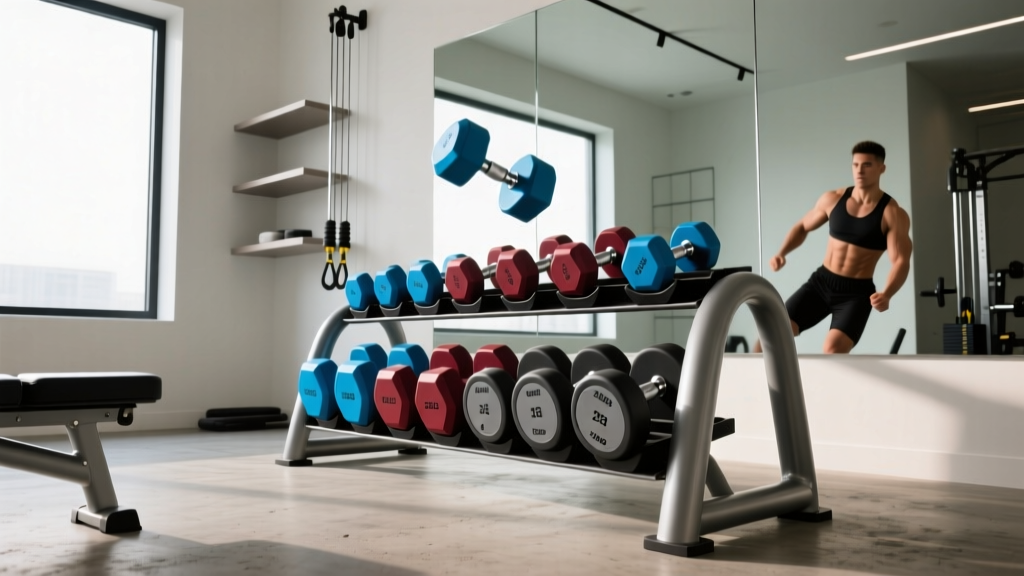
2026 Dumbbell Rack Trends: Storage and Dumbbell Hyperextension Flow
Explore 2026 dumbbell rack market trends, storage solutions, and facility layouts optimized for posterior chain workflows like the dumbbell hyperextension.

The 2026 Paradigm Shift: From Static Storage to Functional Zones
In the commercial and high-end home gym markets of 2026, dumbbell storage has fundamentally evolved. The era of treating the dumbbell rack as a static, utilitarian dumping ground for loose weights is over. Today's facility designers and strength coaches view storage as the anchor of 'functional workflow zones.' This shift is heavily driven by the integration of complex, multi-apparatus routines that require seamless transitions between free weights and specialized benches.
According to recent commercial fitness market analyses published by Club Industry, modern gym layouts are prioritizing 'micro-zones'—dedicated 10x10 foot spaces where a user can execute an entire posterior chain or hypertrophy circuit without crossing the main floor. In these micro-zones, the proximity, height, and structural design of the dumbbell rack directly dictate the safety and efficiency of the exercises being performed. This is particularly evident in the rising popularity of weighted Roman chair work, where the rack's placement and tier angles are now being specifically engineered to support the dumbbell hyperextension.
Market Data: What's Driving the Premium Storage Sector?
The global market for premium free weight storage has seen a 14% year-over-year growth, driven largely by the demand for heavy-duty, 11-gauge steel 3-tier racks that minimize footprint while maximizing weight capacity. Gym owners are moving away from vertical A-frame racks—which consume excessive floor space and pose lower-back hazards when retrieving heavy weights from the bottom tier—toward horizontal, tiered shelving units.
Below is a 2026 market comparison of the top-tier commercial dumbbell racks currently dominating the sector:
| Brand & Model | Est. Price (2026) | Steel Gauge | Shelf Lip Height | Max Capacity | Footprint |
|---|---|---|---|---|---|
| Rogue RM-3 3-Tier Rack | $695.00 | 11-Gauge | 1.5 inches | 1,200 lbs | 50" x 30" |
| Eleiko Olympic 3-Tier | $1,250.00 | 11-Gauge | 1.2 inches | 900 lbs | 48" x 28" |
| Rep Fitness 3-Tier | $349.00 | 12-Gauge | 1.0 inches | 600 lbs | 44" x 26" |
| Bells of Steel 3-Tier | $425.00 | 11-Gauge | 1.5 inches | 850 lbs | 47" x 29" |
Note: Pricing reflects base MSRP for standard black powder-coat finishes without add-on weight plate horns.
The 'Dumbbell Hyperextension' Workflow: Why Layout Matters
To understand why rack design and placement have become critical in 2026, we must look at the biomechanics of specific exercises. The dumbbell hyperextension has surged in popularity as a staple for glute and erector spinae hypertrophy. Unlike bodyweight variations, the weighted version requires the lifter to secure a heavy hex or urethane dumbbell (typically ranging from 40 to 80 lbs) against their chest or upper back while mounted on a 45-degree back extension bench.
Biomechanical Insight: Picking an 80lb dumbbell off the floor or the bottom tier of an A-frame rack induces significant lumbar shear force before the actual exercise even begins. Facility guidelines emphasized by the National Strength and Conditioning Association (NSCA) stress the importance of minimizing spinal loading during the 'pickup phase' of any lift.This is where the modern 2-tier and 3-tier horizontal rack solves a critical workflow problem. By placing a low-profile, open-front 2-tier rack (or utilizing the top tier of a 3-tier rack) directly adjacent to the GHD or Roman chair, the user can perform a safe, hinged pickup at waist height. The dumbbell is grabbed, pivoted, and secured for the dumbbell hyperextension in one fluid motion, entirely eliminating the hazardous floor-to-chest carry. Forward-thinking commercial gyms are now bolting these racks directly into the floor at a precise 24-inch distance from the back pad of the extension bench, creating a dedicated 'posterior chain island.'
Urethane vs. Rubber: The Friction Factor
When storing heavy dumbbells used for these intense workflows, the coating matters. Urethane dumbbells (which dominate the 2026 commercial market) are denser and more compact than traditional rubber-coated hex bells. However, urethane has a lower coefficient of friction on bare steel. If a rack lacks an adequate front lip, the vibration from a dropped 70lb dumbbell on an adjacent tier can cause a round-handled urethane bell to roll off. This is why the industry standard for the front lip has shifted from 0.75 inches in 2020 to a minimum of 1.5 inches in 2026.
Failure Modes in Modern Dumbbell Racks (And How to Avoid Them)
Despite the influx of high-quality equipment, the market is saturated with budget imports that fail under the specific stresses of modern training zones. When auditing gym equipment, look out for these specific failure modes:
- Tier Bowing and Weld Fatigue: Racks constructed from 14-gauge or thinner steel will inevitably bow in the center of the middle tier when loaded with more than 400 lbs of iron. Over time, this bowing stresses the spot welds at the vertical uprights, leading to catastrophic shelf collapse. Always insist on 11-gauge or 12-gauge steel with continuous robotic welds.
- Powder Coat Degradation: Cheap electrostatic powder coatings will chip and flake when slammed by cast-iron or rubber dumbbells. This exposes the raw steel to humidity, causing rust that eventually transfers to the knurling of your dumbbells. Look for racks with a minimum 2-mil powder coat thickness or integrated UHMW plastic shelf liners.
- The 'Lip Failure' Edge Case: As mentioned, a sub-1-inch lip is a massive liability. Furthermore, if the shelf is perfectly flat rather than featuring a slight 2-degree backward cant, round dumbbells will rest directly on the lip's edge, accelerating wear and increasing roll-off risk.
'A gym's layout is only as safe as its worst-placed storage unit. If a lifter has to compromise their posture to retrieve a weight for a heavy hinge movement, the facility has failed the user.' — 2025 International Health, Racquet & Sportsclub Association (IHRSA) Facility Design Symposium
Strategic Purchasing Framework for 2026
Whether you are outfitting a 10,000-square-foot commercial facility or a high-end garage gym, use this 3-step framework to select your dumbbell storage solutions:
Step 1: Audit Your Heaviest Workflow
Identify the heaviest dumbbell movement in your programming. If you or your clients regularly perform the dumbbell hyperextension, heavy goblet squats, or farmer's carries with 70+ lb bells, you must prioritize waist-height retrieval. This dictates a 2-tier rack or a 3-tier rack where the top tier is reserved exclusively for the 40-100 lb range.
Step 2: Calculate the True Footprint
Do not just measure the base of the rack. Account for the 'swing zone'—the space required for a user to stand in front of the rack, bend over, and curl a dumbbell outward without hitting a wall or adjacent machine. A standard 50-inch wide 3-tier rack requires a minimum clearance of 48 inches in front of it for safe operation.
Step 3: Evaluate Modularity and Add-Ons
The best 2026 racks are modular. Look for models that offer optional weight plate storage horns on the rear uprights or attachable kettlebell shelves. Consolidating your free weight storage into a single, heavily bolted footprint reduces floor clutter and keeps the pathways between your racks and exercise benches completely clear, ensuring that high-focus movements like the dumbbell hyperextension can be executed with zero environmental distractions.
Final Thoughts on the Storage Evolution
The dumbbell rack is no longer just a place to put weights away; it is the starting line for your most demanding lifts. By understanding the market shift toward functional workflow zones, investing in 11-gauge steel with adequate lip heights, and strategically placing your storage to support complex movements like the dumbbell hyperextension, you future-proof your gym against both spatial inefficiency and biomechanical injury. As we move deeper into 2026, the facilities that thrive will be those that treat equipment storage as an active participant in the training experience, not just a passive accessory.
More gear to consider
All reviews
Barbell Collar Clamps & Behind the Head Dumbbell Raise Mistakes
Smart Dumbbell Storage: Space for Step Ups With One Dumbbell

Space-Saving Kettlebells & Chest Supported Dumbbell Row Alternative

Olympic Barbell Weight & Knurling Guide for Your Dumbbell Program

Extending Rack Life: Dumbbell Hangers & Storage Maintenance
