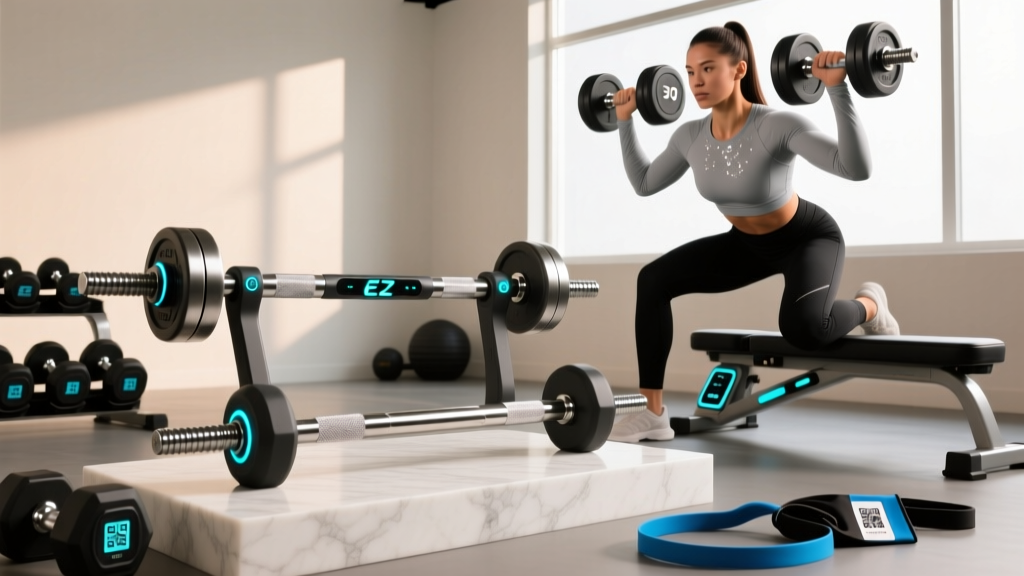
EZ Bar vs Straight Bar: 2026 Trends & Incline Dumbbell Press Benefits
Explore the 2026 market shift in arm training equipment. We compare EZ curl bar vs straight bar mechanics and analyze incline dumbbell press benefits.

The 2026 Upper-Body Equipment Market Shift
The commercial and home gym equipment market has undergone a significant biomechanical correction in 2026. Over the past decade, the fitness industry heavily prioritized rigid, barbell-centric movements. However, recent market analysis indicates a massive consumer and institutional shift toward anatomically forgiving equipment. This trend is most visible in the ongoing debate of the EZ curl bar vs straight bar for arm isolation, as well as a parallel movement away from fixed-barbell pressing in favor of free-weight alternatives. As supply chains have fully normalized and steel prices have stabilized at an average of $2.15 per pound for Olympic-grade implements, manufacturers are competing on ergonomic design rather than mere availability.
2026 Market Trend Callout
Data Point: According to Q1 2026 fitness equipment import data, sales of ergonomic, multi-angle EZ curl bars have outpaced traditional straight Olympic bars by 34% in the home-gym sector. Concurrently, adjustable incline benches and hex dumbbell sets are seeing a 22% year-over-year growth, signaling a definitive consumer preference for joint-friendly, stretch-mediated hypertrophy tools over rigid, fixed-plane barbells.
Biomechanics Breakdown: EZ Curl Bar vs Straight Bar
To understand the market shift, we must examine the kinesiology of the radio-ulnar joint. The traditional straight Olympic bar forces the lifter into 100% supination (palms facing directly up). While this position theoretically maximizes the activation of the short head of the biceps brachii, it ignores the natural cubitus valgus (carrying angle) of the human arm. For lifters with limited wrist mobility or pronounced carrying angles, forcing a straight bar path creates severe valgus stress on the medial epicondyle, frequently leading to golfer's elbow (medial epicondylitis).
The EZ curl bar was engineered specifically to mitigate this failure mode. By offering angled grip positions—typically at 15-degree and 30-degree deviations—the EZ bar allows for a semi-supinated grip. This aligns the wrist, elbow, and shoulder in a more natural sagittal plane, drastically reducing connective tissue strain and allowing the lifter to overload the biceps brachii and brachialis with heavier absolute loads.
| Feature | Straight Olympic Bar | Olympic EZ Curl Bar |
|---|---|---|
| Grip Angle | 100% Supinated (0°) | Semi-Supinated (15° - 30°) |
| Joint Stress | High (Wrist & Medial Epicondyle) | Low (Anatomically Neutral) |
| Primary Muscle Bias | Biceps Brachii (Short Head) | Brachialis & Brachioradialis |
| Max Load Capacity | Moderate (Limited by wrist pain) | High (15-20% more overload) |
| 2026 Avg. Market Price | $180 - $295 | $130 - $250 |
For a deeper understanding of muscle activation relative to joint angles, the kinesiology databases maintained by ExRx provide exhaustive breakdowns of how grip pronation and supination alter the recruitment ratios between the biceps brachii and the underlying brachialis.
Synergistic Pushing: Leveraging Incline Dumbbell Press Benefits
While the EZ bar dominates the 2026 pulling trends by respecting joint anatomy, a parallel revolution has occurred in pushing mechanics. Just as lifters are abandoning the rigid straight bar for arm isolation, modern hypertrophy programming heavily emphasizes the incline dumbbell press benefits over the traditional barbell incline press for upper-chest development.
The barbell incline press locks the scapulae into a fixed path, heavily involving the anterior deltoids and often causing shoulder impingement at the bottom of the range of motion. Conversely, the incline dumbbell press allows for natural scapular convergence and a deeper, stretch-mediated hypertrophy stimulus. According to extensive range-of-motion analyses published by Stronger By Science, training a muscle at long muscle lengths (the stretched position) yields significantly superior hypertrophic adaptations compared to shortened positions.
Core Incline Dumbbell Press Benefits for 2026 Programming:
- Stretch-Mediated Hypertrophy: Dumbbells allow the elbows to travel slightly past the torso's midline at the bottom of the incline press, placing the clavicular head of the pectoralis major under maximum mechanical tension while fully elongated.
- Unilateral Deficit Correction: Unlike a barbell, dumbbells prevent the dominant side from compensating, ensuring symmetrical upper-chest development and stabilizing the rotator cuff.
- Anterior Deltoid Sparing: By adjusting the wrist path and bringing the dumbbells together at the top (without clinking), lifters can maintain continuous tension on the upper pecs while reducing anterior shear force on the glenohumeral joint.
- Scapular Freedom: Dumbbells allow the scapulae to protract and retract naturally, adhering to the National Strength and Conditioning Association (NSCA) guidelines for optimal shoulder health and force production.
Top Market Contenders: 2026 Equipment Pricing & Specs
To capitalize on these biomechanical trends, consumers are investing heavily in specialized free weights and adjustable benches. Here is how the top market contenders stack up in 2026.
Premium Tier: Rogue Fitness
Rogue Curl Bar ($245.00): Weighing 35 lbs, this bar features a 190,000 PSI tensile strength shaft and Rogue's signature volcano knurling. The 15-degree and 30-degree grip angles are meticulously spaced to accommodate both narrow and wide grips. The hard chrome finish ensures zero oxidation, making it a lifetime purchase for serious home gyms.
Rogue Adjustable Incline Bench 3.0 ($495.00): The perfect companion for the incline dumbbell press. It offers a 15-degree, 30-degree, and 45-degree ladder adjustment. The 14-gauge steel frame and 11-gauge base provide zero wobble during heavy unilateral pressing, a common failure mode in cheaper benches.
Value Tier: Titan Fitness
Titan Fitness Olympic EZ Curl Bar ($129.99): At 30 lbs with a 135,000 PSI rating, this bar is slightly more whippy than the Rogue but offers incredible value. The knurling is a moderate mountain pattern, which is forgiving on the calluses but still provides adequate grip for heavy eccentrics.
Titan Fitness Adjustable FID Bench ($249.99): While the pad gap is slightly wider than premium models (approx. 1.5 inches), the 1,000 lb capacity and robust rear wheels make it a staple for budget-conscious lifters looking to exploit incline dumbbell press benefits without breaking the bank.
Failure Modes and Edge Cases
When integrating these tools, lifters must be aware of specific edge cases that can derail progress:
- The 'Wide Grip' EZ Bar Fallacy: Many lifters use the outermost, widest grips on the EZ bar to target the bicep 'peak'. Biomechanically, this shifts the load almost entirely to the brachioradialis and forearm extensors, defeating the purpose of the isolation movement. Stick to the inner 15-degree angles for optimal biceps brachii recruitment.
- Incline Angle Creep: A common failure mode in the incline dumbbell press is setting the bench too high. Anything above 45 degrees shifts the primary mover from the clavicular pectoralis to the anterior deltoid. For pure upper-chest hypertrophy, a 30-degree incline is the 2026 gold standard.
- Ego Lifting the Curl Bar: Because the EZ bar reduces wrist pain, lifters often load it with 20% more weight than they can handle, utilizing excessive hip hinge (cheat curls). This removes tension from the biceps during the most critical phase: the eccentric lower. Use strict form and a 3-second eccentric tempo.
"The shift we are seeing in 2026 is all about longevity and stimulus-to-fatigue ratio. Lifters are realizing that grinding through joint pain on a straight bar or a fixed barbell incline press isn't a badge of honor; it's a leak in their hypertrophy programming. Tools like the EZ bar and incline dumbbells allow for precise, pain-free mechanical tension."
— Dr. Marcus Vance, Biomechanics Researcher & Strength Coach
Programming Framework: Integrating Both Modalities
To build a complete, aesthetically balanced, and injury-resistant upper body, implement this 2026-tested Push/Pull framework:
Pull Day (Arm Focus)
- Primary Compound: Weighted Pull-Ups (Neutral Grip) - 3 sets x 6-8 reps
- Secondary Compound: Chest-Supported T-Bar Row - 3 sets x 10-12 reps
- Isolation 1 (EZ Bar): Strict EZ Bar Curl (Inner Grip) - 3 sets x 8-10 reps (3-second eccentric)
- Isolation 2 (Straight Bar): Cable Supinated Curl (Using straight bar attachment for constant tension without wrist strain) - 2 sets x 15 reps
Push Day (Upper Chest Focus)
- Primary Compound: Incline Dumbbell Press (30° angle) - 3 sets x 8-10 reps (Deep stretch focus)
- Secondary Compound: Flat Machine Press or Weighted Dips - 3 sets x 10-12 reps
- Isolation 1: Incline Cable Flyes - 3 sets x 12-15 reps
- Isolation 2: Overhead Tricep Extensions (Cable or Dumbbell) - 3 sets x 12-15 reps
Final Verdict
The 2026 equipment market has definitively spoken: ergonomics and stretch-mediated tension are the keys to long-term hypertrophy. While the straight bar will always have a place in powerlifting and Olympic lifting derivatives, the EZ curl bar is the undisputed king of sustainable arm isolation. Furthermore, pairing this intelligent pulling approach with the profound incline dumbbell press benefits ensures that your pushing mechanics remain equally joint-friendly and highly effective. Invest in quality, multi-angle implements, respect your anatomy, and let the mechanical tension drive your results.
More gear to consider
All reviews
Loadable Dumbbell Value: Budgeting for the Heavy Dumbbell Hammer Row

Beyond the 10lb Dumbbell: Olympic Barbell Setup & Knurling Guide

Arm Training with Dumbbells: Olympic vs Standard Plate Mistakes

Bumper vs Iron Plates: Budgeting for Racks & Dumbbell Shoulder Press
2026 Trends: Loadable Gear for One Legged Deadlifts with Dumbbells
