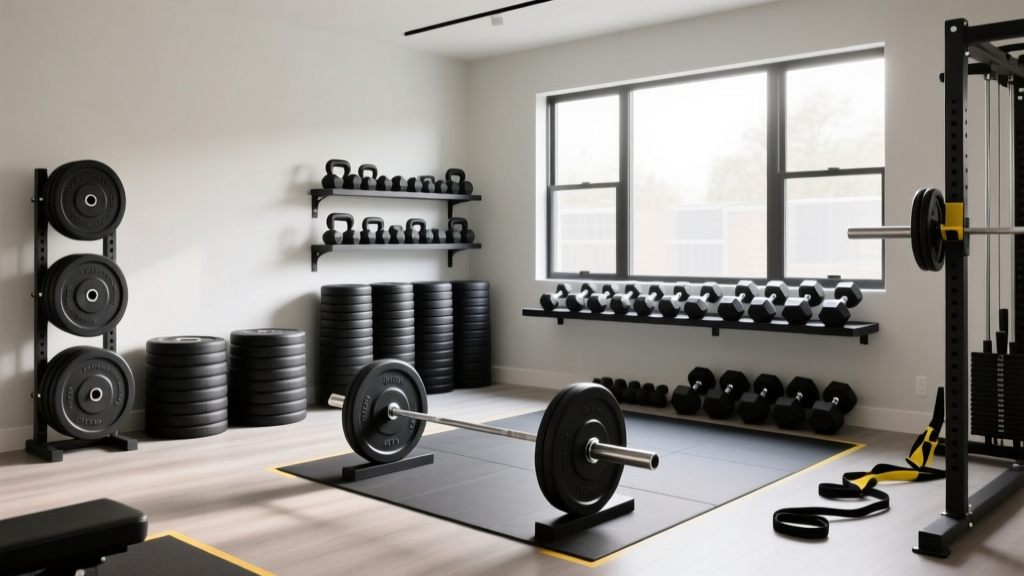
Bumper vs Iron Plates: Gym Layouts & Dumbbell Lateral Raise Form
Compare bumper vs iron plates for home gym space optimization. Learn layout zoning, storage footprints, and spatial needs for dumbbell lateral raise form.

The Spatial Reality: Bumper Plates vs. Cast Iron
When designing a home gym or optimizing a commercial facility layout in 2026, the debate between bumper plates and cast iron plates extends far beyond dropping mechanics and barbell whip. It is fundamentally a question of spatial geometry, storage footprint, and zone allocation. Bumper plates, constructed from high-density virgin rubber or crumb rubber, maintain a uniform 17.7-inch diameter regardless of weight. Cast iron plates, conversely, scale down in diameter as the weight decreases, but their machined steel variants offer a drastically thinner profile on the barbell sleeve and the storage rack.
According to Barbend's comprehensive guide on bumper vs. iron plates, the choice between the two dictates your floor matting requirements, your rack clearance, and the overall square footage needed for safe operation. Before purchasing a 500-pound plate collection, you must understand how the physical dimensions of these plates will dictate your gym's floor plan.
| Plate Type | Diameter | Thickness (Per Plate) | 10-Plate Storage Footprint | Avg. 2026 Cost (Per lb) |
|---|---|---|---|---|
| Competition Bumper (Urethane) | 17.7 in | 1.05 in | 10.5 in (Horizontal Tree) | $4.50 - $6.00 |
| Standard Echo Bumper (Rubber) | 17.7 in | 3.25 in | 32.5 in (Horizontal Tree) | $3.00 - $3.80 |
| Machined Cast Iron (Calibrated) | 17.7 in | 1.30 in | 13.0 in (Horizontal Tree) | $2.20 - $2.80 |
| Standard Cast Iron (Non-Machined) | 14.5 - 17.7 in | 1.50 - 1.80 in | 15.0 - 18.0 in (Tree) | $1.20 - $1.80 |
Zoning Your Gym: Drop Zones vs. Isolation Zones
Space optimization requires dividing your gym into distinct functional zones. The 'Drop Zone' is the high-impact area surrounding your power rack or Olympic lifting platform. This zone mandates the use of bumper plates and heavy-duty floor protection. The 'Isolation Zone' is dedicated to dumbbell work, cable machines, and strict hypertrophy movements where spatial awareness and mirror proximity are critical.
Layout Pro-Tip: Never place your primary dumbbell rack directly adjacent to the Drop Zone. The vibration from dropped bumper plates can cause lighter adjustable dumbbells or kettlebells to shift, creating a tripping hazard and disrupting concentration during strict isolation movements.Designing the Isolation Zone for Optimal Biomechanics
The layout of your isolation zone directly impacts your ability to execute strict hypertrophy movements. Consider the spatial requirements for perfecting your dumbbell lateral raise form. According to biomechanics databases like ExRx, proper execution requires a slight forward hip hinge, a neutral spine, and a strict lateral plane of motion where the arms travel outward to a 90-degree angle.
If your isolation zone is cramped—say, positioned in a narrow hallway or too close to a loaded barbell on a floor rack—you will subconsciously alter your dumbbell lateral raise form to avoid hitting obstacles. This results in excessive elbow flexion, swinging the weight, or shifting tension to the anterior deltoid and upper traps. To optimize your layout for this movement:
- Lateral Clearance: Ensure a minimum of 72 inches (6 feet) of unobstructed horizontal space to accommodate a full wingspan with 15-30 lb dumbbells.
- Depth Clearance: Allow 36 inches of depth behind the lifter to safely execute the 10-to-15-degree forward lean without bumping into a wall or plate tree.
- Mirror Placement: Mount a shatterproof acrylic gym mirror at eye level (starting 24 inches off the floor) directly in front of the isolation zone to monitor the slight forward lean and elbow bend without requiring the lifter to turn their head.
Storage Footprints: A-Frames, Trees, and Wall Mounts
How you store your plates when they are not on the barbell is the single biggest factor in reclaiming usable floor space. The storage solution you choose must align with the plate type you purchase.
Horizontal Plate Trees (Best for Cast Iron)
Horizontal plate trees are the gold standard for cast iron plates. A standard 10-peg Titan Fitness Horizontal Plate Tree occupies roughly 5.5 square feet of floor space. Because machined cast iron plates are thin (1.3 inches for a 45lb plate), you can load a tree with over 500 lbs of iron while maintaining a compact, easily accessible footprint. However, loading heavy bumpers onto a horizontal tree is ergonomically poor and often exceeds the weight capacity of the pegs.
A-Frame Vertical Racks (Best for Bumper Plates)
For standard rubber bumpers, an A-Frame rack is non-negotiable. As noted in the Rogue Fitness specifications for Echo Bumpers, the thick profile of rubber plates makes horizontal storage impossible. An A-Frame rack like the Rogue A-Frame Plate Rack stores plates vertically on dual horns. While it requires a slightly larger footprint (roughly 6.25 square feet), it allows you to store up to 600 lbs of bumpers safely while keeping the center of gravity low to prevent tipping.
'In a 200-square-foot garage gym, every inch of floor space dictates workflow. Switching from thick rubber bumpers to calibrated steel plates and a horizontal tree reclaimed nearly 40% of my central lifting area, allowing me to finally dedicate a proper zone for dumbbell isolation work.' - Home Gym Engineering Survey, 2025
Floor Protection and Spatial Matrices
Your plate choice dictates your flooring layout, which in turn affects the usable square footage of your room. Bumper plates require a dedicated drop zone to protect both the plates and the concrete subfloor.
Warning: Mat Thickness VariationsDo not mix 3/4-inch vulcanized drop mats with 3/8-inch standard rubber flooring in the same continuous lifting zone. The 3/8-inch height discrepancy creates a severe tripping hazard and alters the biomechanics of pulling from the floor, forcing an asymmetrical setup for deadlifts and cleans.
The Bumper Matrix: If you train with bumpers, you must allocate a minimum 8x8 foot (64 sq ft) platform area covered in 3/4-inch horse stall mats or specialized drop pads. This permanently consumes a large portion of a standard single-car garage gym.
The Iron Matrix: If you exclusively use cast iron and perform controlled eccentrics (no dropping), you can reduce your flooring to 3/8-inch rolled rubber or interlocking foam tiles. This allows you to push your power rack flush against a wall, saving up to 24 inches of clearance space behind the rig.
The 2026 Decision Framework: Square Footage vs. Plate Type
Use this framework to finalize your equipment order based on your available spatial layout:
- The Sub-150 Sq Ft Micro-Gym: Choose Machined Cast Iron. Space is at an absolute premium. The thin profile of iron plates on a horizontal tree, combined with wall-mounted dumbbell racks, will maximize your central floor area for strict isolation movements and compact power rack usage.
- The 200-300 Sq Ft Garage Gym (Hybrid Athlete): Choose a Split System. Purchase a set of 10lb and 25lb bumpers for high-rep Olympic variations, and fill the rest of your barbell load with 45lb cast iron plates. Store the iron on a tree and the bumpers on a small wall-mounted vertical horn setup.
- The 400+ Sq Ft Dedicated Facility (CrossFit/Weightlifting): Choose Full Bumper Sets. You have the square footage to support multiple 8x8 drop zones and heavy-duty A-Frame storage racks without compromising the spatial integrity of your isolation and cardio zones.
Frequently Asked Questions
Can I drop iron plates on a thick rubber mat?
No. Even with 3/4-inch vulcanized rubber mats, dropping cast iron plates will eventually crack the plates, bend your barbell sleeves, and degrade the concrete subfloor. Iron plates are strictly for controlled eccentrics. If your workout programming requires dropping the barbell from overhead or the shoulder, you must allocate the space and budget for bumper plates.
Do bumper plates make the barbell harder to balance?
Standard rubber bumpers have a wider surface area on the floor during deadlifts, which can actually provide a slight stability benefit for beginners. However, because they are thicker, they push the weight further out on the barbell sleeve, which can increase barbell whip and oscillation during heavy squats compared to the dense, centralized mass of calibrated iron plates.
How much space do I need for a dedicated dumbbell isolation zone?
For a fully functional isolation zone that accommodates complex movements requiring strict dumbbell lateral raise form, chest flies, and lunges, allocate a minimum 10x10 foot (100 sq ft) area. This ensures you have 360 degrees of clearance, preventing the subconscious form-breakdown that occurs when lifters feel cramped near walls or heavy equipment racks.
More gear to consider
All reviews
Olympic Barbell Guide: Weight, Knurling & Dumbbell Push Ups

Barbell Collar and Clamp Types Comparison: Beyond Dumbbell Romanian Lifts
Cardio With Dumbbells: 2026 Storage Rack Market Trends
Olympic vs Standard Plates & Dumbbell Walking Lunge Alternative
Bumper vs Iron Plates: Budget Guide & Incline Dumbbell Fly GIF Form
