
Storing a Dumbbell That Shakes: Rack Layout & Stability Guide
Learn how to safely store a dumbbell that shakes or rattles. Discover space-saving rack layouts, stability fixes, and custom storage solutions.

The 'Shaking Dumbbell' Dilemma: Why Stability Matters in Storage
When home gym owners search for a dumbbell that shakes, they are typically frustrated by one of two distinct equipment problems. The first is the annoying, high-frequency rattle of adjustable dumbbells (like the Bowflex 552 or Nuobell) vibrating against a hollow, poorly constructed rack. The second involves specialized motorized or oscillating fitness dumbbells (often used for neuromuscular stimulation) that lack a standard cylindrical profile, making traditional cradle storage impossible and causing them to wobble or fall off standard shelving.
Both scenarios ruin the acoustic environment of your gym, compromise your space optimization, and can lead to premature wear on expensive equipment. In 2026, with home gym footprints shrinking and equipment costs rising, designing a layout that neutralizes vibration and accommodates awkward shapes is no longer optional—it is essential for a functional training space.
Quick Definition: In structural gym design, 'shake' refers to kinetic energy transfer. When you drop a 50 lb adjustable dumbbell onto a 14-gauge steel rack, the kinetic energy travels through the metal. If the rack lacks cross-bracing or acoustic dampening, that energy manifests as a violent shake and a loud, echoing rattle.Diagnosing the Shake: Rack Wobble vs. Internal Rattle
To optimize your layout, you must first isolate the source of the shake. Is the rack itself shifting on the floor, or is the metal amplifying the internal mechanical rattle of the dumbbell?
The Role of Steel Gauge and Footprint
The structural integrity of your storage unit dictates how it handles kinetic impact. According to sheet metal thickness standards outlined by the Engineering Toolbox, the lower the gauge number, the thicker and more rigid the steel. Most budget-friendly Amazon racks use 14-gauge or 16-gauge steel (approx. 0.0747 inches thick), which acts like a tuning fork when a heavy dumbbell that shakes internally is placed upon it. Premium racks, like the Rogue 3-Tier Dumbbell Rack, utilize 12-gauge or 11-gauge steel (approx. 0.1046 inches), which possesses the mass required to absorb and deaden high-frequency vibrations.
- Budget Racks (14-16 Gauge): $120 - $180. High resonance, prone to lateral wobble if not anchored.
- Mid-Tier Racks (12-14 Gauge): $250 - $350 (e.g., Rep Fitness 3-Tier). Moderate resonance, requires rubber matting to dampen sound.
- Commercial/Heavy-Duty (11-12 Gauge): $395 - $600 (e.g., Rogue 3-Tier). Low resonance, massive footprint prevents tipping.
Layout Matrix: Choosing the Right Storage Architecture
Space optimization requires matching the rack geometry to your specific dumbbell types. Below is a decision matrix for storing standard adjustables versus oddly shaped vibrating dumbbells.
| Rack Type | Best For | Space Footprint | Vibration Dampening |
|---|---|---|---|
| 3-Tier Horizontal | Standard hex, urethane, and heavy adjustables (PowerBlock) | 52" L x 22" W (approx. 8 sq ft) | Excellent (if 12-gauge steel) |
| A-Frame Vertical | Light neoprene sets, studio gyms | 24" L x 24" W (approx. 4 sq ft) | Poor (high center of gravity causes wobble) |
| Wall-Mounted Flat Shelving | Motorized/vibrating dumbbells that lack cylindrical ends | 0 sq ft floor space (uses vertical wall) | Superior (wall mass absorbs all kinetic energy) |
Accommodating Motorized & Oddly Shaped Dumbbells
If you own a motorized dumbbell that shakes for therapeutic oscillation training, standard U-shaped cradles will not work. These devices often feature tapered handles, digital displays, or asymmetrical weight distribution. Attempting to force them into a tiered rack leads to dangerous rolling and floor damage.
The Layout Fix: Install heavy-duty, flat industrial shelving brackets directly into your wall studs. By utilizing 11-gauge steel brackets rated for 250 lbs per pair, you create a custom, zero-footprint storage zone. Place a 1/4-inch thick neoprene mat on the shelf surface to prevent the plastic housing of the vibrating dumbbell from scratching or sliding off during minor seismic shifts in the house.
Dampening the Shake: Mats, Pads, and Acoustic Isolation
If your budget restricts you to a mid-tier 14-gauge rack, you can engineer a workaround to stop your adjustable dumbbell that shakes from turning your rack into a megaphone. The goal is to introduce acoustic decoupling between the dumbbell and the steel tray.
Expert Insight: Never place bare metal dumbbells directly onto bare metal rack trays. The resulting acoustic resonance can exceed 85 decibels in a closed garage gym, which over time contributes to auditory fatigue and diminishes the psychological 'zen' of your training environment.
The Sorbothane Solution
Sorbothane is a proprietary viscoelastic polymer that absorbs up to 94.7% of kinetic energy. Purchasing a pack of 2-inch by 2-inch Sorbothane isolation pads (Durometer 50, approx. $25 for a set of 8) and adhering them to the four corners of your rack's internal cradles will completely eliminate the metallic 'clack' and subsequent shake. This is a critical space-optimization hack, as it allows you to use cheaper, lighter racks without sacrificing the acoustic benefits of a $600 commercial unit.
Base Layer Flooring
A rack will only shake if the floor beneath it allows for micro-movements. According to facility setup guidelines discussed by EliteFTS strength educators, a proper base layer is mandatory. Use 3/4-inch thick vulcanized rubber horse stall mats (typically 4x6 feet, weighing ~105 lbs each). The sheer mass of the rubber mat grips the concrete and prevents the rack's feet from vibrating against the floor slab.
Step-by-Step: Anchoring Your Rack to Eliminate Shake
If you are storing heavy 90 lb adjustable dumbbells on the top tier of a 3-tier rack, the center of gravity shifts dangerously high. When you aggressively rack a heavy weight, the lateral force can cause the entire unit to shimmy or walk across the floor. Anchoring is the ultimate layout stabilization tool.
- Locate the Structural Elements: If anchoring to a wall, use a magnetic stud finder to locate the 16-inch-on-center wooden studs. If anchoring to a concrete floor, you will need a hammer drill and masonry bits. (For a comprehensive guide on structural anchoring, refer to the Family Handyman structural anchoring guide).
- Select the Right Hardware: For concrete, use 3/8-inch x 3-inch wedge anchors. For wood studs, use 3/8-inch x 3-inch structural lag screws with washers.
- Drill and Clear: Drill your pilot holes. If drilling into concrete, use a shop-vac to remove all silica dust from the hole; otherwise, the wedge anchor will not expand properly and the rack will continue to shake under load.
- Torque to Spec: Tighten the anchors using a torque wrench. Overtightening can strip the concrete or snap the lag bolt, while undertightening leaves a millimeter of play that amplifies vibration.
Frequently Asked Questions
Why does my Bowflex 552 rattle so loudly on my rack?
The Bowflex 552 utilizes a complex internal dial-and-plate selector mechanism. When placed on a rigid, un-dampened steel rack, the microscopic gaps between the internal selector rods and the weight plates act as an acoustic amplifier. Lining your rack trays with 1/8-inch EVA foam or applying Sorbothane pads to the cradle contact points will instantly silence the rattle.
Can I store a vibrating 'Shake Weight' style dumbbell on an A-Frame rack?
It is highly discouraged. A-Frame racks rely on gravity and a cylindrical shape to keep weights seated in the U-brackets. Motorized dumbbells that shake often feature tapered, ergonomic, or asymmetrical handles that will slowly vibrate their way out of the cradle and fall to the floor, potentially damaging the internal motor or your flooring.
What is the ideal layout spacing for a 3-tier dumbbell rack?
For optimal space optimization and ergonomic retrieval, place the rack against a solid wall with at least 36 inches of clearance in front. This allows you to perform drop-sets and safely step back without tripping. Ensure the heaviest dumbbells (50+ lbs) are stored on the bottom tier to keep the rack's center of gravity low, minimizing any lateral shake during heavy racking.
More gear to consider
All reviews
Cast Iron vs Competition Kettlebells vs Back Workouts with Dumbbells
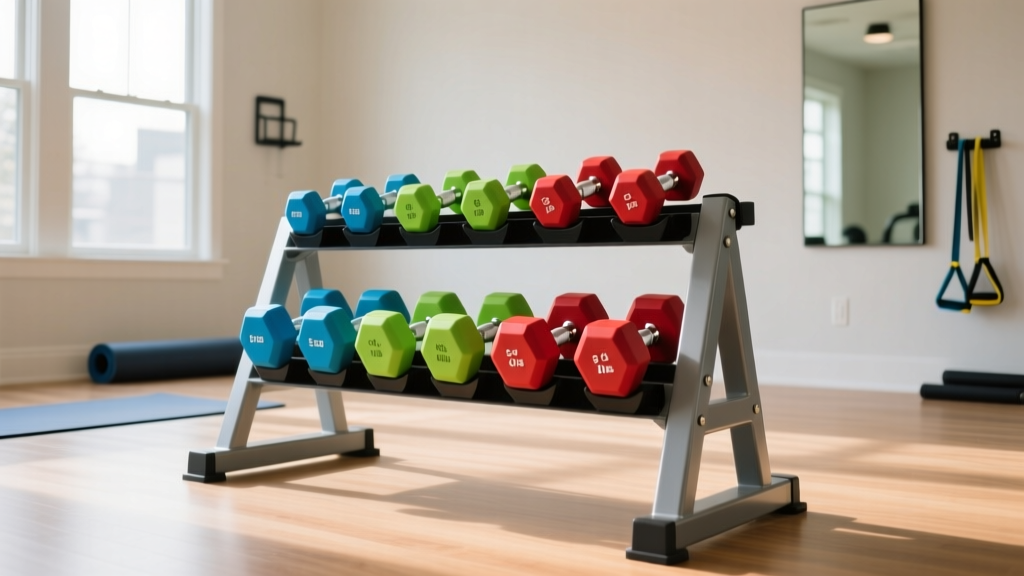
Best Budget Racks for an Arm Toning Workout with Dumbbells
Collar & Clamp Types Comparison: Mistakes & Dumbbells for Rear Delts

Best Dumbbell Racks for Incline Dumbbell Fly Setups (2026)

Bumper vs Iron Plates: What Dumbbell Exercise Is Good for Chest?
