
Bumper vs Iron Plates & Back Exercises at Home with Dumbbells
Analyze 2026 free weight trends: bumper vs iron plate market shifts, pricing, and the rise of targeted back exercises at home with dumbbells.

The 2026 Free Weight Market: A Tale of Two Plate Types
The home gym equipment landscape in 2026 has matured significantly from the panic-buying era of the early 2020s. Today’s consumers are making calculated, biomechanically sound investments, prioritizing space efficiency, material longevity, and specific training adaptations. As a leading indicator of this shift, the ongoing debate between bumper plates and cast iron plates has evolved from a simple matter of noise reduction to a complex analysis of floor space, drop ratings, and cost-per-pound metrics.
According to recent industry analyses, home lifters are increasingly segmenting their purchases based on their primary training modalities. Olympic weightlifters and CrossFit athletes remain loyal to bumpers, while powerlifters and traditional bodybuilders are driving a massive resurgence in precision-machined iron. But how does this plate market shift intersect with the rising popularity of adjustable dumbbells for targeted hypertrophy? Let us break down the data.
Material Science: Virgin Rubber vs. Crumb vs. Urethane
Not all bumper plates are created equal. In 2026, the market is strictly divided into three tiers:
- Hi-Temp Crumb Rubber: Made from recycled tires. While budget-friendly (averaging $2.80 to $3.20 per pound), they are notoriously thick, limiting the amount of weight you can load on a standard barbell sleeve. They also suffer from ‘dead bounce’ degradation over time.
- Virgin Rubber: The gold standard for home gyms. Models like the Rogue Echo Bumpers ($4.25/lb) offer a durometer rating of 85-90, ensuring minimal bounce and high structural integrity when dropped from overhead.
- Urethane: The premium tier. Urethane plates (such as those from York Fitness) resist UV degradation, odor, and scratching, but command a steep premium of $6.50 to $8.00 per pound.
The Cast Iron Resurgence
Iron plates are experiencing a 22% year-over-year sales increase in the residential sector. Why? Density. A 45lb machined iron plate (like the Rogue Machined Iron at $3.15/lb) is significantly thinner than a 45lb crumb bumper. For home lifters with limited square footage who do not perform Olympic drops, iron allows for heavier maximal loads without maxing out the barbell sleeve. Furthermore, modern enamel-coated iron plates resist rust far better than the raw cast iron of the past decade.
| Plate Type | Avg. Cost/lb | Thickness (45lb) | Drop Rating | Best Use Case |
|---|---|---|---|---|
| Hi-Temp Crumb | $3.00 | 3.5 inches | Low | Budget garage gyms |
| Virgin Rubber | $4.25 | 2.1 inches | High | Olympic lifting, WODs |
| Urethane | $7.00 | 1.9 inches | Medium | Commercial, premium home |
| Machined Iron | $3.15 | 1.3 inches | None | Powerlifting, Bodybuilding |
The Dumbbell Pivot: Space, Cost, and Hypertrophy
While plates remain essential for barbell compounds, the 2026 market data shows an undeniable pivot toward adjustable dumbbells for accessory and hypertrophy work. With premium adjustable models like the Nuobell 80lb ($429) and PowerBlock Pro 100 EXP ($399) offering commercial-grade durability, home athletes are replacing massive fixed-dumbbell racks with a single pair.
This spatial efficiency has fundamentally changed how lifters program their splits, particularly when designing back exercises at home with dumbbells. Because heavy barbell bent-over rows place immense shear force on the lumbar spine, home lifters are increasingly utilizing dumbbells to isolate the latissimus dorsi, rhomboids, and trapezius without the systemic fatigue of a loaded barbell.
‘The biomechanical advantage of dumbbells for back training lies in the freedom of wrist rotation and the ability to unilaterally address muscular imbalances, which is critical for home athletes lacking access to specialized cable machines.’ — ExRx Weight Training Directory
Optimizing Back Exercises at Home with Dumbbells
If you are building a 2026 home gym, pairing a set of adjustable dumbbells with an adjustable FID (Flat/Incline/Decline) bench unlocks a suite of high-yield back movements. Here is the expert-recommended framework for back exercises at home with dumbbells:
1. The Chest-Supported Dumbbell Row
By setting an adjustable bench to a 30-degree incline and lying face down, you completely eliminate lower back involvement. This allows you to train the mid-back to absolute failure safely. Pro Tip: Use a neutral grip (palms facing each other) to bias the lats, or a pronated grip (palms down) to bias the upper back and rear delts. Aim for 3 sets of 10-15 reps with 60-80lb dumbbells.
2. Single-Arm Kroc Rows
Named after legendary lifter Matt Kroc, this movement utilizes a heavy dumbbell (often 100+ lbs, requiring strap assistance) for high-repetition sets of 20-30. It builds immense grip strength, core stability, and lat thickness. You only need a flat bench and a single heavy adjustable dumbbell or a loaded plate-loaded handle.
3. Dumbbell Pullovers for Lat Expansion
Often neglected, the pullover is a staple for stretching the lats under load. Lying perpendicular across a flat bench, lower a single heavy dumbbell behind your head until you feel a deep stretch in the lats and serratus anterior. The American College of Sports Medicine (ACSM) notes that incorporating movements that challenge muscles at long muscle lengths (the stretched position) is highly correlated with hypertrophic adaptations.
⚠ Form Warning: The Single-Arm Bench Row
While the traditional one-arm dumbbell row with a hand on the bench is popular, it often leads to unwanted torso rotation and hip hiking as the weight gets heavy. In 2026, biomechanics coaches recommend the 3-point staggered stance row (hand on knee or no support, bracing against a rack) to maintain a neutral pelvis and ensure the load is borne entirely by the latissimus dorsi.
2026 Buyer’s Framework: Allocating a $2,000 Free Weight Budget
How should you allocate your capital between plates and dumbbells? The answer depends on your primary training goal. Below is a data-driven decision matrix for a $2,000 free weight budget.
| Athlete Profile | Plate Allocation | Dumbbell Allocation | Recommended Gear |
|---|---|---|---|
| Strength / Powerlifter | $1,400 (70%) | $600 (30%) | 300lb Machined Iron Set + PowerBlock Pro 50 |
| Functional Fitness / Oly | $1,600 (80%) | $400 (20%) | 230lb Virgin Rubber Bumpers + Nuobell 50 |
| Bodybuilding / Hypertrophy | $800 (40%) | $1,200 (60%) | 150lb Iron Set + Nuobell 80 + Adjustable Bench |
The Verdict on Market Trends
The 2026 home gym market is no longer about buying every piece of equipment available; it is about strategic curation. While the bumper vs. iron plate debate will always hinge on whether you intend to drop your barbell from overhead, the integration of high-quality adjustable dumbbells has revolutionized accessory work. By mastering targeted back exercises at home with dumbbells, lifters can achieve commercial-gym-level hypertrophy in a fraction of the square footage, proving that intelligent equipment selection always trumps sheer volume.
More gear to consider
All reviews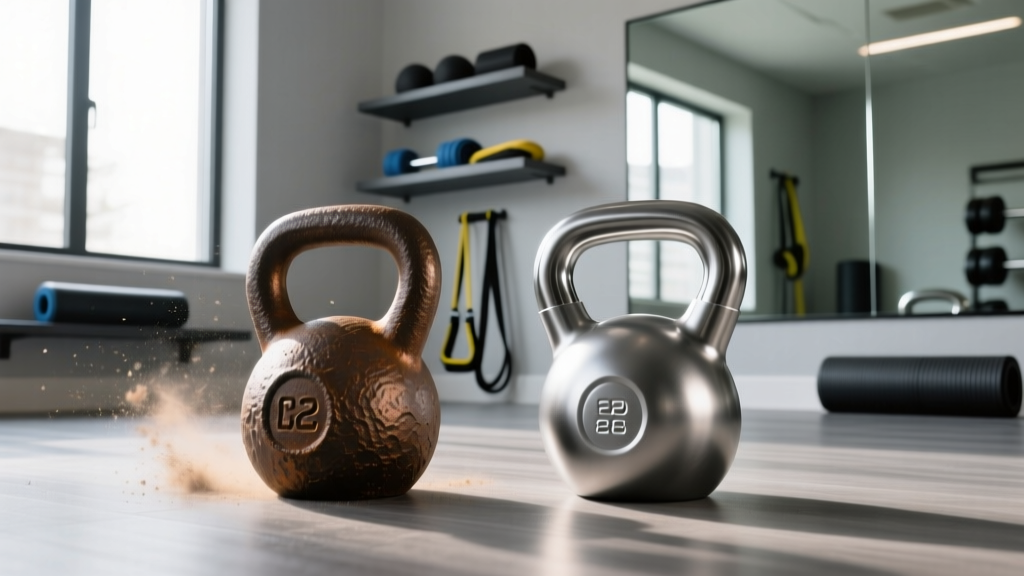
Cast Iron vs Competition Kettlebells: Beyond the Single Dumbbell RDL

Bumper Plate vs Iron Plate for 1 Inch Dumbbell Handles

Best Loadable Dumbbells for Dumbbell Concentration Curls (2026)

Compact Layouts: Sitting Dumbbell Shoulder Press, Hex vs Urethane

EZ vs Straight Bar Care: Longevity & Skater Squats with Dumbbells
