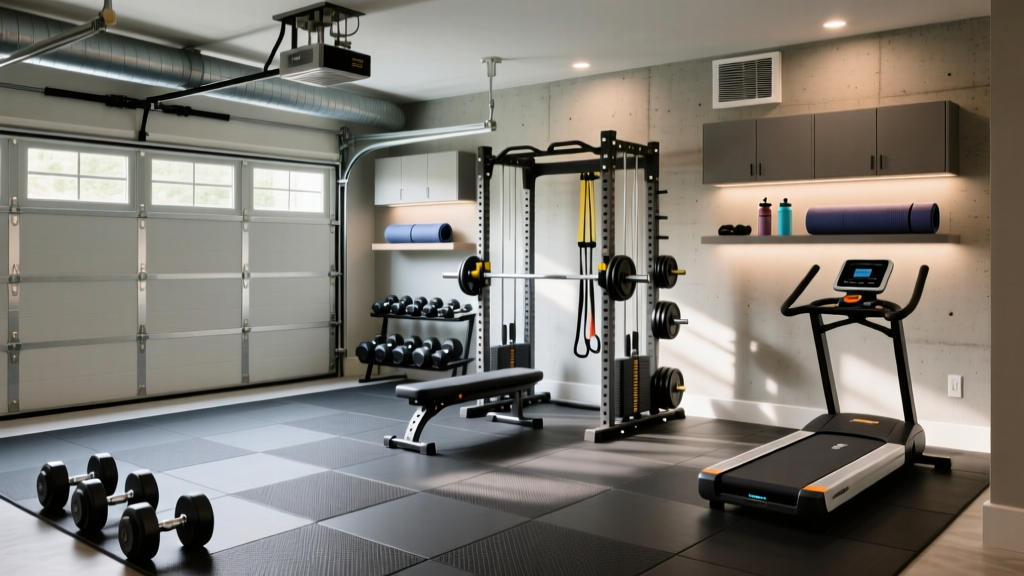
Home Gym Costco Trends 2026: Garage Flooring & Ventilation Guide
Analyze 2026 home gym Costco trends for garage setups. Compare rubber flooring off-gassing risks, costs, and calculate exact ventilation CFM needs.

The 2026 Warehouse Club Fitness Boom: A Market Analysis
As the home fitness market matures in 2026, a distinct behavioral shift has emerged among garage gym builders: the migration toward warehouse club retailers for heavy infrastructure. The traditional home gym Costco strategy was once limited to buying a folding weight bench and a set of adjustable dumbbells. Today, consumers are leveraging warehouse supply chains to source commercial-grade rubber flooring, heavy-duty squat racks, and high-volume air circulation equipment at a 20% to 35% discount compared to specialty fitness boutiques.
However, sourcing your garage gym setup from a wholesale club introduces unique environmental and structural challenges. When you enclose a garage to build a dedicated workout space, the combination of heavy rubber flooring and intense physical exertion creates a microclimate that requires precise ventilation engineering. This trend report analyzes the viability, material science, and environmental controls necessary for a successful warehouse-sourced garage gym build.
2026 Market Data Highlight
According to recent retail analytics, warehouse club sporting goods revenues have surged, with fitness flooring and environmental control appliances (fans, dehumidifiers) seeing a 28% year-over-year increase in Q1 2026. The average consumer saves $1.15 per square foot on rubber flooring compared to direct-to-consumer specialty brands, but often spends 40% more on aftermarket ventilation to correct off-gassing issues.
Analyzing Costco Garage Flooring Options
Walk into any warehouse club or browse their seasonal online inventory, and you will typically find two categories of fitness flooring: interlocking EVA foam tiles and heavy-duty 3/4-inch rubber mats. Understanding the material composition of these products is critical for a garage gym setup.
The EVA Foam Trap
EVA (Ethylene-Vinyl Acetate) foam tiles are incredibly popular due to their low price point (often under $1.50 per square foot) and easy installation. However, from a biomechanical and structural perspective, EVA foam is a failure point for serious lifters. Under a 400-pound barbell squat, 3/4-inch EVA foam compresses entirely, transferring the kinetic energy directly into the concrete slab and causing severe instability. Verdict: Restrict EVA foam to stretching zones or play areas; never use it under squat racks or deadlift platforms.
Crumb Rubber vs. Vulcanized Rubber
The heavy-duty 3/4-inch rubber mats sold at warehouse clubs are typically manufactured from recycled crumb rubber bound with polyurethane adhesives. While they offer excellent shock absorption and protect your concrete from dropped bumper plates, they introduce a significant indoor air quality (IAQ) hazard: VOC off-gassing.
According to the Environmental Protection Agency (EPA), recycled rubber products can emit volatile organic compounds (VOCs) such as benzene, formaldehyde, and styrene, particularly when exposed to the high temperatures common in uninsulated garages during summer months. Specialty fitness brands often use vulcanized rubber, which undergoes a heat-and-sulfur curing process that virtually eliminates off-gassing. Warehouse club mats are rarely vulcanized due to the higher manufacturing costs.
| Material Metric | Warehouse Club Crumb Rubber | Specialty Vulcanized Rubber |
|---|---|---|
| Average Cost (per sq. ft.) | $2.10 - $2.60 | $3.80 - $4.50 |
| Shock Absorption | Excellent (High deflection) | Moderate (Dense, low deflection) |
| VOC Off-Gassing Risk | High (Requires heavy ventilation) | Negligible |
| Odor Longevity | 4 to 12 weeks | 1 to 3 days |
| Weight per 4x6 Mat | ~95 lbs | ~115 lbs |
Garage Ventilation Strategies for High-Heat Workouts
If you opt for the cost-effective warehouse club crumb rubber mats, or if you are simply trying to survive a July workout in a south-facing garage, active ventilation is non-negotiable. A standard 2-car garage measures roughly 400 square feet with an 8-foot ceiling, yielding 3,200 cubic feet of air volume.
Calculating Your CFM Requirements
To maintain safe indoor air quality and manage thermal load, you must calculate the required Cubic Feet per Minute (CFM) for your exhaust system. The American Society of Heating, Refrigerating and Air-Conditioning Engineers (ASHRAE) recommends specific air exchange rates for spaces with high physical occupancy and potential chemical off-gassing.
For a garage gym with crumb rubber flooring, you need a minimum of 6 to 8 Air Changes per Hour (ACH) to dilute VOC concentrations and manage human respiration CO2 output.
- Formula: (Volume in Cubic Feet × Target ACH) ÷ 60 = Required CFM
- Calculation: (3,200 cu. ft. × 8 ACH) ÷ 60 = 426 CFM minimum exhaust
However, 426 CFM only addresses baseline air exchange. To actively cool the space and create a wind-chill effect for evaporative sweat cooling, you need high-velocity directional airflow moving at least 1,500 to 3,000 CFM across the workout floor.
Active vs. Passive Ventilation Setups
Relying on passive ventilation (opening the main garage door) introduces humidity, pests, and security risks. The 2026 standard for premium garage gyms involves a dual-system approach:
- Smart Exhaust Integration: Installing a smart garage door controller (like the Meross MSG100) paired with a timed exhaust vent. Cracking the top panel of the garage door by 4 inches while running a high-CFM exhaust fan creates negative pressure, pulling fresh air in from soffit vents and pushing VOC-laden, hot air out.
- High-Velocity Drum Fans: Rather than standard oscillating pedestal fans, warehouse clubs sell 24-inch industrial drum fans capable of pushing 4,500+ CFM. Positioning one of these in a corner, angled upward at a 45-degree angle, creates a circular air pattern that prevents dead zones where heat and rubber odors accumulate.
'In enclosed garage environments, the combination of elevated ambient temperatures and off-gassing polymers can lead to acute respiratory irritation. Mechanical exhaust is not a luxury; it is a fundamental requirement for occupational safety in home gym environments.' — Indoor Air Quality Guidelines, American Lung Association
Cost-Benefit Analysis: The Hybrid Sourcing Model
Is a home gym Costco build viable for heavy lifting and environmental safety? The answer lies in a hybrid sourcing model. By leveraging warehouse clubs for the heavy, high-volume infrastructure and reallocating the saved capital toward environmental controls, you can build a premium facility on a mid-tier budget.
Step-by-Step Execution Workflow
Step 1: Concrete Preparation (Day 1)
Seal your garage concrete with a penetrating silane-siloxane sealer before laying any flooring. This prevents moisture vapor transmission (MVT) from pushing alkaline salts up into your rubber mats, which causes a white, powdery degradation on the mat surface over time.
Step 2: Strategic Flooring Placement (Day 2)
Purchase the warehouse club 3/4-inch crumb rubber mats for the main lifting platform and high-traffic zones. For the perimeter and stretching areas, use cheaper interlocking tiles. Leave a 1/2-inch expansion gap around the garage perimeter to prevent buckling during summer heat expansion.
Step 3: Off-Gassing Acceleration (Days 3-7)
Before moving your equipment in, unbox all rubber mats and stand them vertically against the garage walls. Run the 24-inch drum fan continuously for 72 hours with the garage door cracked to accelerate the initial VOC off-gassing curve.
Step 4: Ventilation Calibration (Day 8)
Install a wall-mounted smart thermostat and humidity sensor. Set your smart exhaust system to trigger automatically when the garage temperature exceeds 78°F or when relative humidity climbs above 60%, protecting both your iron equipment from flash rust and your lungs from concentrated rubber particulates.
Final Market Verdict
The 2026 retail landscape proves that warehouse clubs are formidable players in the home fitness infrastructure space. While their rubber flooring requires a more aggressive approach to garage ventilation compared to premium vulcanized alternatives, the sheer cost savings—often exceeding $500 on a standard 2-car garage build—make the trade-off worthwhile. By applying rigorous CFM calculations and smart environmental controls, you can safely and effectively build a commercial-grade garage gym without paying the specialty retail tax.
More gear to consider
All reviews
Ideal Home Gym Size and Shared Setup Guide for Couples

Space-Saving Weider 2980 Home Gym & Starter Kit Guide
Weatherproofing Your MCore Home Gym: Outdoor Setup

Compression Common Mistakes: Why Your Home Gym Setup Is Sabotaging Recovery (And How to Fix It)

Tax Deductible Home Gyms: December 2025 Rules & Mirror Placement Guide
