
Beginner Bowflex Home Gym Workout Guide & Floor Plan
Master your space and routine with our beginner-friendly Bowflex home gym workout guide, complete with exact floor plans, setup steps, and a full-body routine.

Phase 1: Mapping Your Bowflex Floor Plan
Setting up a cable-based resistance machine requires more spatial awareness than a simple pair of adjustable dumbbells. Unlike free weights, a Bowflex machine relies on Power Rods and a complex pulley system that requires specific clearance for cable travel and user movement. Before you unbox your machine, you must map out a dedicated floor plan to ensure safety and full range of motion.
Footprint and Clearance Requirements
The two most popular beginner and intermediate models are the Bowflex PR1000 and the Bowflex Xtreme 2SE. Here are the exact spatial requirements for each:
- Bowflex PR1000: The machine footprint is 103" L x 100" W x 82" H. However, you must add a minimum of 24 inches of clearance on the front and sides for the lat tower and cable extensions. Total required floor space: 151" L x 148" W (roughly 12.5 x 12.5 feet).
- Bowflex Xtreme 2SE: This model is more compact, with a footprint of 70" L x 49" W x 83.25" H. With the necessary 24-inch clearance for the squat station and lat pulldown, your total required floor space is 118" L x 97" W (roughly 10 x 8 feet).
Phase 2: Flooring, Mirrors, and Environment
A proper home gym setup goes beyond just plugging in the machine. The environment dictates your safety, form, and equipment longevity.
Step 1: Install Vulcanized Rubber Flooring
Do not assemble a 300-pound cable machine on carpet or bare concrete. You need high-density rubber flooring to protect the subfloor from dropped weight stacks (if you add free weight accessories later) and to provide a non-slip surface for the leg press attachment. Purchase 3/8-inch or 1/2-inch thick vulcanized rubber horse stall mats (typically 4x6 feet, costing around $55 to $65 per mat from agricultural suppliers). Lay them down in an interlocking brick pattern to prevent seam separation during heavy lateral movements.
Step 2: Strategic Mirror Placement
Because cable machines do not have a fixed barbell path to guide your form, visual feedback is critical. Mount a large, shatterproof gym mirror (at least 48" W x 60" H) directly in front of the seated bench position. Ensure the bottom edge of the mirror is roughly 18 inches from the floor so you can see your lower body alignment during seated rows and leg extensions.
Step 3: Climate and UV Control
Bowflex Power Rods are made from a proprietary composite material that is highly sensitive to ultraviolet (UV) light and extreme temperature fluctuations. If your home gym is in a garage or basement with windows, apply UV-blocking window film. Prolonged sun exposure will cause the rods to become brittle and lose their resistance rating.
Phase 3: The Beginner Bowflex Home Gym Workout Guide
Now that your floor plan is optimized and your machine is securely bolted to the floor mat, it is time to train. According to the Mayo Clinic, beginners should focus on full-body resistance training two to three times per week, allowing at least 48 hours of recovery between sessions to promote muscle protein synthesis and central nervous system adaptation.
The following routine is designed specifically for the biomechanics of a Bowflex cable system, utilizing constant tension throughout the entire range of motion.
| Exercise | Target Muscle | Sets | Reps | Rest |
|---|---|---|---|---|
| Seated Chest Press | Pectorals, Anterior Deltoids | 3 | 10-12 | 60s |
| Seated Low Row | Latissimus Dorsi, Rhomboids | 3 | 10-12 | 60s |
| Leg Press (Squat Station) | Quadriceps, Glutes | 3 | 12-15 | 90s |
| Lat Pulldown (Bar Attachment) | Upper Back, Biceps | 3 | 10-12 | 60s |
| Seated Shoulder Press | Deltoids, Triceps | 2 | 10-12 | 60s |
| Standing Bicep Curl (Lower Pulley) | Biceps Brachii | 2 | 12-15 | 45s |
| Tricep Pushdown (Upper Pulley) | Triceps | 2 | 12-15 | 45s |
Execution Nuances for Cable Machines
As highlighted by Harvard Health Publishing, proper form is vastly more important than the sheer amount of resistance moved. When using a Bowflex, remember that the resistance is not purely vertical like gravity-based free weights. The resistance vector follows the angle of the cable. Therefore, during a standing bicep curl using the lower pulley, lean back slightly to align your torso with the cable's pull, ensuring continuous tension on the bicep rather than the lower back.
"The constant tension provided by cable machines is excellent for muscle hypertrophy, but it requires strict control of the eccentric (lowering) phase. Do not let the Power Rods snap the weight stack back to the starting position; take a full 2-3 seconds to return to the start."
Phase 4: Progression and Power Rod Maintenance
Beginners often outgrow the base 210 lbs of resistance within 6 to 12 months of consistent training. Both the PR1000 and Xtreme 2SE are upgradeable to 310 lbs or 410 lbs. When you purchase the upgrade kit, you will physically replace the thinner rods on the tower with thicker, higher-tension rods.
Essential Maintenance Checklist
- Monthly Cable Inspection: Run a microfiber cloth along the entire length of the aircraft-quality steel cables. If you feel any fraying, kinks, or "fishhooks," stop using the machine immediately and order a replacement cable from Bowflex. A snapped cable under 200 lbs of tension can cause severe injury.
- Pulley Lubrication: Every 90 days, apply a single drop of 3-in-One silicone-based lubricant to the axle of each nylon pulley wheel to prevent squeaking and ensure smooth cable tracking.
- Rod Cover Utilization: Always slide the neoprene Power Rod covers over the rods when the machine is not in use. This is your primary defense against UV degradation and accidental impacts.
Frequently Asked Questions
Can I build muscle effectively with a Bowflex compared to free weights?
Yes. Muscle tissue does not know the difference between an iron plate and a flexing composite rod; it only recognizes mechanical tension and metabolic stress. The Bowflex provides continuous tension throughout the entire range of motion, which actually eliminates the "dead zones" found in free-weight dumbbell exercises where gravity isn't pulling directly against the muscle.
Do I need to anchor the machine to the floor?
While the machine's base is wide and heavy, the leg press and lat pulldown exercises can generate significant upward and lateral force. For the Xtreme 2SE, Bowflex highly recommends using the included floor brackets and lag bolts to secure the front stabilizer to your rubber mat and wooden subfloor to prevent tipping during aggressive pulling motions.
How long should a beginner spend on this workout?
This full-body routine should take approximately 40 to 45 minutes to complete, assuming you adhere strictly to the 60-second rest periods. Keep your sessions under an hour to avoid excessive central nervous system fatigue and cortisol elevation.
More gear to consider
All reviews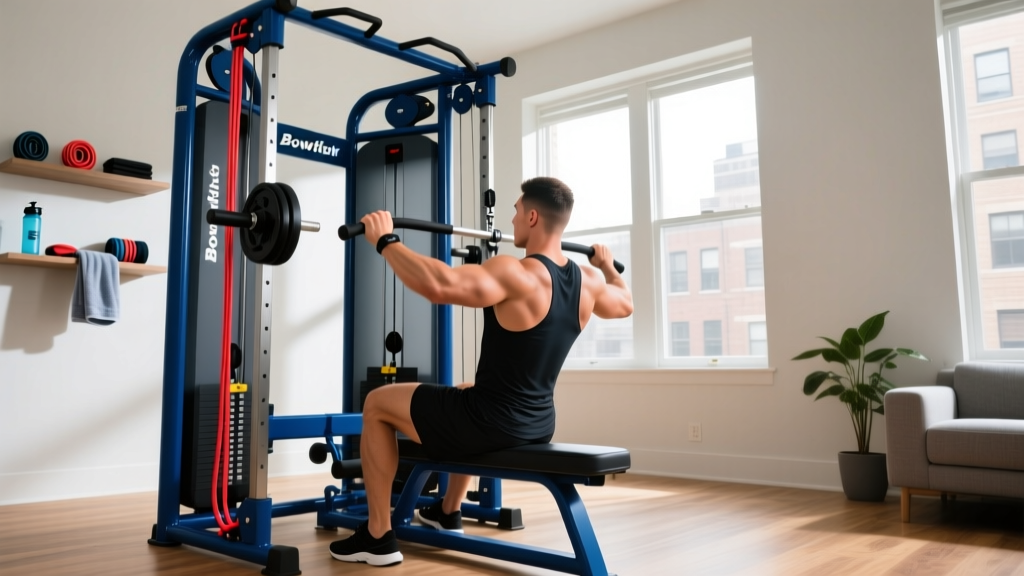
Bowflex PR 1000 Home Gym Setup: Strength Training Walkthrough

Changing Home Gym Planet Fitness Style: Mirrors and Lighting Compared
Best Home Gym Colors for Focus and Energy: Design Guide
Floor Plan Guide: Snode All-in-One Home Gym Smith Machine Power Rack
Planet Fitness Switching Home Gym: Apartment Setup Mistakes
