Rubber Hex vs Urethane: 2026 Dumbbell Cost & Market Trends
Compare rubber hex and urethane dumbbells in our 2026 market analysis. Discover the true dumbbell cost, durability metrics, and commercial gym trends.

The 2026 Free Weight Market: A Shift in Material Preferences
As the commercial and home fitness equipment market matures in 2026, facility owners and serious home gym builders are increasingly scrutinizing the total lifecycle value of their investments. The free weights sector, specifically dumbbells, has seen a distinct bifurcation. On one end, budget-conscious buyers default to traditional rubber hex dumbbells. On the other, premium commercial facilities and high-end home studios are migrating toward urethane. But how does the initial dumbbell cost translate to long-term value? This trend report dissects the material science, market pricing, and failure modes of rubber hex versus urethane dumbbells to provide a definitive procurement framework.
According to recent facility standards outlined by the National Strength and Conditioning Association (NSCA), equipment durability and user experience—including noise and odor mitigation—are now paramount in gym design. This has directly impacted market share, with urethane capturing a larger percentage of new commercial deployments over the past 24 months.
Material Science: Vulcanized Rubber vs. Cast Polyurethane
To understand the pricing disparity, we must examine the manufacturing processes and material properties of both options. According to testing frameworks established by ASTM International, polyurethane elastomers consistently outperform vulcanized rubber in tear strength and abrasion resistance tests.
Virgin Rubber Hex Dumbbells
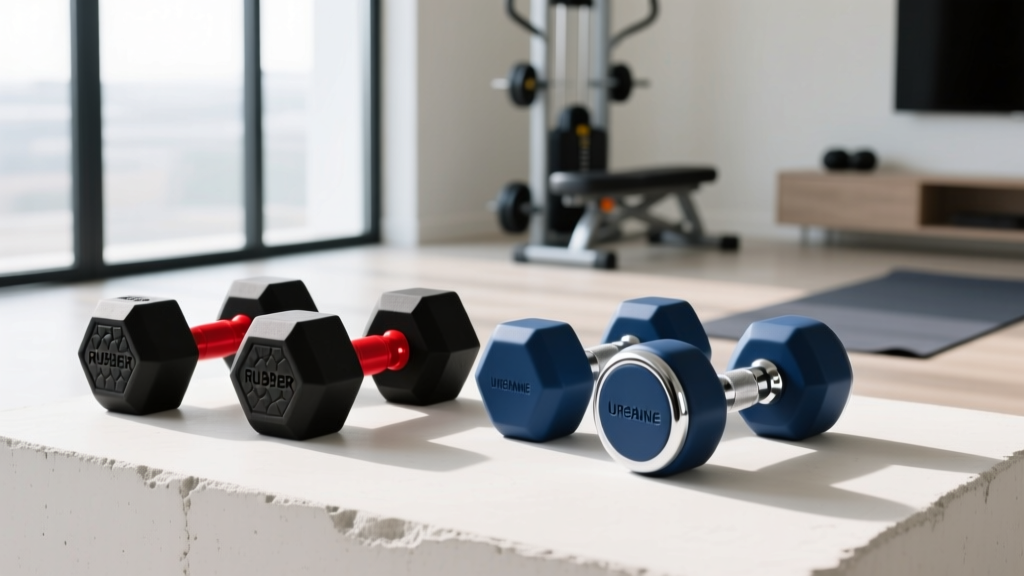
Most modern rubber hex dumbbells utilize virgin or recycled rubber that is vulcanized and bonded to a steel core. The rubber typically registers between 60 and 75 on the Shore A durometer scale. While this provides adequate floor protection, the softer compound is susceptible to tearing, especially at the critical stress point where the rubber head meets the chrome handle.
Urethane (Polyurethane) Dumbbells
Urethane is a synthetic polymer that offers vastly superior abrasion resistance and structural memory. Premium models boast a Shore A hardness of 85 to 90. This higher density means the material does not permanently deform when dropped from shoulder height. Furthermore, urethane is UV-resistant and entirely odorless, solving two of the most common complaints associated with rubber weights.
Market Insight: The Odor Factor
In 2026, boutique fitness studios and garage gym owners with poor HVAC systems are actively avoiding low-grade rubber. The volatile organic compounds (VOCs) responsible for the 'tire smell' in cheap rubber dumbbells can take months to off-gas, leading to negative customer reviews and member churn in commercial spaces.
Breaking Down the Dumbbell Cost: Upfront vs. Lifetime Value
The most common mistake procurement managers make is evaluating equipment solely on the initial invoice price. A comprehensive market analysis requires calculating the cost-per-year-of-utility. Below is a comparative matrix based on Q1 2026 wholesale and direct-to-consumer pricing for a standard 5-to-50 lb commercial set (in 5 lb increments, totaling 20 pairs).
| Metric | Virgin Rubber Hex | Commercial Urethane |
|---|---|---|
| Average Cost Per Pound | $1.15 - $1.60 | $2.80 - $4.20 |
| Total Set Cost (5-50 lbs) | $630 - $880 | $1,540 - $2,310 |
| Expected Commercial Lifespan | 2 - 4 Years | 10 - 15+ Years |
| Primary Failure Mode | Neck tearing, handle rust, rubber chunking | Cosmetic scratching, logo fading |
| 10-Year Replacement Cost | $1,890 - $2,640 (3x replacements) | $0 (Original set intact) |
When analyzing the dumbbell cost over a decade, the urethane set actually yields a lower total cost of ownership (TCO) for high-traffic environments, despite the 2.5x higher initial capital expenditure.
2026 Brand Spotlight: Market Leaders and Pricing Tiers
To ground this analysis in current market realities, let us examine three dominant players in the 2026 landscape and their specific offerings.
- Rogue Fitness (Rubber Hex Line): Rogue's standard rubber hex dumbbells remain the gold standard for the budget-conscious commercial buyer. Priced at approximately $1.35 per pound for a 50lb pair, they feature a hard chrome handle and a proprietary rubber blend that minimizes odor compared to generic imports. However, the rubber heads are still prone to cosmetic scuffing and eventual tearing at the neck if dropped repeatedly on bare concrete.
- Rep Fitness (UR-100 Urethane Series): Rep has aggressively captured the mid-market urethane space. The UR-100 series features a 90 Shore A durometer rating and a knurled stainless steel handle. At roughly $2.90 per pound, it undercuts legacy commercial brands while offering 95% of the durability. The UR-100 is currently the highest ROI urethane dumbbell for independent gym owners in 2026.
- Eleiko (Urethane Dumbbells): Sitting at the absolute apex of the market, Eleiko's urethane offerings exceed $5.00 per pound. These are precision-balanced to a tolerance of +/- 10 grams, aimed at Olympic training centers and luxury wellness clubs where the dumbbell cost is secondary to absolute biomechanical perfection and brand prestige.
Hidden Costs and Edge Cases
Beyond the sticker price, several hidden variables impact the true financial footprint of your free weight rack.
- Freight and Shipping Surcharges: Cast iron and steel cores are heavy, but shipping costs have stabilized in 2026. However, rubber hex dumbbells are often shipped in smaller, less dense pallets compared to precision-machined urethane sets, sometimes resulting in higher dimensional weight freight charges from overseas manufacturers.
- Flooring Damage: Softer rubber (Shore A 65) can develop flat spots or hardened edges over time due to UV exposure and ozone degradation. Dropped from overhead, a degraded rubber hex dumbbell acts like a chisel on expensive rubber flooring. Urethane's superior shock absorption protects your $3/sqft gym flooring.
- Maintenance Labor: Chrome handles on budget rubber hex dumbbells require weekly wire-brushing and WD-40 treatments to prevent oxidation in humid environments. Urethane models frequently feature knurled, hard-chrome or stainless steel handles that resist rust and require minimal upkeep.
Procurement Framework: Which Should You Buy?
To optimize your equipment budget, apply this decision matrix based on your facility profile.
Scenario A: The Budget Home Gym or Low-Traffic Studio
If your dumbbells will be used fewer than 10 hours a week, dropped infrequently, and stored in a climate-controlled environment, virgin rubber hex dumbbells are the mathematically correct choice. The upfront dumbbell cost savings of $800+ on a standard set can be reallocated to a quality adjustable bench or a power rack. Pro-Tip: Avoid 'recycled' rubber; insist on virgin rubber to prevent persistent off-gassing in enclosed spaces.
Scenario B: CrossFit Boxes, Commercial Gyms, and High-Volume Facilities
If your equipment will see 40+ hours of weekly use, endure drops from chest height, and be subjected to chalk, sweat, and varying temperatures, urethane is non-negotiable. The International Health, Racquet & Sportsclub Association (IHRSA) consistently highlights equipment aesthetics and safety as primary drivers of member retention. A rack of battered, torn rubber dumbbells signals neglect, whereas a pristine urethane rack justifies premium membership pricing.
"In commercial facility management, buying cheap free weights is essentially taking out a high-interest loan. You will pay for it in replacement costs, member complaints, and staff maintenance hours." — Facility Operations Director, Regional Fitness Chain
The Verdict: Strategic Allocation of Capital
The 2026 fitness equipment market offers unprecedented clarity regarding material performance. While the initial dumbbell cost of urethane remains a barrier to entry for budget shoppers, the lifecycle economics heavily favor polyurethane for any environment where durability, aesthetics, and user experience are prioritized. Rubber hex dumbbells retain their place as the undisputed champion of entry-level and low-impact home setups, provided buyers are aware of the maintenance requirements and eventual degradation of the vulcanized rubber. Assess your traffic volume, calculate your 5-year TCO, and purchase accordingly.
More gear to consider
All reviews
Dumbbell Racks for Weighted Sit Ups: 2026 Storage Market Trends

Barbell Collars vs. Clamps: Surviving Deadlifts & Dumbbell Burpees

Rubber Hex vs Urethane: Gear for a Chest Workout With One Dumbbell
Olympic vs Standard Plates: Troubleshooting NuBell Dumbbell Mistakes

Target Incline Dumbbell Press Muscles With Loadable Dumbbell Sets
