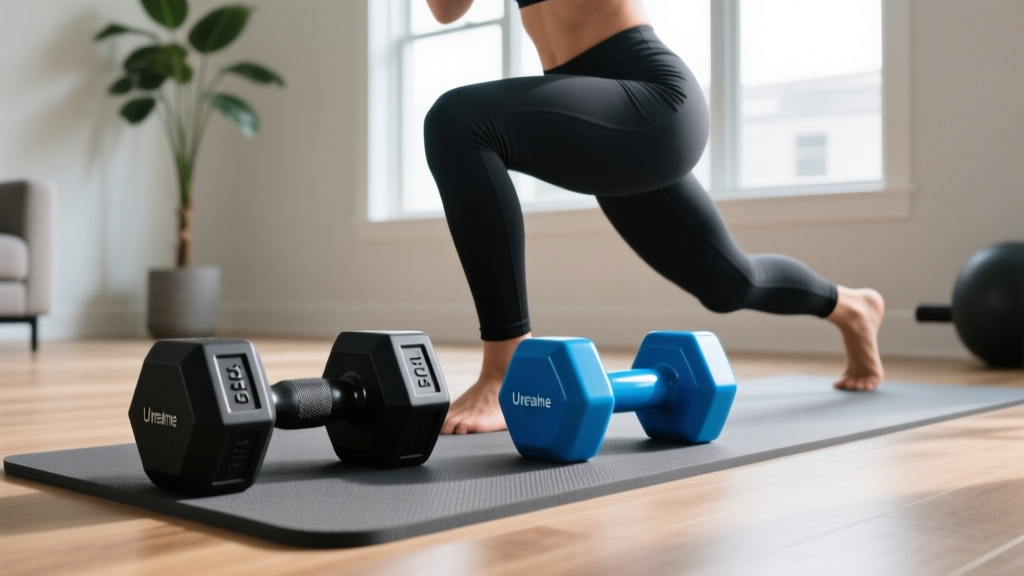
Rubber Hex vs Urethane: Maintenance When You Lunge with Dumbbells
Compare rubber hex vs urethane dumbbells for longevity. Learn expert maintenance tips to protect your gear when you lunge with dumbbells and lift heavy.

The Biomechanics of Wear: How Lunging Destroys Dumbbells
When you execute a high-volume lunge with dumbbells, your equipment undergoes severe mechanical and environmental stress that most upper-body exercises simply do not replicate. Walking lunges, deficit reverse lunges, and heavy Bulgarian split squats demand massive grip endurance. As forearm fatigue sets in, lifters inevitably drop the weights, scrape the heads against rubber flooring, or set them down with excessive force between sets.
Furthermore, the sheer volume of sweat generated during heavy leg days introduces a highly corrosive element to the equation. Human sweat has a pH ranging from 4.5 to 7.0, making it acidic enough to degrade metal finishes and accelerate the breakdown of certain elastomers. If your primary leg day staple is the lunge with dumbbells, choosing between rubber hex and urethane dumbbells—and knowing how to maintain them—will dictate whether your equipment lasts three years or three decades.
Rubber Hex Dumbbells: Budget-Friendly but High-Maintenance
Rubber hex dumbbells, such as the widely used CAP Barbell Cast Iron Hex series, dominate the home gym and commercial fitness market due to their accessible price point. In 2026, you can expect to pay between $1.50 and $2.20 per pound for quality rubber hex sets. However, the 'rubber' used is often a recycled vulcanized compound that is highly susceptible to environmental degradation.
Common Failure Modes
- UV and Ozone Degradation: If stored near a window or in a garage, UV rays break down the polymer chains, causing the rubber to become brittle, crack, and eventually flake off the cast iron core.
- Thermal Melting: In non-climate-controlled spaces exceeding 85°F (29°C), lower-grade recycled rubber can begin to 'weep' or melt, leaving a sticky, permanent residue on your floors and hands.
- Edge Chipping: The sharp corners of the hex design are structural weak points. Dropping them during a heavy set of lunges often results in chunked corners, creating uneven rolling hazards.
Urethane Dumbbells: The Premium Standard for High-Impact Lifters
If your programming heavily features the lunge with dumbbells, urethane is the undisputed champion of durability. Urethane (polyurethane) is a high-density synthetic elastomer that boasts a Shore A durometer rating typically between 85A and 90A, compared to rubber's softer 60A-70A. Premium models, like the Rogue Urethane Dumbbells, are engineered to absorb high-impact drops without deforming, tearing, or emitting the noxious off-gassing odors associated with recycled rubber.
The Cost of Indestructibility
Urethane demands a premium. Expect to invest $3.50 to $5.50 per pound in 2026. While the upfront cost is steep, the total cost of ownership plummets because urethane does not degrade from UV exposure, temperature fluctuations, or ozone. It is virtually impervious to sweat and acidic gym cleaners.
Urethane's Single Weakness: Concrete Impact
While urethane survives drops on 3/4-inch horse stall mats or commercial rubber flooring flawlessly, it has one critical failure mode: raw concrete. The high durometer rating means the material is stiff. If you drop a 70lb urethane dumbbell directly onto an unsealed concrete garage floor, the kinetic energy has nowhere to dissipate, which can cause the urethane to chip or crack at the bonding seam where it meets the steel core.
Head-to-Head Comparison Matrix
| Feature | Rubber Hex Dumbbells | Urethane Dumbbells |
|---|---|---|
| Avg. Cost (2026) | $1.50 - $2.20 / lb | $3.50 - $5.50 / lb |
| Durometer (Hardness) | 60A - 70A (Soft) | 85A - 90A (Hard) |
| UV / Ozone Resistance | Poor (Requires Protectant) | Excellent (Inert) |
| Drop Tolerance (Mats) | Moderate (Edges chip) | High (Absorbs impact) |
| Odor / Off-Gassing | High (Recycled compounds) | None (Virgin polyurethane) |
Handle Maintenance: Surviving the Sweat of Leg Day
According to biomechanics research highlighted by the American Council on Exercise (ACE), lower-body unilateral movements like lunges require immense stabilizing grip strength. This leads to heavy sweat accumulation on the handle knurling. The maintenance of the handle is just as critical as the heads.
Chrome vs. Zinc vs. QPQ Finishes
- Hard Chrome: Found on premium urethane sets. Highly resistant to rust but requires weekly wiping with a microfiber cloth and occasional 3-in-One oil application to prevent oxidation in the knurling valleys.
- Zinc Plating: Common on mid-tier rubber hex sets. Offers a sacrificial layer of protection but will eventually white-rust if exposed to acidic sweat without being neutralized.
- QPQ (Black Oxide): Offers a sleek, non-reflective finish but has the lowest corrosion resistance. Must be oiled after every single leg day session.
Your 2026 Dumbbell Maintenance Schedule
To maximize the ROI on your free weights, implement this exact maintenance cadence:
- Daily (Post-Workout): Wipe down handles with a damp microfiber cloth to remove sweat salts. Inspect hex corners for fresh chips.
- Weekly: Use a nylon bristle brush on the knurling. Apply 2 drops of 3-in-One oil to a rag and buff the steel handles to displace microscopic moisture.
- Quarterly: For rubber hex dumbbells, clean the heads with a mild dish soap solution, let dry completely, and apply a UV-blocking protectant like 303 Aerospace. Check the bonding seam between the steel core and the elastomer head for any signs of separation.
Frequently Asked Questions
Can I drop urethane dumbbells during walking lunges?
Yes, but only onto proper flooring. Dropping urethane onto 3/4-inch vulcanized rubber mats is perfectly safe and will not damage the bell. However, dropping them directly onto concrete, tile, or thin vinyl flooring will result in catastrophic chipping due to the material's high density and lack of internal dampening.
Why do my rubber hex dumbbells feel sticky in the summer?
This is a phenomenon known as 'polymer weeping.' When low-grade recycled rubber is exposed to high heat and humidity, the chemical plasticizers used during the vulcanization process begin to leach to the surface. You can temporarily clean this with a degreaser, but the only permanent fix is to move the equipment to a climate-controlled environment (below 75°F).
Does the hex shape really prevent rolling during lunges?
Yes. When performing deficit lunges or stepping up onto a platform, you often need to set the dumbbells down quickly beside your feet. The flat edges of a hex dumbbell prevent them from rolling away or off the edge of a wooden plyo box, providing a crucial layer of safety that round urethane bells cannot offer without specialized storage racks.
More gear to consider
All reviews
Loadable Dumbbells: Space-Saving Dumbbell Exercises for Home Workout

Dumbbell Suitcase Deadlift Guide & Top Adjustable Dumbbells

Beyond the Heaviest Dumbbell: Olympic vs Standard Plates
Power Rack vs Squat Rack vs Stand: Space for RDLs with Dumbbells

Pullover Dumbbell Chest Guide: Adjustable Picks 2026
