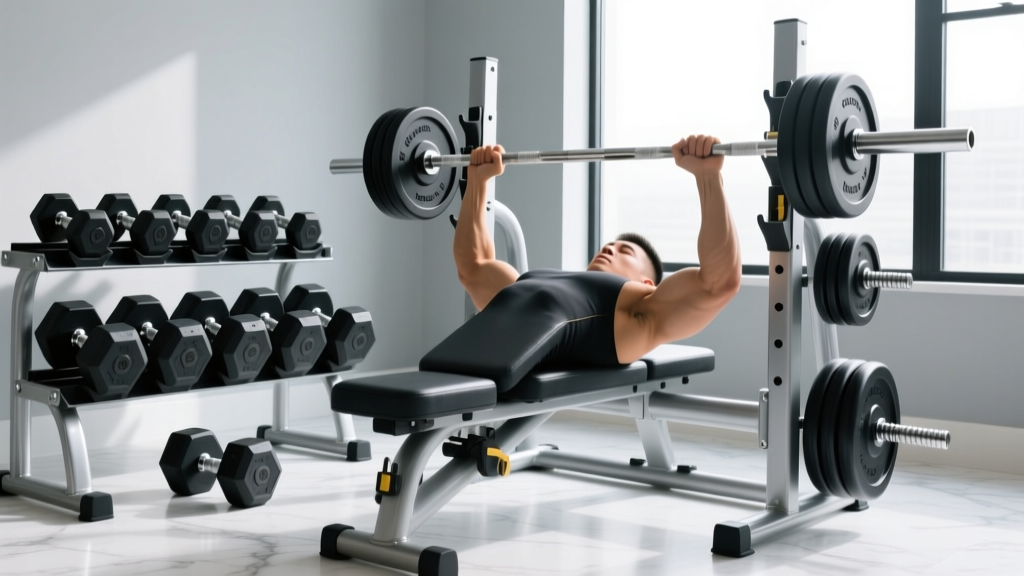
Power Rack vs Squat Rack vs Squat Stand & Dumbbell Workout App
Compare power racks, squat racks, and squat stands. Discover which rig best complements your favorite dumbbell workout app for a complete 2026 home gym.

Most home gym owners begin their fitness journey relying on a high-quality dumbbell workout app and a pair of adjustable 52.5 lb dumbbells. It is an accessible, space-efficient way to build foundational muscle and learn movement patterns. However, as progressive overload demands heavier loads—especially for lower body compound movements like squats and deadlifts—you will inevitably hit the ceiling of dumbbell-only training. By 2026, the transition from app-guided dumbbell routines to heavy barbell lifting is the most common evolution in garage gyms.
When you are ready to invest in a rig, you are faced with three primary categories: the power rack, the squat rack (half rack), and the squat stand. Choosing the right one depends not just on your budget and ceiling height, but on how you plan to integrate heavy barbell work with the accessory hypertrophy work still prescribed by your favorite dumbbell workout app.
The Core Differences: Equipment Matrix
Before diving into specific models and steel gauges, it is crucial to understand the structural and functional differences between these three rig types. The following matrix breaks down the critical specifications you need to evaluate.
| Feature | Power Rack (Full Cage) | Squat Rack / Half Rack | Squat Stand |
|---|---|---|---|
| Footprint | Large (48' x 48' or larger) | Medium (48' x 36' typical) | Small (48' x 24' typical) |
| Safety Mechanism | Internal pin-pipe or strap safeties | External spotter arms (extended) | External spotter arms or none |
| Weight Capacity | 800 - 1,200+ lbs | 600 - 1,000 lbs | 500 - 800 lbs |
| Attachment Ecosystem | Extensive (cable systems, monolifts) | Moderate (dip bars, lat pulldowns) | Minimal (J-cups, basic bands) |
| Avg. Price Range (2026) | $800 - $1,800+ | $450 - $900 | $250 - $450 |
Power Racks: The Ultimate Enclosure for Heavy Lifting
A power rack (often called a full cage) consists of four main uprights connected by crossmembers, creating a secure enclosure. This is the gold standard for home gyms because the safety bars are housed inside the rack. If you fail a heavy back squat, you simply drop the bar a few inches onto the safeties without needing a human spotter.
Top 2026 Models & Specs
- REP Fitness PR-4000: The undisputed king of mid-tier home gyms. It features 3x3-inch 11-gauge steel uprights with Westside hole spacing (1-inch holes, 2-inch spacing in the bench/squat zone). Priced around $1,099, it offers infinite attachment compatibility, including the highly sought-after Athena cable attachment system.
- Rogue R-3 Power Rack: A staple in commercial and elite home gyms. Built with 2x3-inch 11-gauge steel, it has a slightly smaller internal working area (43x43 inches) but offers bombproof stability. Base price starts at $1,050 before shipping and attachments.
Squat Racks & Half Racks: The Open-Front Compromise
The term 'squat rack' is often used interchangeably with 'half rack.' A half rack typically features two main front uprights and two rear stabilizing legs. The defining characteristic is that you perform lifts outside the main uprights, utilizing extended spotter arms to catch failed reps.
Space Efficiency vs. Safety
Half racks are ideal if you want to perform Olympic lifts (cleans, snatches) where a full cage might restrict your bar path or bail-out options. However, the spotter arms must be heavy-duty and properly counterbalanced. According to safety guidelines outlined by the National Strength and Conditioning Association (NSCA), utilizing proper spotting mechanisms is non-negotiable when lifting near your one-rep max without a human partner. Half racks require you to be meticulous about setting your spotter arms at the exact height of your sternum at the bottom of a squat.
'The open design of a half rack is fantastic for dynamic movements and easy barbell loading, but the extended spotter arms create a tripping hazard in smaller garages. Always fold them up when transitioning to your dumbbell accessory work.' — Home Gym Engineering Best Practices
Model Spotlight: Titan T-3 Half Rack
At roughly $599, the Titan T-3 Half Rack offers 3x3-inch 11-gauge steel and a generous 24-inch spotter arm depth. It provides ample room for dumbbell floor presses and app-guided core routines right in front of the rig without feeling boxed in.
Squat Stands: Minimalist but Risky
Squat stands are essentially two independent metal posts with J-cups. They are the most affordable and space-efficient option, but they come with severe safety caveats. They lack an integrated safety system. While some brands sell bolt-on spotter arms, the lightweight base of a squat stand makes it prone to tipping if a heavy barbell is dropped aggressively onto the spotters.
When to Choose Squat Stands
Squat stands are best suited for lifters who primarily do bench pressing with a dedicated spotter, or those who strictly perform front squats and overhead presses where bailing forward or backward is safe. Models like the Rogue SML-2C 90'' Monster Lite Squat Stand ($395) feature a heavy triangular gusset base that mitigates some tipping risk, but they still cannot replace the sheer physics of a bolted-down power rack.
Bridging the Gap: Pairing Your Rack With a Dumbbell Workout App
A common mistake home gym owners make is abandoning their previous training modalities once a barbell rack arrives. The most effective 2026 training splits utilize the rack for heavy, low-rep central nervous system (CNS) work, while relying on a dumbbell workout app for high-rep, unilateral hypertrophy and mobility work.
The Hybrid Training Protocol:- Primary Lift (In the Rack): Barbell Back Squat (5 sets of 5 reps at 80% 1RM).
- Secondary Lift (In the Rack): Barbell Overhead Press (3 sets of 8 reps).
- Accessory Block (Open Floor Space): Open your dumbbell workout app and execute the prescribed unilateral hypertrophy circuit (e.g., Bulgarian split squats, single-arm DB rows, and lateral raises) utilizing the open floor space adjacent to your rack.
By choosing a squat rack or squat stand over a massive power rack, you preserve valuable square footage in your garage for the dynamic, multi-directional dumbbell movements prescribed by your app. Conversely, if your app frequently prescribes heavy dumbbell bench presses or rack pulls, a full power rack with an adjustable utility bench and pin safeties becomes invaluable.
As noted by the exercise biomechanics database ExRx, combining heavy axial-loaded barbell movements with targeted, free-weight accessory work is the most scientifically validated method for maximizing both strength and muscular symmetry. Your rack handles the axial load; your dumbbells and app handle the symmetry.
The 2026 Home Gym Decision Tree
Still unsure which rig to buy? Follow this step-by-step logic framework to find your exact match:
- Step 1: Evaluate Your Spotting Situation. Do you train alone 100% of the time? If yes, immediately eliminate squat stands. You must choose between a Power Rack or a Half Rack with heavy-duty spotter arms.
- Step 2: Measure Your Ceiling and Depth. If your ceiling is under 84 inches, look for short power racks (72-inch uprights). If your garage depth is less than 10 feet, a power rack will consume too much of your open workout space; opt for a half rack or folding squat stand to preserve room for your dumbbell workout app routines.
- Step 3: Assess Attachment Needs. Do you want to add a lat pulldown, low row, or monolift in the future? Only a 3x3-inch 11-gauge Power Rack or Half Rack will support the robust attachment ecosystem available in 2026.
- Step 4: Budget Allocation. If your budget is under $500, buy a high-quality squat stand and invest the remaining capital into premium adjustable dumbbells and a premium app subscription. If your budget exceeds $1,000, invest in a REP PR-4000 or Rogue R-3 power rack.
Frequently Asked Questions
Can I do dumbbell workouts inside a power rack?
Yes, but it is often unnecessary. A power rack's internal width is usually 43 to 49 inches. While this is enough for a flat bench and dumbbell chest presses, it can feel claustrophobic for wide lateral raises or dynamic app-guided HIIT circuits. Most lifters pull an adjustable bench out of the rack and use the open floor space for dumbbell work.
Do I need to bolt my squat rack to the floor?
It is highly recommended. According to ACE Fitness safety standards for home environments, securing your equipment prevents catastrophic tipping. Half racks and squat stands have a high center of gravity when loaded with heavy plates. If you cannot bolt into concrete, use heavy-duty expansion bolts or load the rear storage pegs with maximum weight to counterbalance the rig.
What is 'Westside Hole Spacing' and why does it matter?
Standard racks have holes spaced 2 inches apart. Westside spacing features 1-inch holes spaced 1 inch apart in the critical bench press and squat zone. This allows you to set your J-cups and safety bars at a much more precise height, which is vital for dialing in your exact range of motion and avoiding shoulder strain during heavy pressing.
More gear to consider
All reviews
Standard vs Olympic Plates for a Dumbbell Hip Thrust Floor Setup
Smart Storage for Strength Training at Home With Dumbbells

Fixing Squats with Dumbbell Weights: Adjustable Dumbbell Mistakes

Best Neoprene Dumbbells for Push Exercises With Dumbbells (2026)

Space-Saving Gym: Kettlebells & How to Work Tricep with Dumbbells