Power Rack vs Squat Rack vs Stand for Upper Body Dumbbell Workouts
Compare power racks, squat racks, and squat stands to find the best footprint, safety, and clearance for heavy upper body dumbbell workouts.

The Hidden Conflict: Rack Uprights vs. Dumbbell Biomechanics
When outfitting a home gym, most lifters prioritize barbell safety, leading them straight to a full power cage. However, this decision often creates a massive, unforeseen conflict when it comes time to perform upper body dumbbell workouts. The very steel uprights designed to catch a failed barbell bench press become physical barriers during heavy dumbbell chest presses, lateral raises, and seated shoulder presses. In 2026, as hybrid training methodologies combining barbell strength and dumbbell hypertrophy dominate the fitness space, choosing the right rack requires a deep understanding of spatial clearance, biomechanics, and safety arm configurations.
According to comprehensive testing by Garage Gym Reviews, the interior dimensions of a rack dictate not just your barbell path, but your entire dumbbell training experience. Below, we break down the exact differences between power racks, half racks (squat racks), and squat stands, specifically evaluating them through the lens of dumbbell clearance, safety, and overall versatility.
The 43-Inch Rule: Why Full Cages Restrict Dumbbell Training
To understand why rack selection matters for dumbbells, we must look at human biomechanics. A standard 6-foot-tall male with a 72-inch wingspan holding 100-pound dumbbells at the bottom of a chest press will have elbows extending roughly 48 to 52 inches apart.
The Elbow-Strike Failure Mode
Most standard power racks, including the highly popular Rogue RML-390F, feature an exterior width of 49 inches. Because the uprights are constructed from 3x3-inch steel tubing, the actual interior clearance is only 43 inches. If you attempt to perform wide-grip dumbbell flyes or heavy incline dumbbell presses inside this cage, your elbows will strike the uprights at the bottom of the movement, ruining your range of motion and risking severe joint injury.
The common workaround is to drag your adjustable FID (Flat/Incline/Decline) bench outside the rack. But once you move outside the cage, the internal pin-pipe safeties or strap safeties are completely useless. If you fail a heavy dumbbell press, there is nothing to catch the weights, forcing you to dump them onto the floor—potentially damaging your subflooring or the dumbbells themselves.
Power Racks: Maximum Safety, Minimum Dumbbell Freedom
Full power racks (4-upright cages) remain the gold standard for barbell squats and heavy benching, but they are the most restrictive for upper body dumbbell workouts.
Top 2026 Contender: Rep Fitness PR-4000 Power Rack
- Price: ~$1,299 (Base model)
- Interior Width: 43 inches (Standard) or 47 inches (Wide attachment)
- Footprint: 43" x 43" or 43" x 47"
- Dumbbell Verdict: Excellent for barbell work, but highly restrictive for lateral dumbbell movements. You will spend half your workout moving the bench in and out of the cage to utilize the spotter arms.
Half Racks (Squat Racks): The Hybrid Lifter's Compromise
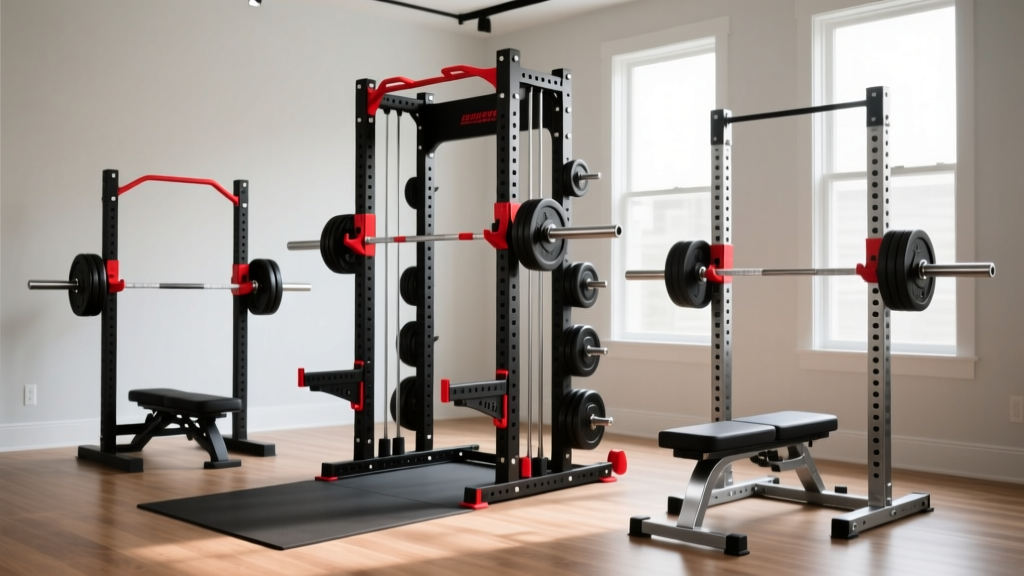
A half rack (often referred to interchangeably as a squat rack in commercial settings) typically features two main front uprights connected to a rear base or dual rear uprights with a pull-up bar. The open-front design is a game-changer for dumbbell training.
Top 2026 Contender: Titan Fitness T-3 Series Half Rack
- Price: ~$699
- Interior Width: 43 inches, but completely open to the front.
- Safety Arms: 24-inch extended spotter arms.
- Dumbbell Verdict: Superior. You can position the bench slightly forward, allowing your elbows to clear the uprights during the eccentric phase of a dumbbell press. If you fail, the extended 24-inch safety arms act as a wide catch-net for dropped dumbbells or the bench itself.
'The half-rack is the unsung hero of the hybrid home gym. It provides 90% of the barbell safety of a full cage while offering the lateral spatial freedom required for heavy unilateral and bilateral dumbbell pressing.' — Home Gym Equipment Analysis, 2025
Squat Stands: Ultimate Clearance for Dumbbell Training
Squat stands consist of two completely independent uprights. They take up the least amount of visual space and offer zero restrictions on lateral movement. For lifters whose programming heavily prioritizes upper body dumbbell workouts alongside basic barbell squatting, stands are incredibly appealing.
Top 2026 Contender: Rogue SML-2C 90" Monster Lite Squat Stands
- Price: ~$595
- Base: 24" x 24" footprint per stand.
- Safety Arms: 42.5" extended Monster Lite spotter arms (sold separately, ~$165).
- Dumbbell Verdict: Unmatched freedom. You can place your bench at any angle, anywhere in the room. The 42.5-inch extended safety arms provide a massive catch zone for failed dumbbell presses. However, they must be bolted to a platform or heavily loaded with band pegs/weight storage to prevent tipping during re-racking.
2026 Comparison Matrix: Rack Types for Dumbbell & Barbell Work
| Feature | Power Rack (Full Cage) | Half Rack (Squat Rack) | Squat Stands |
|---|---|---|---|
| Lateral DB Clearance | Poor (Restricted by 43" interior) | Good (Open front design) | Excellent (Independent posts) |
| DB Safety Catch Zone | Internal only (Useless if bench is pulled out) | Extended arms (17" - 24") | Extended arms (Up to 42.5") |
| Avg. Price Range | $1,100 - $1,800+ | $650 - $1,200 | $450 - $750 (w/ safeties) |
| Barbell Safety | Maximum (Enclosed) | High (Rear base stability) | Moderate (Tip-risk if unbolted) |
| Best For | Powerlifters, Heavy Barbell Focus | Bodybuilders, Hybrid Lifters | Small Spaces, DB-Dominant Routines |
Expert Decision Framework: Which Should You Buy?
Choosing the right equipment requires an honest audit of your programming. Use this 3-step framework to make your final decision:
- Audit Your Routine Split: If your upper body dumbbell workouts consist primarily of seated shoulder presses, single-arm rows, and floor presses, a Power Rack is fine, as these movements either don't require lateral clearance or are done on the floor. If your routine heavily features heavy incline dumbbell presses, flat bench flyes, and lateral raises, you need a Half Rack or Squat Stands.
- Measure Your Ceiling and Depth: Squat stands require a lower ceiling clearance for assembly but demand more floor depth when utilizing long safety arms. Ensure you have at least 8 feet of depth to accommodate a bench, the stands, and the extended spotter arms.
- Evaluate Anchor Options: If you opt for squat stands to maximize your dumbbell freedom, you must have a way to anchor them. According to safety guidelines highlighted by Titan Fitness and other manufacturers, independent stands can tip forward if a heavy barbell is racked aggressively or if a lifter drops a dumbbell onto the safety arm unevenly. Bolt them to a 3/4-inch plywood platform or use rear band pegs loaded with heavy plates.
Frequently Asked Questions
Can I do dumbbell bench press inside a power rack?
You can, but only if you use a narrow grip and keep your elbows tucked. For traditional hypertrophy-style upper body dumbbell workouts where the elbows flare at a 45-to-60-degree angle, a standard 43-inch interior power rack will block your range of motion. You will be forced to pull the bench outside the rack.
Are strap safeties better than pin-pipe safeties for dumbbells?
For dumbbells, strap safeties (like the Rogue Monster Lite Strap Safety System) are vastly superior. Dumbbells are often dropped at odd angles when a lifter fails. Steel pin-pipes can dent the dumbbells or cause them to bounce off unpredictably. Heavy-duty nylon straps absorb the impact and cradle the dumbbell or the bench frame securely.
What is the best bench to pair with squat stands for dumbbell work?
Look for a bench with a wide, tripod-style rear base and rubber-padded feet. The Rep Fitness AB-4100 or the Rogue Adjustable Bench 3.0 are excellent choices. The wide footprint prevents the bench from tipping if you drop a heavy dumbbell on one side of the extended safety arms, creating a lever effect.
More gear to consider
All reviews
Storing Scheels Dumbbells: 2026 Rack Trends & Market Analysis

Dumbbell vs Barbell Curls: Best Neoprene Dumbbells for Home Use
Rack Guide for Incline Dumbbell Form: Power vs Squat vs Stand
EZ Bar vs Straight Bar: Maintenance for Free Dumbbell Workouts

Front Dumbbell Press Troubleshooting & Adjustable Dumbbell Reviews