Power Rack vs Squat Rack vs Squat Stand: Lower Body Dumbbell Workout PDF
Outgrown your lower body dumbbell workout PDF? Compare power racks, squat racks, and stands to find the safest, most versatile home gym rig for 2026.

Introduction: Outgrowing the Dumbbell Phase
You have just finished week 12 of your favorite lower body dumbbell workout PDF. Your goblet squats, Bulgarian split squats, and dumbbell Romanian deadlifts have built a phenomenal foundation. But now you have hit a wall: you have maxed out your adjustable dumbbells, and your grip is failing before your glutes do. To keep progressing, you need a barbell, heavier loads, and most importantly, a safe place to rack them.
Transitioning from dumbbell-only routines to barbell training is a massive milestone. However, walking into the home gym equipment market in 2026 can feel overwhelming. The terms power rack, squat rack, and squat stand are often used interchangeably by big-box retailers, but they represent three entirely different classes of equipment with distinct safety profiles, footprints, and price points.
This step-by-step guide will help you choose the exact rig that bridges the gap between your beginner dumbbell roots and advanced barbell strength.
Step 1: Define the Big Three Rigs
Before dropping hundreds of dollars, you must understand the structural differences between the three main categories of squatting equipment.
1. The Power Rack (Full Cage)
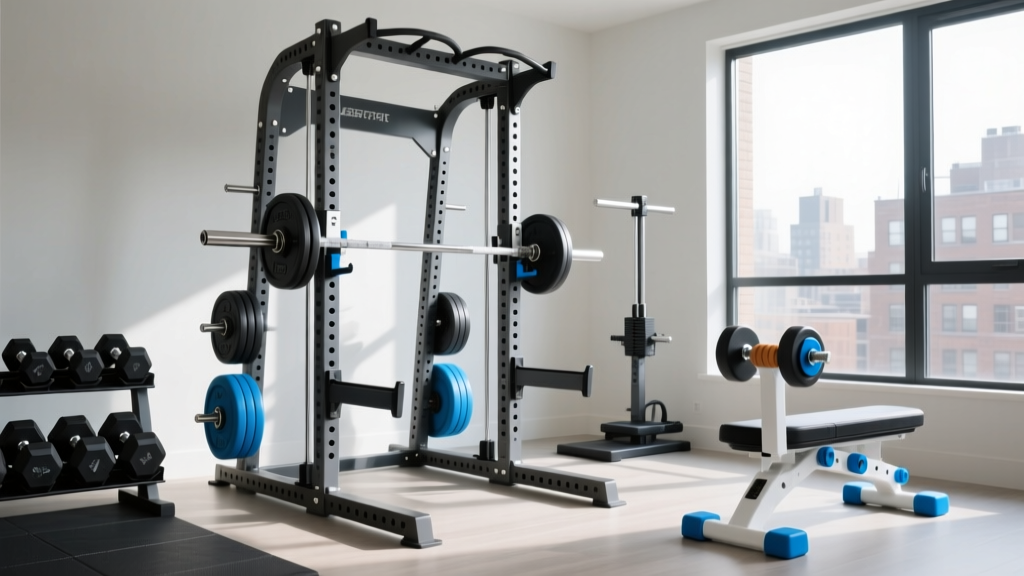
A power rack consists of four vertical steel uprights connected by crossmembers and a top pull-up bar. It creates a fully enclosed 'cage.' The primary advantage is that safety spotter arms or straps can be mounted inside the cage, meaning if you fail a rep, the bar drops safely within the footprint of the rack.
2. The Squat Rack (Half Rack)
Typically featuring two main front uprights and two shorter rear stabilizers, a half rack is open in the front. The spotter arms extend outward toward the user. This design saves interior space and makes racking dumbbells for heavy rack pulls or step-ups easier, but it requires more forward floor space for the extended arms.
3. The Squat Stand
Squat stands are two independent, freestanding steel posts. They have the smallest footprint and are highly portable. However, they lack a connecting top crossmember, meaning they are inherently less stable and must be bolted to a platform or loaded with heavy weight storage pegs on the rear to prevent forward tipping.
Step 2: Evaluate Safety and Spotter Capabilities
When moving from a lower body dumbbell workout PDF to heavy barbell back squats, safety is non-negotiable. According to a comprehensive epidemiological study on weightlifting injuries published by the National Institutes of Health (NIH), the vast majority of severe home-gym crushing injuries occur during un-spotted bench presses and heavy squats where safety catches were either absent or improperly set.
The Mayo Clinic also emphasizes that proper equipment setup and the use of spotters (mechanical or human) are critical for safe strength training progression.
Safety Feature Comparison Matrix
| Feature | Power Rack (e.g., REP PR-4000) | Half Rack (e.g., Rogue RML-390F) | Squat Stand (e.g., Rogue SML-2C) |
|---|---|---|---|
| Spotter Arm Direction | Inward (Inside Cage) | Outward (Extends Forward) | Outward (Extends Forward) |
| Tip-Over Risk | Zero (Fully enclosed/bolted) | Low (Heavy rear base) | High (Requires counterbalance) |
| Best Safety Accessory | Nylon Safety Straps | Steel Pin-Pipe Combo | UHMW-lined Flip-down Arms |
| Fail-Safe Rating | Excellent | Good | Fair (User error risk) |
In 2026, the gold standard for power racks is the nylon safety strap rather than traditional steel pin-pipe safeties. Straps catch the barbell quietly, do not damage the aggressive knurling of your barbell, and are infinitely easier to adjust between working sets.
Step 3: Measure Your Space and Ceiling Height
The most common beginner mistake is buying an 84-inch (7-foot) power rack only to realize it will not fit in the basement. You must account for the rack height plus the height of a standard 7-foot Olympic barbell being pulled overhead for strict presses.
- Standard Ceilings (84 to 96 inches): You must purchase a 'Short' rack (typically 72 inches tall). The REP Fitness PR-4000 (72-inch) is a top-tier choice here, offering 3x3 inch 11-gauge steel and 1-inch Westside hole spacing in the bench zone.
- High Ceilings / Garages (96+ inches): You can comfortably fit a standard 84-inch rack, allowing full pull-ups without your head hitting the ceiling.
- Apartment / Spare Bedroom: If you are limited to a 4x6 foot rubber mat area, a Squat Stand like the Rogue SML-2C Monster Lite is your only viable option. It tucks away into a corner when not in use.
Step 4: Translate Your PDF Routine to the Rack
How does your new rig support the movements you mastered in your lower body dumbbell workout PDF? According to the exercise mechanics database ExRx.net, proper depth and pin placement are vital for translating unilateral dumbbell strength to bilateral barbell strength.
- Goblet Squats to Barbell Box Squats: Use your rack's safety straps set just below parallel to build confidence in hitting proper depth without fear of falling backward.
- Dumbbell RDLs to Rack Pulls: Set the J-cups on your power rack to the mid-thigh position. This allows you to overload the posterior chain with weights far exceeding what your grip could hold with dumbbells.
- Bulgarian Split Squats: Use the rack's pull-up bar or a securely mounted landmine attachment to stabilize your torso while holding heavy kettlebells or dumbbells, taking the balance limitation out of the equation.
Step 5: 2026 Model Recommendations & Budget Breakdown
Here is exactly what to buy based on your budget and space constraints this year.
The Premium Power Rack: REP Fitness PR-4000
- Price: ~$999 (Base configuration)
- Specs: 3x3 uprights, 1-inch hole spacing, 1000 lb capacity, sandwich J-cups with UHMW plastic liners.
- Pros: Fully customizable, compatible with dozens of third-party attachments, incredible safety strap options.
- Cons: Heavy, requires two people to assemble, shipping can take 2-4 weeks.
The Space-Saving Squat Stand: Rogue SML-2C Monster Lite
- Price: ~$395
- Specs: 3x3 uprights, 90-inch height, 1000 lb capacity, includes basic spotter arms.
- Pros: Minimal footprint, premium Rogue build quality, easy to move if you rent your home.
- Cons: Spotter arms extend outward (requires 8+ feet of depth), no built-in pull-up bar, must be bolted down for heavy use.
The Budget Half-Rack: Titan Fitness T-2 Series
- Price: ~$299
- Specs: 2x2 uprights, 1-inch holes, 800 lb capacity.
- Pros: Extremely affordable, free shipping, great for beginners transitioning from dumbbells.
- Cons: 2x2 steel is less rigid than 3x3, hardware requires frequent tightening, limited attachment ecosystem.
FAQ: Final Checks Before You Buy
Do I need to bolt my rack to the floor?
If you buy a Power Rack or a Half Rack with a rear weight storage base, bolting is optional but recommended. If you buy independent Squat Stands, bolting to a wooden platform or using heavy rear counterbalance pegs is mandatory to prevent catastrophic forward tipping during re-racking.
Can I still do my dumbbell workouts inside a power rack?
Absolutely. In fact, a power rack is the ultimate dumbbell station. You can set the safety straps waist-high to use as a bench for heavy dumbbell chest presses, or use the interior space to perform heavy dumbbell rows with a built-in pull-up bar anchor for resistance bands.
What is Westside hole spacing?
Westside spacing refers to a 1-inch distance between pin holes in the 'bench zone' (the lower half of the rack), compared to the standard 2-inch spacing higher up. This allows you to set your safety pins at the exact millimeter needed to protect your chest during a bench press or your neck during a low-bar squat.
More gear to consider
All reviews
EZ vs Straight Bar & Full Body Exercises With Dumbbells: Care Guide
How to Store and Maintain Your Set Dumbbell Rack for Longevity

Adjustable Dumbbell Review: Dumbbell Core Workout Women Setup Guide

Upgrading From a 25 Pound Dumbbells Pair: Adjustable Set Guide

Best Adjustable Dumbbells for the Dumbbell 21 (2026)
