
EZ vs Straight Bar: Space Hacks for Full Body Dumbbell Workout Women
Compare EZ curl vs straight bars for compact home gyms. Discover space-saving layouts, biomechanics, and gear to optimize your dumbbell-focused routines.

The Spatial Dilemma: Complementing Your Dumbbell Routine
When designing a compact home gym, space is the ultimate premium. Many lifters anchor their programming around a full body dumbbell workout women and men alike use to build functional strength, correct muscular imbalances, and protect joint health. Dumbbells are incredibly versatile, but as your strength progresses, you will inevitably hit a ceiling with unilateral movements. Heavy Romanian deadlifts (RDLs), hip thrusts, and overhead presses eventually demand the bilateral stability and heavier loading capacity of a barbell.
This creates a critical spatial dilemma: Do you sacrifice precious floor space for a traditional straight barbell, or do you opt for a compact EZ curl bar? From a space optimization and layout design perspective, the choice between an EZ bar and a straight bar extends far beyond simple wrist ergonomics. It dictates your wall clearance, storage footprint, and overall gym flow. In this guide, we break down the exact dimensions, 2026 market pricing, and layout configurations to help you make the most space-efficient choice for your home gym.
Footprint Analysis: Straight Bar vs. EZ Curl Bar
To understand which barbell belongs in a space-constrained environment, we must first look at the raw geometry and the operational clearance required for safe loading and unloading of weight plates.
| Feature | Standard Straight Bar (Olympic) | Standard EZ Curl Bar (Olympic) |
|---|---|---|
| Total Shaft Length | 71 inches (Standard) / 86 inches (Full Olympic) | 47 to 52 inches |
| Sleeve Length (Loadable) | 16.3 inches per side | 10 to 12 inches per side |
| Minimum Wall Clearance | 90+ inches (for safe plate loading) | 65 inches (for safe plate loading) |
| Average Bar Weight | 44 lbs (20kg) | 15 to 22 lbs (7 to 10kg) |
| Floor Storage Footprint | Requires 36" x 18" horizontal rack | Fits on standard dumbbell rack tiers |
Biomechanics in Confined Spaces: Why the EZ Bar Wins
While the straight bar is the gold standard for heavy powerlifting, the EZ curl bar offers distinct biomechanical advantages that perfectly complement a dumbbell-heavy routine, especially when space limits your ability to set up spotting arms or safety straps.
According to biomechanical analyses of wrist articulation, the semi-supinated grip of an EZ bar reduces valgus stress on the medial collateral ligament of the elbow and minimizes impingement in the triangular fibrocartilage complex (TFCC) of the wrist (ExRx Wrist Articulation Mechanics). When performing heavy skull crushers or upright rows in a cramped home gym where you cannot easily dump the weight if a joint flares up, the ergonomic angles of the EZ bar provide a critical safety margin.
Exercise Overlap and Gap Analysis
Since your primary programming is a full body dumbbell workout, women and men often use dumbbells for chest presses, lunges, and rows. The barbell is brought in to fill specific strength gaps. Here is how the two bars compare for those gap-filling movements:
- Hip Thrusts & RDLs: The straight bar allows for maximal loading (300+ lbs), but an EZ bar can comfortably hold 150-200 lbs of bumper plates, which is sufficient for 90% of home gym lifters. The angled grips of the EZ bar also make it easier to hold onto during heavy RDLs without relying entirely on wrist straps.
- Overhead Pressing: A straight bar requires a wide grip that can impinge shoulders in low-ceiling spaces. An EZ bar allows for a slightly narrower, more natural pressing path, reducing the risk of hitting ceiling drywall or overhead light fixtures.
- Isolation Work: For bicep curls and tricep extensions, the EZ bar is vastly superior, entirely replacing the need for heavy dumbbell curls that take up time and require frequent weight changes.
2026 Market Pricing & Specific Models
When optimizing a layout, you must also consider the storage hardware required for the bar. Here is a breakdown of top-tier 2026 market options and their spatial requirements.
1. Rogue Fitness Curl Bar (The Premium Compact Choice)
Priced at approximately $135, the Rogue Curl Bar features a 47-inch total length and a 25mm shaft diameter. The 25mm shaft is notably thinner than standard straight bars (28.5mm), making it highly comfortable for smaller hands. Crucially for space optimization, its 10.5-inch loadable sleeves are long enough to hold three 45lb bumper plates per side, maximizing weight capacity without extending the bar's footprint.
2. Titan Fitness EZ Curl Bar (The Budget Space-Saver)
Retailing around $89, Titan's offering is slightly heavier at 22 lbs and features a more aggressive camber angle. While the knurling is less refined than Rogue's, its 52-inch length still easily fits inside a standard 4x6 foot rubber flooring mat setup, leaving ample room for a 3-tier dumbbell rack at the foot of the platform.
Storage Hardware: The Vertical Advantage
A straight barbell requires a dedicated horizontal A-frame or wall-mounted cradle, protruding at least 18 inches from the wall. Conversely, an EZ curl bar can be stored vertically using a simple $25 wall-mounted barbell hanger. This reduces the storage footprint to less than 6 inches of depth against the wall, preserving your 36-inch minimum walking clearance paths mandated by the National Strength and Conditioning Association (NSCA) for safe gym layouts (NSCA Equipment Layout Guidelines).
Layout Configurations for Compact Rooms
Integrating a barbell into a room designed for a full body dumbbell workout requires strategic zoning. Here are two proven layouts for spaces under 150 square feet.
Configuration A: The Corner Anchor (Recommended for EZ Bars)
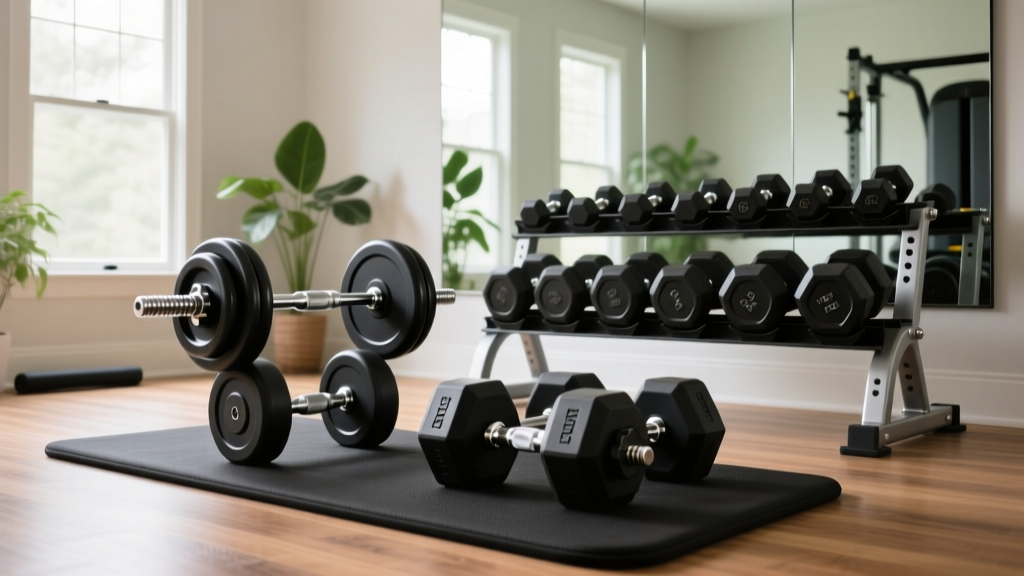
Place your 3-tier rubber hex dumbbell rack in the corner, angled at 45 degrees. This creates a triangular dead zone behind the rack where you can mount a vertical barbell hanger. The EZ bar is stored vertically in this dead zone. When in use, the 47-inch bar can be lifted directly onto a flat bench positioned in the center of the room. Because the EZ bar is short, you only need 4 feet of lateral clearance on either side of the bench, keeping you well within the boundaries of a standard 6x8 foot home gym footprint.
Configuration B: The Closet Conversion (Straight Bar Compromise)
If you absolutely require a 71-inch straight bar for heavy deadlifts, a walk-in closet or alcove conversion is mandatory. You must utilize a wall-mounted folding squat rack (like the PRx Profile) that folds flat to 4 inches. The straight bar must be stored horizontally on the rack's J-cups when not in use. Warning: This configuration requires you to load and unload plates while the bar is suspended in the air, which is a significant failure mode and safety hazard for solo lifters in tight spaces.
Failure Modes & Edge Cases to Avoid
When buying budget equipment for tight spaces, be aware of these specific mechanical failure modes:
- Sleeve Seizure on Cheap EZ Bars: Inexpensive EZ bars (under $60) often use basic brass bushings instead of needle bearings. During dynamic movements like upright rows or cleans, the sleeves fail to spin independently of the shaft. In a tight space where you cannot easily drop the bar, this transfers massive rotational torque directly into your wrists, leading to acute sprains.
- Knurling Damage to Hardwood: Straight bars feature aggressive center knurling. If you are storing the bar horizontally on a rack near a wall, sliding the bar in and out will inevitably scrape the knurling against the wall or baseboards. EZ bars lack center knurling and have smoother, shorter shafts, making them significantly safer for rooms with finished drywall or exposed trim.
- Plate Compatibility: Many 47-inch EZ bars have shorter sleeves. If you use thick, virgin rubber bumper plates (which are 3.5 inches wide per 10lb plate), you will max out the sleeve capacity at roughly 135 lbs total. If your strength goals require more weight, you must invest in thin urethane plates or steel calibration plates to maximize the limited sleeve real estate.
Final Verdict: Optimizing Your Space
If your primary training modality is a high-frequency, full body dumbbell workout, women and men will find that adding an EZ curl bar is the most spatially efficient way to introduce bilateral barbell loading. The 47-inch footprint, vertical storage capability, and ergonomic joint angles make it the undisputed champion of the compact home gym. Reserve the 71-inch straight bar only if you have a dedicated 10x10 foot space with reinforced flooring and a clear 9-foot ceiling height for overhead movements. By choosing the right tool for your square footage, you maintain a safe, functional, and highly effective training environment without sacrificing your home's livable space.
More gear to consider
All reviews
Olympic Barbell Knurling: Rogue vs REP & Dumbbell Fly Machine Pairings

Dumbbell Workout Routine for Beginners: Barbell Knurl Mistakes

EZ vs Straight Bar: Seated Dumbbell Tricep Extension Trends 2026
Bumper vs Iron Plate Comparison: Kneeling Dumbbell Press Setup Guide

Leg Exercises With Dumbbells At Home: Neoprene Mistakes & Fixes
