
Power Rack vs Squat Rack: How to Build Biceps Without Dumbbells
Compare power racks, squat racks, and stands to maximize arm growth. Learn how to build biceps without dumbbells using barbells, cables, and bodyweight.

When outfitting a home gym, most lifters assume they need a massive 5-to-100-pound dumbbell set to achieve serious arm hypertrophy. This is a costly and space-consuming myth. If you are currently debating between a power rack, a squat rack (half rack), or a squat stand, you are actually choosing the foundational ecosystem for your entire physique. This head-to-head comparison breaks down the architecture, safety, and attachment compatibility of these three rigs, specifically answering the ultimate home-gym question: how to build biceps without dumbbells using barbells, cables, and bodyweight leverage.
The Contenders: Architecture and 2026 Market Pricing
Before diving into bicep-specific biomechanics, we must define the structural differences between the three primary rig types available on the 2026 market. Your choice here dictates which arm-training attachments you can safely mount.
- Power Rack (Full Cage): Four heavy-duty uprights connected by crossmembers, featuring front and rear pin-pipe or strap safeties. Example: Rep Fitness PR-4000 (approx. $1,699 - $2,100) or Rogue R-3 ($3,995).
- Squat Rack / Half Rack: Typically features four uprights (two heavy front posts, two lighter rear stabilizers) or an open-front 4-post design. It saves space while maintaining a pull-up bar and some attachment compatibility. Example: Titan Fitness T-3 Half Rack (approx. $1,299).
- Squat Stand: Two independent, freestanding uprights with heavy base stabilizers. Highly portable but lacks an integrated pull-up bar or enclosure. Example: Rogue SML-2 Monster Lite Squat Stand (approx. $495).
Heavy Barbell Curls: Safeties and Strict Form
The barbell curl is the undisputed king of overall bicep mass, targeting both the short and long heads of the biceps brachii. However, as you progress into the 115–155 lb range, form breakdown (using hip momentum) becomes the primary failure point. This is where your rack choice dictates your training quality.
The Power Rack "Cheat-Proof" Setup
In a power rack, you can set the safety spotter arms at waist height. Stand inside the rack and perform strict barbell curls. If you attempt to swing your hips to cheat the weight up, the barbell will physically hit the safety pins, preventing the rep. This forces pure isolation and maximizes mechanical tension on the biceps without requiring a spotter or dumbbells.
The Squat Stand Limitation: Squat stands lack horizontal safety bars. If you fail a heavy barbell curl or lose your balance, the barbell drops directly onto your floor—or your feet. While you can still do barbell curls in front of a squat stand, you lose the psychological safety required to push to true muscular failure on heavy sets.
The Secret Weapon: Rack-Mounted Cable Crossovers
According to Stronger By Science, maintaining continuous tension through a muscle's full range of motion is a primary driver of hypertrophy. Free weights (like a barbell) lose tension on the biceps at the very top of the curl when the weight stacks directly over the elbow joint. Cables solve this by providing constant, linear tension.
As of 2026, the most cost-effective way to get a commercial-grade cable system at home is by attaching a Functional Trainer / Cable Crossover to your rack. Exercises like Cable Bayesian Curls (facing away from the pulley) and Cross-Body Hammer Curls are unparalleled for brachialis and bicep peak development.
| Feature | Power Rack | Half Rack | Squat Stand |
|---|---|---|---|
| Cable Attachment Compatibility | Excellent (Front & Rear mounting) | Good (Front mounting only) | None (Uprights cannot support pulley tension) |
| Strict Curl Safety Pins | Yes (Adjustable height) | Yes (Front uprights only) | No |
| Inverted Row Setup | Excellent (Multiple bar heights) | Excellent | Good (Requires careful weight balancing) |
| Supinated Chin-Ups | Yes (Integrated Pull-up Bar) | Yes (Integrated Pull-up Bar) | No (Must buy separate doorway bar) |
| Avg. Footprint | 48" x 48" (Enclosed) | 48" x 36" (Open front) | 48" x 24" (Minimalist) |
Bodyweight Bicep Blasters: Inverted Rows and Chin-Ups
If you want to know how to build biceps without dumbbells on a strict budget, look no further than supinated bodyweight movements. ExRx.net's kinesiology database highlights that the biceps brachii acts as a powerful supinator and elbow flexor. Chin-ups (palms facing you) elicit some of the highest EMG activations recorded for bicep growth.
The Inverted Row Advantage
By placing your barbell into the J-cups of your rack at waist height, you can perform inverted bodyweight rows. Using a supinated (underhand) grip shifts the bias heavily onto the biceps and brachialis.
Pro-Tip for Squat Stand Users: If you use a squat stand, ensure your barbell is heavily loaded on both sides (e.g., two 45lb plates per side) before doing inverted rows. If the weight is too light, the leverage of your bodyweight will flip the bar out of the J-cups, leading to a dangerous fall. Power racks and half racks with bolted-in crossmembers eliminate this risk entirely.
Biomechanics and Volume: The Science of Rack-Based Arm Training
Building the biceps requires adequate weekly volume. A landmark dose-response study published by the National Center for Biotechnology Information (NCBI) confirms that 10 to 20 working sets per muscle group per week is the optimal range for maximizing hypertrophy in trained individuals. You can easily hit this volume using only a rack, a barbell, and a cable attachment:
- Heavy Barbell Curls (Power Rack Safeties): 3 sets of 5-8 reps (Focus on mechanical tension and overload).
- Supinated Chin-Ups (Pull-up Bar): 3 sets to failure (Focus on the stretched position at the bottom).
- Cable Bayesian Curls (Functional Trainer): 3 sets of 12-15 reps (Focus on constant tension and the squeeze).
- Supinated Inverted Rows (Barbell in J-Cups): 3 sets of 10-15 reps (Focus on the brachialis and forearm flexors).
The Preacher Pad Hack
Don't want to buy a $300 freestanding preacher curl bench? If you own a Power Rack or Half Rack with a lat pulldown attachment, you can place a standard adjustable FID bench inside the rack, sit facing the weight stack, and use the straight lat pulldown bar to perform cable preacher curls. This provides the exact same elbow-stabilizing benefits as a traditional pad, but with the superior resistance profile of cables.
The Verdict: Which Rig Wins for Arm Day?
Choose the Power Rack if: You have the space and budget ($1,500+). It is the undisputed champion for answering how to build biceps without dumbbells because it safely supports heavy barbell cheating-prevention, integrated chin-up bars, and heavy-duty cable crossover attachments. It is a complete commercial gym in a 4x4 footprint.
Choose the Squat Rack (Half Rack) if: You want 90% of the power rack's functionality but need to save 12 inches of depth in your garage. You still get the pull-up bar and front-mounted cable attachments, making it a phenomenal choice for arm hypertrophy.
Choose the Squat Stand if: You are on a sub-$500 budget, live in an apartment, or need to move your gear frequently. You will still build massive biceps using heavy barbell curls and by pairing the stand with a separate doorway chin-up bar, but you must sacrifice cable attachments and strict-curl safety pins.
More gear to consider
All reviews
Organizing Your Dumbbell Curl Weight Collection: Storage & Layout
Bent Over Two Dumbbell Row with Palms In: Olympic vs Standard Plate Fixes
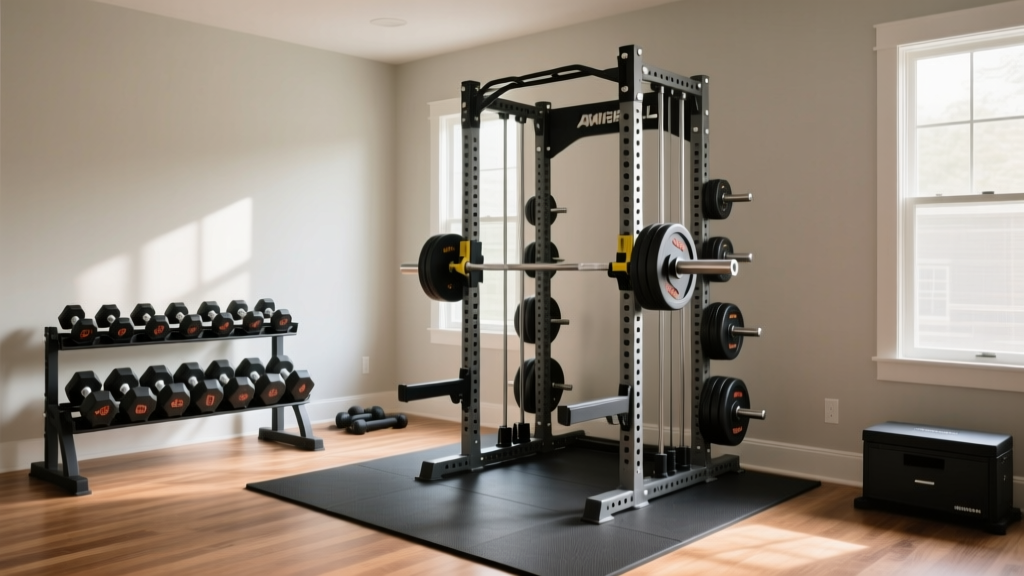
Power Rack vs Squat Stand: American Barbell Dumbbell Layout Mistakes
Adjustable Dumbbell Review: One Arm Dumbbell Row Bench Supported 2026

Bumper vs Iron Plates: Rack Drops & Push Up Dumbbell Tactics
