
Olympic vs Standard Weight Plates: Buying Guide & Standing Ab Workouts with Dumbbells
Compare Olympic vs standard weight plates for your home gym. Plus, master core stability with our top standing ab workouts with dumbbells.

The Great Debate: Olympic vs. Standard Weight Plates
When outfitting a home gym, the foundation of your strength training ecosystem relies on a critical, often overlooked decision: the sleeve diameter of your barbells and the corresponding center holes of your weight plates. In 2026, the market is saturated with options, but the divide between Olympic and standard weight plates remains the most defining choice for lifters. While standard plates might seem like a budget-friendly entry point, understanding the metallurgical, dimensional, and functional differences is vital for long-term progress and safety.
According to comprehensive equipment analyses by BarBend, the primary distinction lies in the sleeve diameter. Olympic plates feature a 50mm (approx. 2-inch) center hole, designed to slide onto Olympic barbells with rotating sleeves. Standard plates feature a 25.4mm (1-inch) center hole, meant for cheaper, fixed-sleeve bars. This single inch of difference dictates not just the equipment you can use, but the maximum load capacity, the biomechanics of your lifts, and the longevity of your gear.
Dimensional & Mechanical Breakdown
To make an informed purchasing decision, you must look beyond the painted numbers on the side of the iron. Here is how the two formats stack up against each other in real-world home gym scenarios.
| Feature | Olympic Weight Plates | Standard Weight Plates |
|---|---|---|
| Center Hole Diameter | 50mm (2 inches) | 25.4mm (1 inch) |
| Barbell Sleeve Type | Rotating (bushings/bearings) | Fixed (solid steel) |
| Max Load Capacity | 1,000 lbs - 1,500+ lbs | 150 lbs - 250 lbs (bar fails first) |
| Plate Materials | Cast Iron, Steel, Urethane, Rubber | Cast Iron, Vinyl/Cement Filled |
| Diameter Consistency | 450mm across all bumper plates | Varies wildly by weight |
| Average Cost (2026) | $1.50 - $4.50 per lb | $0.80 - $1.50 per lb |
The Rotating Sleeve Advantage
Why does the 50mm Olympic standard dominate commercial and serious home gyms? The answer is rotational force. During Olympic lifts (like the clean and jerk) or even heavy deadlifts, the barbell bends and twists. Olympic barbells feature sleeves that rotate independently of the shaft via bronze bushings or needle bearings. This rotation dissipates torque, protecting your wrists and elbows. Standard bars are solid pieces of steel; the plates cannot spin, forcing your joints to absorb the rotational energy, which frequently leads to wrist strains during dynamic movements.
⚠️ Buyer's Warning: The Cement-Filled TrapMany entry-level standard weight plate kits sold at big-box retailers are not solid iron. They are vinyl shells filled with cement or sand. These plates are incredibly bulky, meaning you cannot physically fit enough 45lb plates on a standard bar to reach heavy loads. Furthermore, the cement can shift or crack, altering the plate's balance and center of gravity.
Cost Analysis: Investing in Iron vs. Urethane
The pricing landscape for weight plates has stabilized in 2026, but the material you choose heavily impacts your wallet and your floors. If you are buying Olympic plates, you generally have three tiers:
- Raw Cast Iron (e.g., York Legacy, Titan Fitness): Priced between $1.50 and $2.20 per pound. These are the gold standard for traditional lifting, offering a slim profile so you can load the bar to 400+ lbs without running out of sleeve space.
- Rubber Grip Plates (e.g., Rep Fitness RG-280): Priced around $2.00 to $3.00 per pound. The rubber coating dampens noise and protects flooring, while the grip handles make loading and unloading the bar significantly easier.
- Virgin Urethane Bumpers (e.g., Rogue Echo Bumpers): Priced between $3.50 and $5.00 per pound. Urethane is vastly superior to rubber; it does not degrade, smell, or bounce dangerously when dropped from overhead. As noted by Rogue Fitness, high-quality urethane is essential for CrossFit and Olympic weightlifting environments where dropping the bar is part of the sport.
Standard plates, while cheaper upfront (often $1.00 per pound for iron), represent a dead-end investment. Once you surpass a 200-pound squat or deadlift, you will be forced to sell your standard bar and plates at a loss to upgrade to an Olympic setup.
Transitioning to Functional Core Training
While Olympic plates and barbells are the undisputed kings of bilateral, heavy compound movements (squats, deadlifts, presses), a complete home gym requires functional, unilateral, and rotational training. This is where your dumbbell collection comes into play.
Many lifters neglect their core or rely on endless sets of supine crunches, which primarily target the rectus abdominis through spinal flexion. However, the core's primary evolutionary function is anti-movement—resisting rotation, extension, and lateral flexion to protect the spine. To build a truly resilient midsection, you must incorporate standing ab workouts with dumbbells, which force your core to stabilize your torso against asymmetric, multi-planar loads.
Top Standing Ab Workouts with Dumbbells
Below are three highly effective, biomechanically sound standing ab exercises that utilize dumbbells to build functional core strength. These pair perfectly with a heavy barbell day, serving as an elite finishing circuit.
1. The Single-Arm Dumbbell Farmer's Carry (Anti-Lateral Flexion)
The Farmer's Carry is a staple in strongman and athletic performance circles. By holding a heavy dumbbell in only one hand, you introduce a massive lateral flexion force. Your obliques and quadratus lumborum (QL) must fire maximally to keep your spine perfectly vertical.
- Setup: Grab a heavy dumbbell (men: 50-75 lbs; women: 30-50 lbs) in your right hand. Let it hang at arm's length.
- Execution: Walk slowly for 30 to 40 yards. Focus on keeping your shoulders perfectly level—do not let the weight pull your right shoulder down.
- Coaching Cue: Imagine balancing a book on your head while walking. Brace your core as if preparing for a punch.
2. Dumbbell Woodchoppers (Anti-Rotation & Transverse Power)
Woodchoppers train the core through the transverse plane, mimicking the rotational power needed in sports like golf, baseball, and martial arts. According to the American Council on Exercise (ACE), rotational and anti-rotational core exercises are critical for transferring power from the lower body to the upper body safely.
- Setup: Hold a single dumbbell (15-25 lbs) by the inner plates with both hands. Stand with feet shoulder-width apart.
- Execution: Start with the dumbbell high and to the outside of your right shoulder. In one explosive but controlled motion, chop the weight diagonally down across your body toward your left hip, pivoting your back foot.
- Volume: 3 sets of 12 reps per side. Focus on the eccentric (return) phase, taking 2 seconds to bring the weight back to the start.
3. Standing Dumbbell Halos (Core Bracing & Shoulder Mobility)
Halos are often categorized as a shoulder mobility drill, but when performed with a moderately heavy dumbbell while standing, they become a profound anti-extension and anti-rotation core workout.
- Setup: Hold a dumbbell (20-35 lbs) vertically by one end at chest level.
- Execution: Slowly circle the dumbbell around your head. As the weight shifts from the front of your face to behind your neck, your center of gravity shifts. Your deep core stabilizers (transverse abdominis) must contract to prevent your ribcage from flaring and your lower back from arching.
- Volume: 3 sets of 8 clockwise and 8 counter-clockwise circles.
'The core is not a show muscle; it is a transmission system. Standing ab workouts with dumbbells teach your body how to transfer force from the ground, through a rigid torso, and into the extremities without energy leaks.'
Frequently Asked Questions
Can I use an adapter to put standard plates on an Olympic bar?
Yes, you can purchase 1-inch to 2-inch sleeve adapters. However, this is generally not recommended for heavy lifting. Adapters add unnecessary length to the sleeve, pushing the weight further outboard, which alters the bar's whip and balance. Furthermore, cheap plastic adapters can crack under heavy loads, creating a severe safety hazard.
Are standard plates ever the right choice?
Standard plates are only recommended if you are setting up a very light, budget-conscious space for rehabilitation, light resistance training, or for children/teens where the maximum load will never exceed 100 pounds. For any adult serious about progressive overload, Olympic is the only viable path.
How often should I perform standing dumbbell ab workouts?
Integrate these standing core movements 2 to 3 times per week at the end of your primary strength sessions. Because these exercises rely on stabilization rather than spinal flexion, they are generally safe for daily practice, provided the load is managed and you are not training through lower back pain.
More gear to consider
All reviews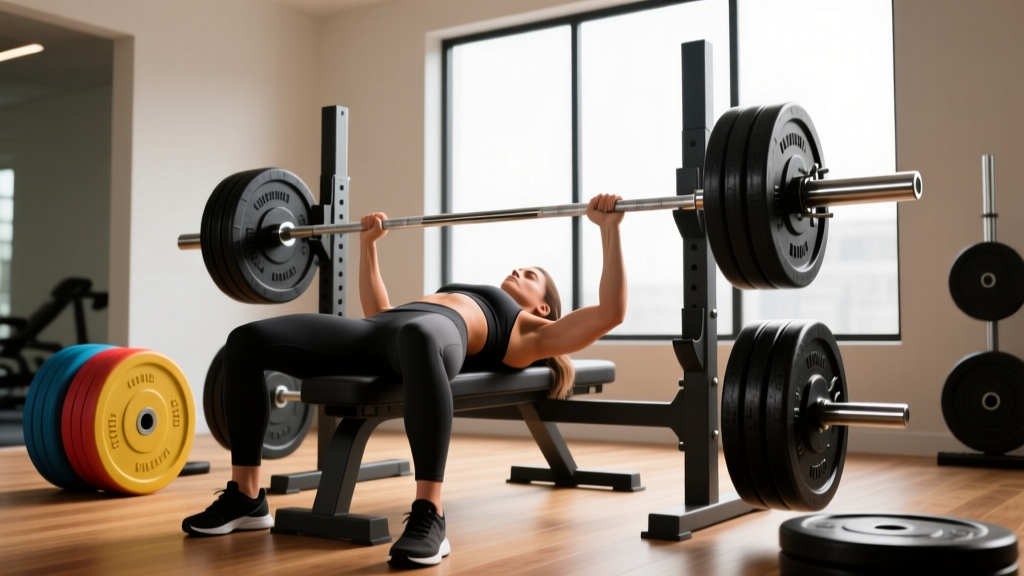
Bumper vs Iron Plates: Beyond Dumbbell Chest Workouts for Women
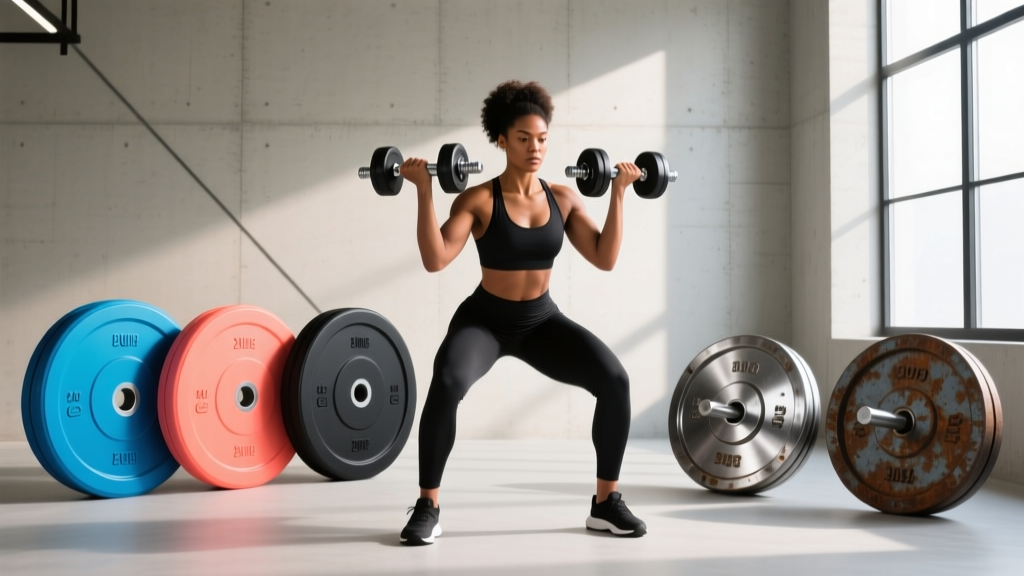
Bumper vs Iron Plates: 2026 Trends & The Woman Lifting Dumbbells Boom
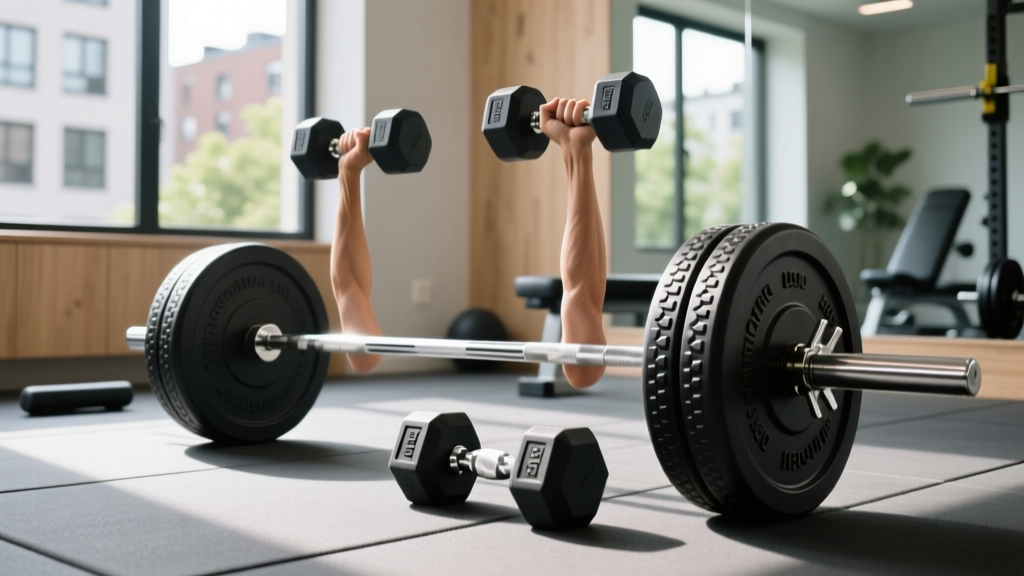
Barbell Knurling Guide & Dumbbell Bicep Curl to Shoulder Press Setup
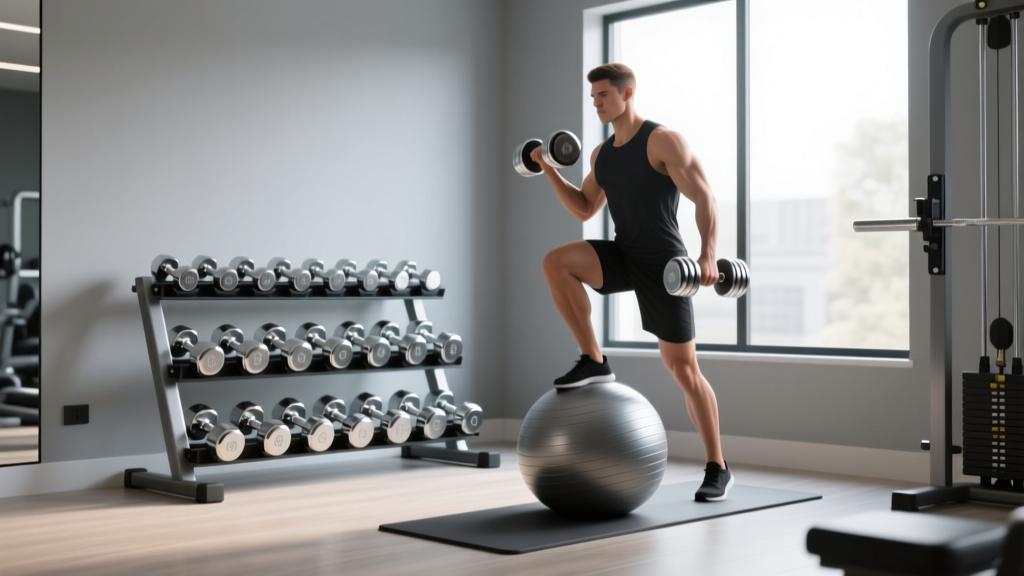
Space-Saving Dumbbell Racks for a Dumbbell Stability Ball Workout

Skip the 25 lb Dumbbell Walmart Run: Best Loadable Handles 2026
