
Power Rack vs Squat Rack vs Stand: Deadlift Dumbbell Workout Setups
Compare power racks, squat racks, and stands to optimize home gym space, safety, and storage for barbell and deadlift dumbbell workout routines.

The Spatial Economics of Home Gym Rigs
When designing a home gym in 2026, most lifters fixate on barbell clearance and pull-up height. But if your programming heavily features a high-volume deadlift dumbbell workout, your equipment choices must account for lateral floor space, heavy dumbbell storage, and safe drop zones. Choosing between a power rack, a half squat rack, and independent squat stands is no longer just about barbell safety; it is about spatial economics.
Executing heavy dumbbell deadlifts—particularly sumo variations or deficit movements—requires a wide stance and a sprawling 'hike' setup phase. A full power cage can restrict this movement, while independent stands maximize floor area but introduce severe tipping hazards if not properly spec'd. This guide breaks down the structural realities, 2026 pricing, and failure modes of each rig type to help you build the ultimate hybrid lifting station.
Core Terminology Check
- Power Rack (Full Cage): Four uprights connected by crossmembers, offering enclosed safety spotting.
- Squat Rack (Half Rack): Two main uprights with rear storage horns or stabilizers, open at the front.
- Squat Stands: Two independent, freestanding uprights with minimal base footprint.
Power Racks: Maximum Safety, Minimum Floor Space
Power racks like the REP PR-4000 or Rogue RML-390F are the gold standard for heavy barbell squatting and benching. Constructed from 3x3-inch 11-gauge steel, these cages weigh upwards of 350 lbs and provide an enclosed environment where spotter arms or safety straps catch failed reps without requiring a human spotter.
The Dumbbell Deadlift Conflict
The primary drawback of a power rack for a dedicated deadlift dumbbell workout is the interior footprint. A standard 49-inch interior width seems spacious until you factor in a wide sumo stance plus two 100-lb hex dumbbells. According to ExRx dumbbell deadlift biomechanics, the lateral span of a heavy sumo dumbbell pull can easily exceed 40 inches. This leaves virtually zero margin for error, increasing the risk of clipping the uprights during the eccentric phase or the initial setup.
Furthermore, power racks consume 16 to 25 square feet of prime 'drop zone' real estate. If you are doing high-rep dumbbell deadlifts to failure, you need an open 6x8 foot rubber-matted area to safely drop the weights without worrying about bouncing them off steel crossmembers.
Half Squat Racks: The Hybrid Storage Solution
Half racks, such as the Titan T-3 Half Rack or Rogue SML-2 Monster Lite Half Rack, offer a compelling middle ground. By removing the front uprights, you gain unrestricted forward floor space, making it significantly easier to transition from rack pulls to floor-based dumbbell work.
Integrated Dumbbell Storage
The hidden advantage of the half rack for dumbbell users is rear-end storage. Many 2026 half rack models feature integrated tiered dumbbell horns on the rear stabilizer feet. Storing heavy pairs (e.g., 80s, 100s, 120s) on the rack's base lowers the center of gravity, acting as a counterbalance while keeping your floor clear for your deadlift dumbbell workout.
Expert Warning: Never store heavy dumbbells on the upper tiered horns of a half rack. Keeping 200+ lbs of dumbbell weight elevated on a half-rack shifts the center of gravity upward, creating a catastrophic tipping hazard during barbell re-racking. Always store heavy iron on the lowest tier.
Squat Stands: Unrestricted Floor Area
Independent squat stands (e.g., Rogue S-2 Squat Stands or REP PR-1100) are essentially two isolated uprights. They take up a mere 4 to 6 square feet of floor space, leaving your entire garage or basement open for sprawling functional movements, kettlebell swings, and heavy deadlift dumbbell workout routines.
The Tipping Hazard and Counterbalance Tech
The fatal flaw of traditional squat stands is the spotter arm. If a lifter dumps a missed barbell squat forward onto the spotter arms, the leverage can flip the entire stand backward. However, modern engineering has solved this. As detailed in Rogue Fitness squat stand specifications, many premium 2026 stands now feature counterbalanced safety spotter arms. These arms utilize a rearward weight distribution or a secondary grounding strut that prevents the upright from tipping forward, even if 300 lbs is dropped on the front pins.
If you opt for stands to maximize your dumbbell floor space, you must either bolt them to a wooden platform or purchase the counterbalanced models. Standard friction-fit stands are entirely unsafe for unsupervised heavy lifting.
Equipment Matrix: 2026 Buyer's Comparison
Use this matrix to align your rig choice with your specific spatial constraints and programming needs. Pricing reflects average market rates for 11-gauge, commercial-grade home gym equipment in 2026.
| Feature | Power Rack (Full Cage) | Half Squat Rack | Squat Stands |
|---|---|---|---|
| Avg. Price (2026) | $1,200 - $1,800 | $800 - $1,300 | $350 - $600 |
| Footprint | 16 - 25 sq ft | 12 - 18 sq ft | 4 - 6 sq ft |
| Dumbbell Storage | Excellent (Attachable tiers) | Good (Rear base horns) | Poor (Requires separate rack) |
| Floor Space for DB Deadlifts | Restricted (Interior clipping risk) | Moderate (Open front) | Unrestricted (Max open area) |
| Safety (Unspotted) | Maximum | High | Low (Unless counterbalanced) |
Optimizing the Deadlift Dumbbell Workout Zone
If your primary goal is to facilitate a heavy deadlift dumbbell workout, the rack is only half the equation. The interaction between your equipment, your flooring, and your dumbbell profile dictates the safety and longevity of your home gym.
Mat Thickness and Drop Zones
Standard 1/2-inch horse stall mats are insufficient for dropping 100-lb hex dumbbells. The concentrated force of a hex corner hitting a thin mat will transfer directly to your concrete subfloor, causing spalling and cracking over time. For dedicated dumbbell drop zones, you must invest in 3/4-inch vulcanized rubber tiles with a Shore A durometer rating of 60 or higher. This density absorbs the kinetic energy of a fatigued drop without bottoming out.
Hex vs. Urethane Round Profiles
When storing dumbbells on a half-rack or power rack tier, urethane-coated hex dumbbells are vastly superior to round-head dumbbells. Round dumbbells require deep, cradled saddles to prevent rolling off the tiers during minor gym vibrations (like dropping a barbell). Hex dumbbells can rest safely on flat tier shelves, allowing for much higher storage density on the rear of your squat rack.
Frequently Asked Questions
Can I do a deadlift dumbbell workout inside a power rack?
Yes, but it is generally not recommended for heavy or sumo variations. The interior width of most standard power racks is 49 inches. A wide sumo stance combined with the lateral width of large dumbbells leaves less than 2 inches of clearance on either side, increasing the risk of scraping the uprights and disrupting your lifting groove. It is better to pull the dumbbells out to an open floor space.
Are squat stands safe for home gyms in 2026?
They are safe only if you mitigate the tipping hazard. According to Garage Gym Reviews' comprehensive squat rack testing, you must either bolt the stands directly into a wooden platform, use them exclusively for exercises where the barbell is never dumped forward (like strict presses), or invest in modern stands equipped with counterbalanced safety spotter arms.
How much weight can a half-rack dumbbell tier hold?
Most commercial-grade 11-gauge steel half-rack rear storage tiers are rated for 500 to 800 lbs of static weight. However, the limiting factor is not the steel's yield strength, but the rack's overall center of gravity. Keep your heaviest pairs (100+ lbs) on the bottom tier to maintain a stable base.
More gear to consider
All reviews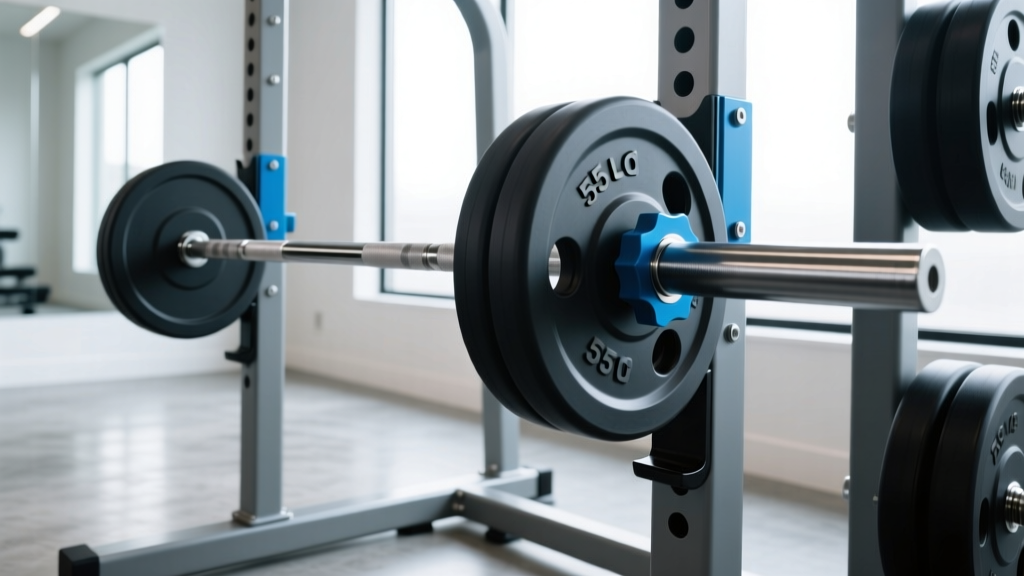
Building a Custom 55 Dumbbell: Olympic vs Standard Plate Mistakes

Power Rack vs Squat Rack vs Squat Stand: Incline Dumbbell Curl Setup

Dumbbell Rack Care After Core Dumbbells Exercise Routines
Bumper vs Iron Plates for a Dumbbell Chest and Back Workout Setup

Rubber Hex vs Urethane Dumbbells for a Space-Saving Dumbbell Circuit
