
Olympic vs Standard Setup for Dumbbell Exercises Workout Routines
Master your 2026 home gym setup. We compare Olympic vs standard plates, install storage racks, and optimize space for dumbbell exercises workout routines.

The Foundation: Olympic vs. Standard Plate Anatomy
When architecting a comprehensive home gym in 2026, the decision between Olympic and standard weight plates dictates not just your barbell training, but your entire spatial layout, storage infrastructure, and how you integrate dumbbell exercises workout routines into your daily flow. While standard plates (1-inch hub) remain a budget-friendly entry point, Olympic plates (2-inch hub) are the undisputed standard for serious lifters due to their superior weight distribution, sleeve rotation, and load capacity.
According to equipment tolerances published by Rogue Fitness, calibrated Olympic plates maintain a strict ±10-gram variance, whereas standard cast iron plates can fluctuate by up to 10%. This discrepancy is negligible for casual use but catastrophic for competitive powerlifting or precise progressive overload tracking.
2026 Specification & Pricing Matrix
| Feature | Olympic Plates (2-inch Hub) | Standard Plates (1-inch Hub) |
|---|---|---|
| Hub Diameter & Material | 50mm (Stainless Steel / Brass) | 25mm (Cast Iron / Plastic) |
| Weight Tolerance | ±1% to ±10g (Calibrated) | ±5% to ±10% |
| Avg. Cost (2026 Market) | $1.80 - $3.50 / lb | $1.10 - $1.60 / lb |
| Max Load Capacity | 800+ lbs (Barbell dependent) | 250 - 350 lbs |
| Drop Durability | High (Bumper/Urethane) | Low (Prone to chipping/cracking) |
Complete Storage & Rack Installation Walkthrough
Setting up your weight storage requires precision. A fully loaded Olympic plate tree or a rack-mounted plate peg system can easily exceed 800 lbs of localized downward and lateral force. Improper installation is a leading cause of home gym equipment failure.
Step 1: Subfloor Assessment and Mapping
Before unboxing your storage tree or power rack, map your footprint. Standard Olympic bars require 84 inches of lateral clearance. If you plan to transition seamlessly into dumbbell exercises workout routines, you must allocate an adjacent 6x6 foot clear zone with 3/4-inch vulcanized rubber matting to protect both the floor and the dumbbell knurling during drop-sets.
Step 2: Concrete Anchoring Protocol
If you are bolting a standalone plate tree or a rack with integrated plate storage to a concrete slab, do not use standard lag shields. Follow this heavy-duty anchoring sequence:
- Drill: Use a 1/2-inch carbide-tipped masonry bit to drill 3.5 inches deep into cured concrete (minimum 3000 PSI).
- Clean: Vacuum the dust from the hole. Residual dust reduces anchor shear strength by up to 40%.
- Insert: Drive 3/8-inch x 3-inch Red Head wedge anchors through the baseplate.
- Torque: Use a calibrated torque wrench to tighten the nut to exactly 35 ft-lbs. This expands the wedge against the concrete matrix without micro-fracturing the surrounding slab.
Bridging the Gap: Integrating Dumbbell Exercises Workout Routines
A common failure in home gym setups is treating barbell and dumbbell zones as entirely separate entities. To maximize efficiency, your Olympic plate storage must be positioned to support hybrid training sessions. According to spatial programming guidelines from the American Council on Exercise (ACE), minimizing the transit distance between heavy loading zones and isolation zones keeps heart rates elevated and session density high.
Optimizing the Dumbbell Tier Rack Placement
When setting up your dumbbell tier rack, position it exactly 36 inches from the front uprights of your power rack. This specific measurement allows you to unrack a barbell, perform your heavy compounds, and immediately pivot to your dumbbell exercises workout routines without navigating around loaded plate trees.
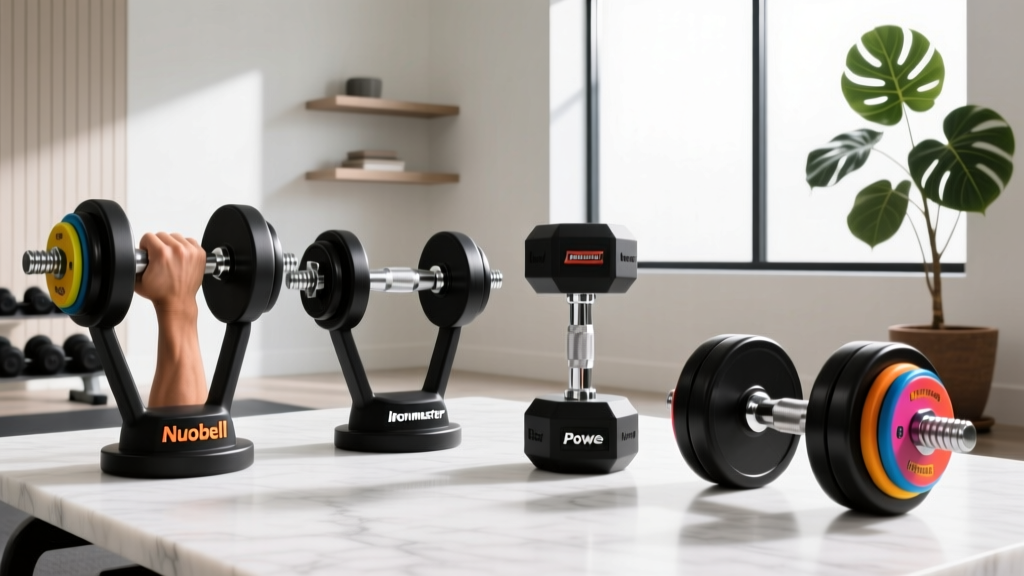
If you are using adjustable dumbbells like the PowerBlock Elite EXP or Nuobell 80, traditional tier racks may not fit their blocky geometry. In 2026, the best practice is to install wall-mounted, heavy-duty steel shelving (rated for 150 lbs per shelf) at 30-inch and 40-inch heights, allowing you to slide the adjustable dumbbells directly off the shelf into your working position.
Real-World Failure Modes & Edge Cases
Even with premium gear, specific environmental and mechanical edge cases can compromise your setup. As highlighted in long-term durability tests by Garage Gym Reviews, environmental factors play a massive role in equipment lifespan.
- Urethane Degradation: If your garage lacks climate control, UV exposure and temperature swings can cause cheaper urethane Olympic plates to become brittle and crack. Always store plates away from direct sunlight and apply a UV-protectant spray annually.
- Standard Bar Bend: Standard 1-inch bars typically max out at 350 lbs before experiencing permanent plastic deformation (bending). If your leg day exceeds this, you must upgrade to an Olympic setup.
- Sleeve Play and Clip Failure: When loading Olympic plates, always use calibrated steel collars or heavy-duty spring clips. Standard spring clips can slip off the 50mm sleeve during explosive movements like barbell rows, leading to catastrophic weight shifts.
Sample Hybrid Setup Flow
To test your newly installed storage and spatial flow, run this high-density hybrid session. This routine leverages the proximity of your Olympic rig and your dumbbell station.
The 45-Minute Spatial Flow Test:
1. Barbell Back Squats (Olympic Rig) - 4 x 6
Strip bar, rack plates on integrated pegs (15 seconds).
2. Dumbbell Romanian Deadlifts (Adjacent Mat Zone) - 3 x 10
Return DBs to tier rack (10 seconds).
3. Barbell Bench Press (Olympic Rig) - 4 x 8
Transition to floor.
4. Dumbbell Floor Press & Flye Superset (Mat Zone) - 3 x 12
By meticulously planning the installation of your plate storage and respecting the spatial requirements of both barbell and dumbbell modalities, you create a frictionless training environment. Whether you are loading up 45-pound Olympic bumpers or grabbing 50-pound hex dumbbells, a properly anchored and logically mapped gym ensures that your focus remains entirely on the lift, not the logistics.
More gear to consider
All reviews
Olympic vs Standard Plates for the Single Hand Dumbbell Row
Best Adjustable Dumbbells for the Narrow Dumbbell Press: 2026 Review
Loadable Barbell Dumbbell Handles: 2026 Budget Breakdown

Replacing Barbell Curls With Dumbbells: A Beginner's Step-by-Step Guide

Chasing the Mazoni Golden Dumbbell Tarkov? Buy Real Olympic Plates
