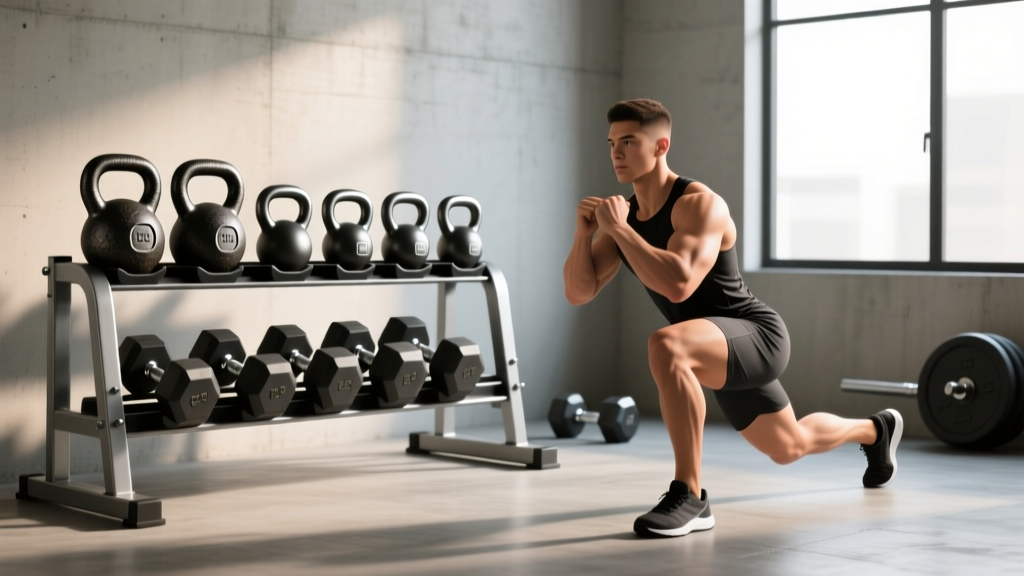
Olympic vs Standard Plates for Your Dumbbell Triceps Press
Discover how choosing between Olympic and standard weight plates impacts your grip, budget, and safety during the dumbbell triceps press.

The Home Gym Dilemma: Standard vs. Olympic Plates
Building a space-efficient home gym in 2026 almost always involves purchasing adjustable, plate-loaded dumbbells. They are cost-effective, versatile, and take up a fraction of the space of a full dumbbell rack. However, beginners quickly hit a crossroads: should you buy standard weight plates (with a 1-inch center hole) or Olympic weight plates (with a 2-inch center hole)?
While this choice might seem like a minor hardware detail, it drastically alters your biomechanics, safety, and progression—especially for isolation movements like the dumbbell triceps press (often referred to as the lying triceps extension or skull crusher). In this step-by-step guide, we will break down exactly how standard and Olympic plates affect your triceps training, your grip strength, and your wallet, helping you make the right purchase for your fitness journey.
Step 1: Decode the Hardware Specifications
Before analyzing the exercises, you must understand the physical differences between the two plate ecosystems. The center hole diameter of the plate dictates the thickness of the dumbbell handle you must use.
| Feature | Standard Plates (1-Inch) | Olympic Plates (2-Inch) |
|---|---|---|
| Center Hole Diameter | ~1 inch (25-28mm) | 2 inches (50mm) |
| Dumbbell Handle Thickness | 1.0 to 1.25 inches | 1.9 to 2.0 inches |
| Typical Handle Length | 14 inches (Spinlock) | 20+ inches (Loadable) |
| Max Weight per Dumbbell | ~45 lbs (limited by sleeve) | 120+ lbs (heavy duty) |
| Collar Mechanism | Threaded Spinlock Nut | Spring Clip / Bolt Clamp |
Step 2: Analyze Biomechanics for the Dumbbell Triceps Press
The dumbbell triceps press is a highly effective isolation exercise targeting the long, lateral, and medial heads of the triceps brachii. According to exercise anatomy databases like ExRx.net, the movement requires strict elbow stabilization and a neutral or slightly pronated grip while lowering the weights toward the forehead or ears.
Why Handle Thickness Matters
If you choose Olympic plates, you must use Olympic loadable dumbbell handles. These handles are nearly 2 inches thick. Gripping a 2-inch handle requires immense forearm and brachioradialis engagement. During a triceps press, your forearms will likely reach mechanical failure before your triceps do. You will find yourself dropping the weights because your grip gives out, completely ruining the triceps isolation.
Conversely, standard plates use 1-inch handles. This thinner profile allows you to wrap your fingers securely around the bar with minimal forearm fatigue. Your triceps will be the limiting factor, ensuring maximum hypertrophy and strength gains in the target muscle. For strict isolation work like the triceps press, standard 1-inch handles are biomechanically superior.
Step 3: The Hidden Safety Hazard (Collar Rotation)
When performing the dumbbell triceps press, the weight is suspended directly over your face and skull. Safety is non-negotiable. This is where the difference between standard spinlock collars and Olympic spring collars becomes a critical, often overlooked factor.
⚠️ Safety Warning: The Spinlock Unscrewing Effect
Standard dumbbell handles use threaded sleeves and screw-on spinlock nuts to secure the plates. During the eccentric (lowering) phase of the triceps press, the plates naturally rotate and spin against the collar due to wrist mechanics and gravity. Over a set of 10-12 reps, this friction can actually unscrew the spinlock nut. If the nut loosens, the plates can slide off the sleeve and fall directly onto your face.
Olympic loadable dumbbell handles feature smooth, non-threaded sleeves secured by heavy-duty spring clips or bolt-down clamps. These collars are immune to rotational unscrewing, making them vastly safer for overhead and over-the-face movements, despite the grip-thickness drawback.
Step 4: Evaluate 2026 Pricing and Material Options
Your budget will heavily influence your decision. Here is a realistic look at the cost of outfitting your home gym in 2026, based on current market rates from major fitness retailers.
- Standard Cast Iron Plates: The most budget-friendly option. Expect to pay between $1.50 and $2.00 per pound. A 100lb set of standard plates (e.g., CAP Barbell or Yes4All) will cost around $160. Pair this with a $25 pair of 14-inch spinlock handles, and you have a complete setup for under $200.
- Olympic Cast Iron Plates: Slightly more expensive due to the extra steel used for the 2-inch hub. Expect to pay $2.00 to $2.50 per pound.
- Olympic Urethane Plates: The premium choice for home gyms. Urethane is odorless, highly durable, and protects your floors. Brands like Rogue or Titan Fitness charge between $3.50 and $5.00 per pound for virgin urethane. A 100lb set can easily exceed $400.
Pro Tip: If you buy standard plates, opt for rubber-coated or neoprene-coated standard plates (approx. $2.20/lb) to reduce the loud clanking noise, which is especially jarring during quiet, focused isolation sets like the triceps press.
Step 5: Step-by-Step Execution and Loading Guide
Once you have selected your plate type, proper loading and execution are vital for joint health and muscle engagement. The National Strength and Conditioning Association (NSCA) emphasizes the importance of symmetrical loading and controlled tempos for single-joint exercises.
1. Symmetrical Loading
Always load your dumbbells symmetrically. If you are using standard 1-inch plates, place the heavier plates (e.g., 10 lbs) closest to the handle, followed by lighter plates (e.g., 5 lbs and 2.5 lbs). This keeps the center of gravity tight and prevents the dumbbell from feeling 'tippy' during the press.
2. Secure the Collars
If using standard spinlocks, tighten the nut as much as possible by hand, then use a rubber mallet to tap it tight if necessary. If using Olympic handles, ensure your spring collars are fully seated against the outermost plate.
3. The Setup
Lie flat on a bench. Kick the dumbbells up to your shoulders, then press them to the ceiling with a neutral grip (palms facing each other). This neutral grip is much friendlier on the wrists and elbows than a pronated (palms forward) grip.
4. The Eccentric Phase
Keep your upper arms completely vertical and locked in place. Hinge only at the elbows, lowering the dumbbells down toward the sides of your head. Stop when your forearms are slightly past parallel to the floor to maintain constant tension on the triceps.
5. The Concentric Press
Drive the weight back up by extending the elbows, squeezing the triceps hard at the top without locking out the elbow joint completely. This protects the joint capsule while maximizing muscle fiber recruitment.
Final Verdict: Which Should You Choose?
If your primary goal is bodybuilding, arm isolation, and budget-consciousness, standard 1-inch plates and handles are the clear winner for the dumbbell triceps press. The thinner handle ensures your triceps fail before your grip does, and the cost per pound is unbeatable for beginners.
However, if you are a strength athlete who plans to use your adjustable dumbbells for heavy floor presses, goblet squats, and farmers walks (where grip strength should be challenged), investing in Olympic plates and loadable handles is the more future-proof choice. Just be mindful of the grip thickness during your triceps isolation work, and perhaps keep a pair of lifting straps handy or switch to cable pushdowns for your triceps finishers.
More gear to consider
All reviews
Upper Body Dumbbell Workout Men: Hex vs Urethane Gym Layout Guide

Reverse Pec Deck with Dumbbells Setup & Adjustable Dumbbell Comparison

Best Dumbbell Racks to Organize Your Full Body Dumbbell Workout Plan
8 lbs Dumbbell Value: Rubber Hex vs Urethane Cost Breakdown

Dumbbell Rack Storage & Dumbbell Bench to Barbell Bench Conversion