EZ Bar vs Straight Bar: Space Layouts & Dumbbell Pullover Clearance
Compare EZ curl bar vs straight bar for home gym space optimization. Learn layout tips, rack clearances, and dumbbell pullover movement envelopes.

The Spatial Reality: Barbell Dimensions and Room Layout
When designing a compact home gym in 2026, the debate between an EZ curl bar and a standard straight barbell is rarely just about bicep activation or wrist ergonomics. For the space-conscious lifter, this choice fundamentally dictates your floor plan, rack placement, and storage footprint. While biomechanics matter, the physical envelope of your equipment determines whether your gym feels like a high-performance training facility or a cluttered garage.
A standard 7-foot Olympic straight bar measures exactly 86 inches in length, requiring substantial lateral wall clearance. In contrast, a typical Olympic EZ curl bar spans between 47 and 52 inches. This nearly 40-inch discrepancy changes everything about how you integrate your barbell into a power rack, how you store it post-workout, and how you navigate the surrounding 'swing zones' required for expansive movements.
💡 The 2026 Micro-Gym Rule of Thumb
Always measure your 'dead space'—the gaps between your rack uprights and the nearest wall. If you have less than 18 inches of lateral clearance on either side of your squat rack, loading and unloading a 7-foot straight bar becomes a frustrating puzzle, making the compact EZ curl bar a superior choice for high-frequency isolation work in tight layouts.
The Dumbbell Pullover Benchmark: Testing Your Clearance
Why use the dumbbell pullover as a spatial benchmark for barbell selection? The dumbbell pullover is one of the most spatially demanding exercises in a free-weight arsenal. Whether performed lying parallel on a flat bench or perpendicular across it, the arc of a heavy dumbbell demands significant longitudinal and vertical clearance.
Mapping the Movement Envelope
When executing a dumbbell pullover, the weight travels in an arc that extends roughly 36 to 42 inches behind the lifter's head. If your power rack is positioned flush against a wall, or if your barbell storage rack sits directly behind your bench, you will inevitably strike the dumbbell against your straight barbell or the wall during the eccentric phase of the pullover.
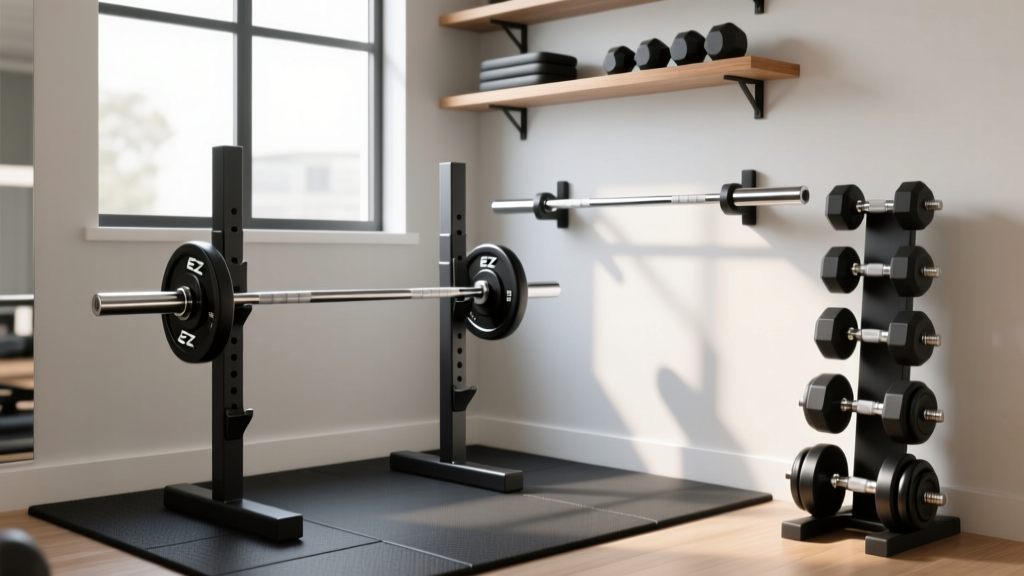
This is where the EZ curl bar vs straight bar comparison intersects with layout design. A straight bar stored on horizontal wall hooks protrudes significantly into the room's walkways and movement envelopes. An EZ curl bar, however, can be stored vertically on a wall-mounted sleeve or tucked tightly into a vertical rack attachment, preserving the crucial 36-inch longitudinal clearance required for an unobstructed dumbbell pullover.
Dimensional & Spatial Comparison Matrix
To optimize your layout, you must understand the exact spatial requirements of each bar type. The following matrix breaks down the physical footprint and necessary clearances based on current industry standards and Rogue Fitness barbell specifications.
| Equipment Type | Total Length | Min. Wall Clearance | Storage Footprint | Rack Integration |
|---|---|---|---|---|
| Standard Olympic Straight Bar | 86 inches | 18 - 24 inches | 7.2 sq ft (Horizontal) | Requires full J-cup width |
| Olympic EZ Curl Bar | 47 - 52 inches | 6 - 10 inches | 1.5 sq ft (Vertical) | Fits inside uprights |
| Super Curl Bar (Fat Grip) | 55 - 59 inches | 8 - 12 inches | 2.0 sq ft (Vertical) | Requires wide J-cups |
Rack Integration and the 'Swing Zone'
According to guidelines on exercise mechanics and facility design from the National Strength and Conditioning Association (NSCA), adequate spacing between equipment is critical for safety and performance. In a home gym, your 'swing zone'—the area where plates, bars, and dumbbells travel—must remain unobstructed.
The Straight Bar Dilemma in Compact Racks
If you are utilizing a compact fold-away rack or a shallow 24-inch deep squat stand, a 7-foot straight bar extends well beyond the uprights. When performing floor presses or rack pulls, the extended sleeves can interfere with adjacent walls or equipment. Furthermore, storing a straight bar horizontally on a rack-mounted holder eats up valuable interior rack space, limiting where you can position your bench for exercises like the dumbbell pullover.
The EZ Bar Advantage for Interior Layouts
An EZ curl bar can be rested entirely within the 49-inch interior width of a standard power rack. This means you can leave the bar on the J-cups, set up your flat bench directly in the center of the rack, and still have ample room behind the bench to execute a full-range dumbbell pullover without the dumbbell clipping the stored barbell. This spatial efficiency is a game-changer for garages under 200 square feet.
Storage Solutions: Vertical vs. Horizontal
How you store your bars when not in use dictates the flow of your gym. Here is a practical framework for optimizing your storage based on your chosen barbell:
- Vertical Wall Hangers (Best for EZ Bars): Mounting an EZ bar vertically on a wall hanger takes up less than 1 square foot of floor space. This keeps the bar completely out of the dumbbell pullover arc and preserves lateral walkways.
- Horizontal Gun Racks (Required for Straight Bars): Straight bars must be stored horizontally. To save space, mount gun racks on the exterior of your power rack uprights rather than the interior, ensuring the 86-inch length runs parallel to the wall rather than jutting out into the room.
- Under-Bench Storage: Many modern flat benches feature built-in horizontal holders. While great for straight bars, ensure the bench is pulled at least 40 inches away from the rear wall to accommodate the overhang, which directly impacts your pullover clearance.
Biomechanics Meets Spatial Constraints
While space optimization is the primary lens for this comparison, we cannot ignore the physiological reasons for owning both. The straight bar remains the undisputed king for heavy compound movements like deadlifts, bench presses, and squats. Its 51.5-inch shaft provides the necessary width for stable, heavy loading.
However, for isolation work, the angled grips of the EZ curl bar reduce valgus stress on the wrists and elbows. In a space-constrained gym where you might be forced to perform curls in a narrow corner or tight hallway, the 47-inch EZ bar allows you to train effectively without your plates scraping the drywall. According to the American Council on Exercise (ACE), adapting your equipment to fit your environment safely is paramount for long-term adherence and injury prevention.
Frequently Asked Questions (FAQ)
Can I do a dumbbell pullover inside a standard power rack?
Yes, but it requires precise bench placement. A standard power rack has an interior width of 49 inches. A standard 55-inch flat bench will overhang the uprights slightly. To perform a dumbbell pullover safely inside the rack, position the bench so your head is near the front uprights, allowing the dumbbell to travel backward into the open interior space of the rack, avoiding the rear crossmembers.
Is a 6-foot straight bar a good space-saving compromise?
A 6-foot bar (72 inches) saves 14 inches of lateral space compared to a 7-foot bar, making it excellent for narrow rooms. However, the sleeves are typically only 10 to 12 inches long, limiting you to 3-4 plates per side. It is a great compromise for general lifting, but it does not solve the storage footprint issue as elegantly as a vertically stored EZ curl bar.
How much weight does an EZ curl bar hold compared to a straight bar?
Most high-quality Olympic EZ curl bars (like those from Rogue or Titan Fitness) are rated for 300 to 500 lbs, which is more than sufficient for bicep curls, tricep extensions, and front squats. Standard straight bars are rated for 700 to 1,000+ lbs. For space optimization, the EZ bar's weight limit is rarely the bottleneck; its physical footprint is the deciding factor.
Final Verdict: Designing Your 2026 Layout
If your home gym exceeds 250 square feet with ample wall space, the straight bar is mandatory, and spatial constraints are minimal. However, if you are engineering a high-density micro-gym, the EZ curl bar offers undeniable spatial advantages. Its compact length allows for vertical storage, preserves the critical 36-inch movement envelope required for the dumbbell pullover, and integrates seamlessly inside standard power rack uprights without obstructing your workflow. By prioritizing the movement envelope over traditional storage methods, you can build a facility that feels expansive, regardless of the actual square footage.
More gear to consider
All reviews
Barbell Weight & Knurling Guide: Press vs Incline Bench Dumbbell Fly
Half Kneeling Dumbbell Press: Rubber Hex vs Urethane for Small Gyms

Chasing the Mazoni Golden Dumbbell Tarkov? Buy Real Olympic Plates
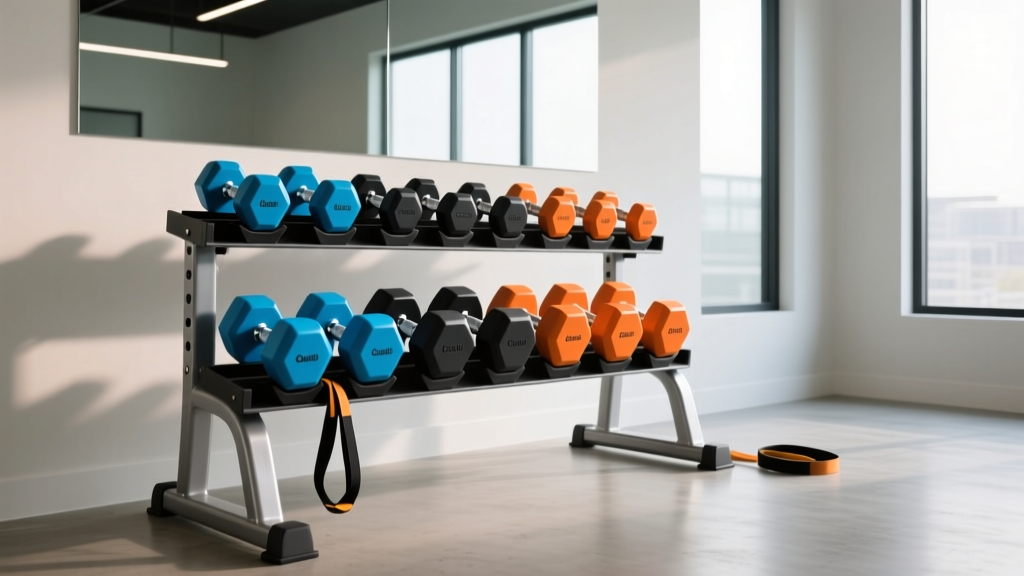
Optimizing Your Upper Chest Dumbbell Station: Storage & Layout

EZ Curl Bar vs Straight Bar: Space for an Abs Workout with Dumbbells